 English
 中文简体
 русский
 عربى


We are equipped with: A full range of welding machines Various riveting equipment Multiple assembly lines Complete testing equipment These assemblies are compatible with products from leading internat...
See Details
AT and AF in Circuit Breakers: Ampere Trip Setting vs Ampere Frame Explained
Content
A purchase order that reads "250AF frame, 160AT trip, 3-pole, with shunt trip release" is not a contradiction. It describes a breaker whose frame can carry 250 amps but whose trip unit opens the circuit above 160 amps. Suppliers who treat those two numbers as one rating quote the wrong product, and the error usually only shows up during panel commissioning.
The short answer: AF (ampere frame) is the maximum continuous current the breaker's frame, terminals and internal current path are built to carry, fixed at the factory. AT (ampere trip) is the current at which the trip unit is set to open, and on many molded case circuit breakers (MCCBs) it is adjustable inside that frame. AF is a physical ceiling; AT is an operating point inside it.
Everything that follows on an order form - lugs, contact assemblies, arc chutes, operating mechanisms and control accessories - hangs off that distinction. Get it right and the breaker, its accessories and its cable protection line up. Get it wrong and you pay for the rework.
What AF, the ampere frame, actually fixes
AF is a manufacturing characteristic, not a setting. You cannot dial it up on site, and you cannot buy a "160 A frame" and later turn it into a 250 A one.
Frame ratings are catalogued in standard steps. In North American practice, molded case breakers are commonly offered in 100, 125, 150, 225, 250, 400, 600, 800, 1200, 1600, 2000, 2500 and 3200 AF frames. IEC-oriented catalogs use a similar ladder, typically 125, 250, 400, 630, 800, 1250 and 1600 A frames. Component suppliers follow the same ladder, because the parts they make have to match it.
What the frame physically determines:
- Terminal and lug capacity, and the busbar interface the breaker bolts onto.
- The cross-section of the current path - moving contacts, stationary contacts, contact fingers and plug-in contacts.
- Arc chute volume and the number of splitter plates, which drive interrupting performance.
- Mechanism energy and, on larger frames, the closing electromagnet.
- The mounting interface for accessories: auxiliary contacts, alarm contacts, shunt trips, undervoltage releases, motor operators, plug-in and withdrawable bases.
That is why a 630AF breaker is not simply a scaled-up 250AF unit. Its contacts, its arc chute and its accessory geometry are different parts.
Illustrative example: the frame rating sets the ceiling (light bar) while the trip setting decides where the breaker actually opens (dark bar).
Internal conductive assemblies are built to the frame, not to the trip setting. A moving contact assembly family such as KYM125-250-400-630-800 covers one range of molded case frames, while frame-class parts for 1600 A to 4000 A breakers use a completely different geometry. Quoting by AT alone is how wrong contact sets get shipped.
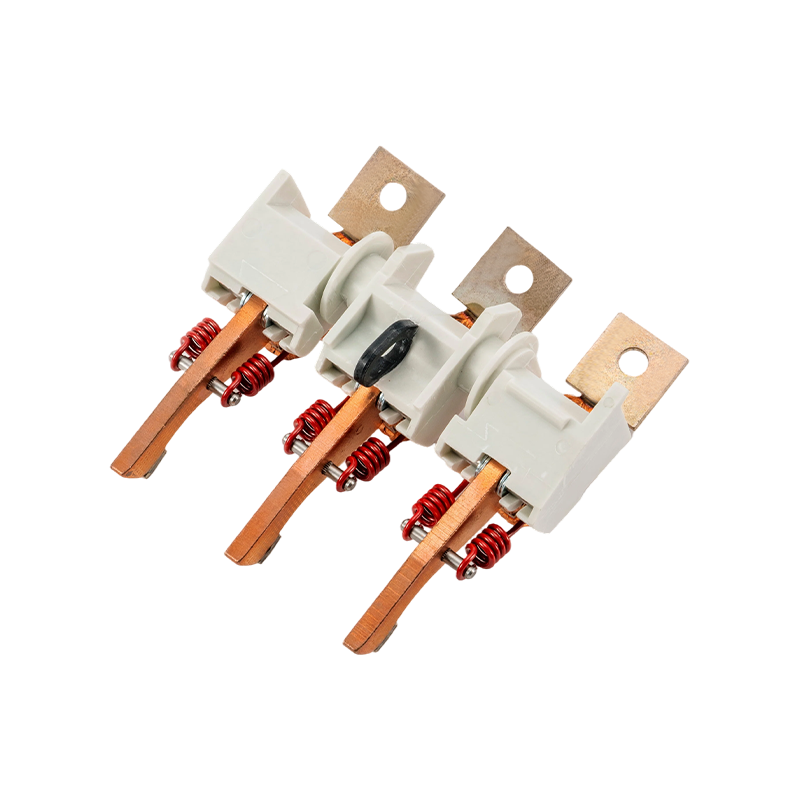 KYM-125/250/400/630/800 Molded Case Moving Contact AssemblyKYM-125/250/400/630/800 Molded Case Moving Contact AssemblyView Product →
What AT, the ampere trip, controls
AT is the rating at which the breaker is designed to open. On a thermal-magnetic MCCB, the thermal element (a bimetal) defines the continuous rating, backed by a fixed magnetic element for short-circuit currents. On an electronic trip unit, AT becomes a set of settable parameters: long-time pickup (often written as Ir), short-time pickup and delay, and instantaneous pickup.
Two rules follow directly from the hardware:
- AT can never exceed AF. A 250AF frame physically cannot be fitted with a 320 A trip unit.
- AT is usually well below AF, and that gap is deliberate.
Standardizing on one frame with several trip ratings lets a panel builder carry a single frame, one set of lugs and one accessory kit across a row of outgoing feeders; only the trip unit changes. For manufacturers, that means one tooling set covering 100 A through 250 A devices. For distributors, it means fewer spare parts on the shelf, because a frame family covers many circuit ratings.
The 80% continuous-load rule in NEC 210.20(A) and 215.3 derates every trip setting: a 1600AT breaker should not carry more than about 1280 A continuously.
Continuous loads add a second constraint that has nothing to do with the frame. A 160 AT breaker should not carry more than roughly 128 A continuously, even if the frame underneath it could physically handle far more current.
AF versus AT at a glance
| Point of comparison | AF (ampere frame) | AT (ampere trip) |
|---|---|---|
| What it describes | Maximum continuous current the frame and current path can carry | Current at which the trip unit opens the circuit |
| Fixed or adjustable | Fixed by the manufacturer | Fixed on thermal-magnetic units; adjustable on electronic trip units |
| Where it appears | Frame size, for example the 250AF frame family | Trip rating on the nameplate, for example 160AT |
| Relationship between the two | Always the ceiling value | Always equal to or lower than AF |
| What it drives in a bill of materials | Contacts, arc chute, terminals and lugs, accessory kit, plug-in base | Cable protection, trip unit type and setting, coordination with upstream devices |
Where AF matters more than AT: accessories and internal assemblies
If you are buying anything other than the trip unit, the frame is the number that matters. Auxiliary contacts, alarm contacts, combined auxiliary-alarm contacts, shunt trips, undervoltage releases, motor operators, plug-in devices and withdrawable devices all attach to the frame's moulding, mechanism or terminal area.
A practical consequence: a 250AF breaker ordered with a 160 AT trip and the same frame ordered with a 250 AT trip accept the same shunt trip, the same auxiliary contact block and the same plug-in base. Catalog tables list these parts by frame and current range - one auxiliary contact series typically spans a family of frames, for example 100 A through 800 A - not by trip setting.
The same logic applies inside the breaker. Moving and stationary contact assemblies, arc chute assemblies and insulated base frames are dimensioned for the frame current, because they must carry the full frame rating and interrupt the associated fault current.
Exploded view: the modules around the current path follow the frame size, while only the trip unit changes with the AT rating.
If the accessory map is unfamiliar, an overview of what actually goes into an MCCB, from contacts to release units, is a useful starting point: what are MCCB accessories.
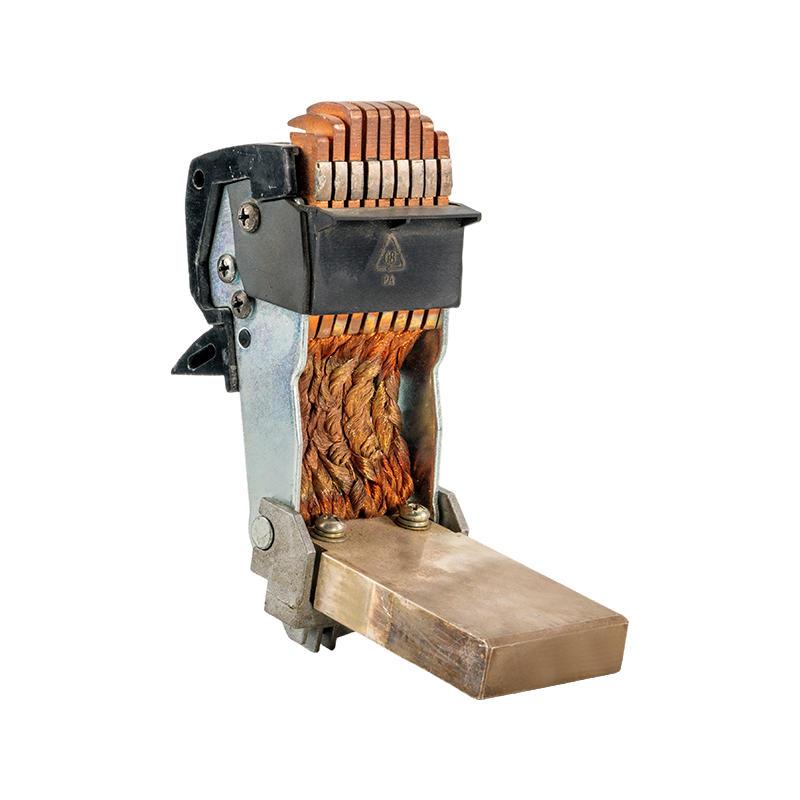
 FC38-63/100/250/400/630/800 MCCB Auxiliary ContactsFC34-63/100/250/400/630/800 MCCB Auxiliary ContactsView Product →
How to specify AF and AT without a rework
Both numbers belong on the order, written separately, with the frame first. A specification that says only "160 A breaker" tells a supplier nothing about which frame, which lug or which accessory kit to supply.
- Write the frame and trip ratings separately: 250AF / 160AT, three-pole. Add the frame's interrupting rating, for example 36 kA at 415 V, because that also belongs to the frame.
- List frame-dependent hardware explicitly: terminals and lugs, plug-in or withdrawable base, operating mechanism, auxiliary and alarm contacts, shunt trip or undervoltage release.
- State the trip unit type: thermal-magnetic with a fixed rating, or electronic with an adjustable setting range, and whether the setting must be field-adjustable.
- Check derating before fixing AT. Ambient temperature inside the enclosure and the 80% continuous-load rule both reduce the usable current.
- Confirm accessory compatibility against the frame's catalog table rather than the trip rating, especially when mixing frames from different product families.
Common mistakes
- Assuming a larger AT is always safer. An oversized trip setting on a small feeder may no longer protect the cable at its ampacity.
- Assuming accessories follow the trip rating. They follow the frame.
- Assuming the frame's instantaneous magnetic element is adjustable. On thermal-magnetic devices it usually is not.
- Mixing IEC and NEMA frame designations in one bill of materials without converting the current levels.
Control accessories follow the same rule. A remote-tripping device such as the FT-S-1600-6300 shunt trip unit is catalogued against a family of large frames and mounts the same way whether the breaker is set at 1250 AT or 1600 AT.
 FT(S)-1600~6300 Shunt Trip UnitFT(S)-630 Shunt ReleaseView Product →
FAQ: AF and AT in circuit breakers
Q1: What does AF mean on a circuit breaker?
AF stands for ampere frame. It is the maximum continuous current the frame, terminals and internal current path are rated to carry. It is fixed at the factory and cannot be adjusted on site.
Q2: What does AT mean on a circuit breaker?
AT means ampere trip: the current at which the trip unit opens the circuit. On thermal-magnetic MCCBs it is fixed by the thermal element; on electronic trip units it is an adjustable setting.
Q3: Can AT be higher than AF?
No. The frame sets the ceiling, so the trip setting must always be equal to or lower than the frame rating. A 250AF frame takes a 250AT trip unit at most.
Q4: Does a 250AF breaker always trip at 250 amps?
No. A 250AF frame often ships with a 160AT or 200AT trip unit, so it opens at that lower setting. The frame rating tells you the ceiling, not the trip point.
Q5: Are MCCB accessories selected by AF or by AT?
By AF. Auxiliary contacts, alarm contacts, shunt trips, undervoltage releases, motor operators and plug-in or withdrawable bases mount to the frame, so compatibility follows frame size and product family.
Q6: How do I choose the right AT for a continuous load?
Size the trip rating so the continuous load stays below 80% of it (NEC 210.20(A)), then check the breaker's derating data for the ambient temperature inside the enclosure before confirming the setting.
Previous Post
What Type of Circuit Breaker Do I Need? How to Match Rating and Trip Unit
Next Post
What Is Interrupting Rating of Circuit Breakers? Definition, Standards & Selection Guide
Related products
-
-
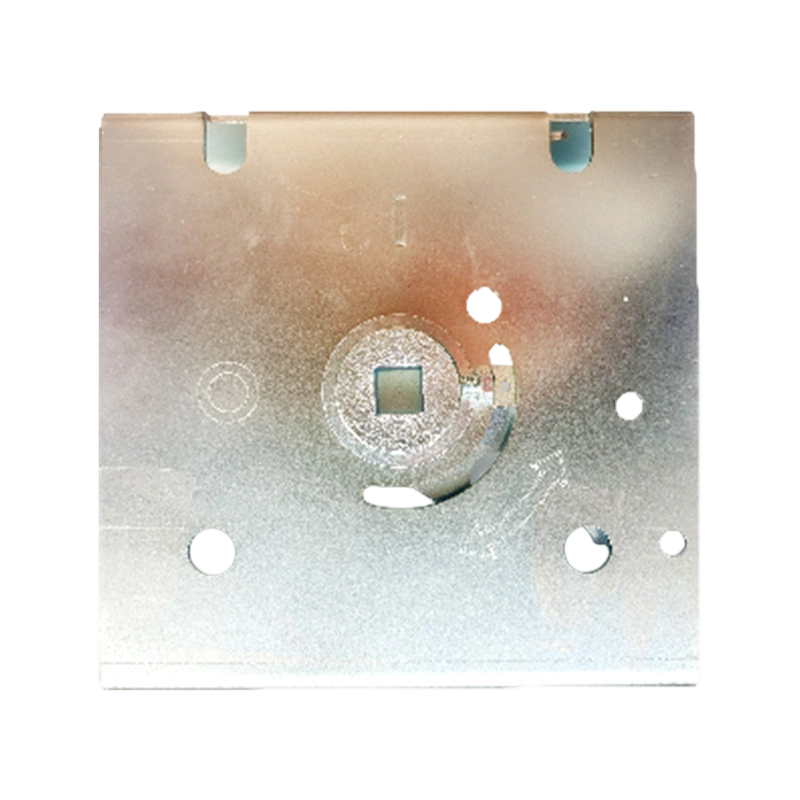
Featuring a simple structure with central operation and linkage-type transmission, this mechanism is compatible with three handle styles. It works with 63/100/250/400/630 frame molded case circuit bre...
See Details -

Featuring a simple structure, this mechanism is driven by an electric motor with a gear reducer, delivering high torque, fast switching, and reliable operation. It supports both AC and DC power, with ...
See Details -
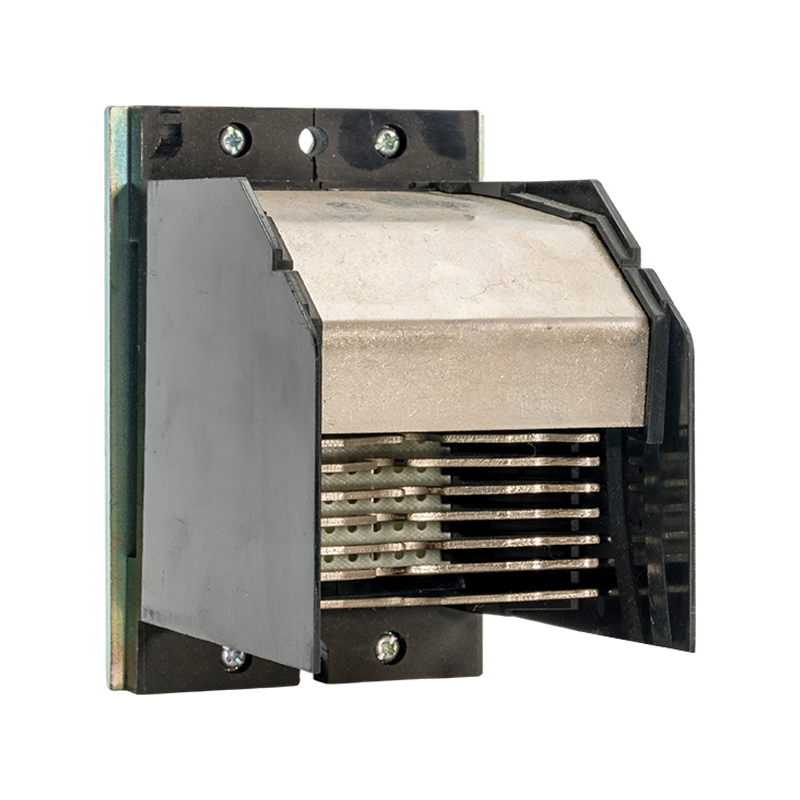
We are equipped with: A full range of welding machines Various riveting equipment Multiple assembly lines Complete testing equipment These assemblies are compatible with products from leading internat...
See Details -
We are equipped with: A full range of welding machines Various riveting equipment Multiple assembly lines Complete testing equipment These assemblies are compatible with products from leading internat...
See Details -
We are equipped with: A full range of welding machines Various riveting equipment Multiple assembly lines Complete testing equipment These assemblies are compatible with products from leading internat...
See Details

Copyright @ Kaiyuanfeng Electrical Machinery Manufacturing Co.,Ltd All Rights Reserved.
OEM MCCB Accessories Manufacturer
ISO Certified Circuit Breaker Factory
