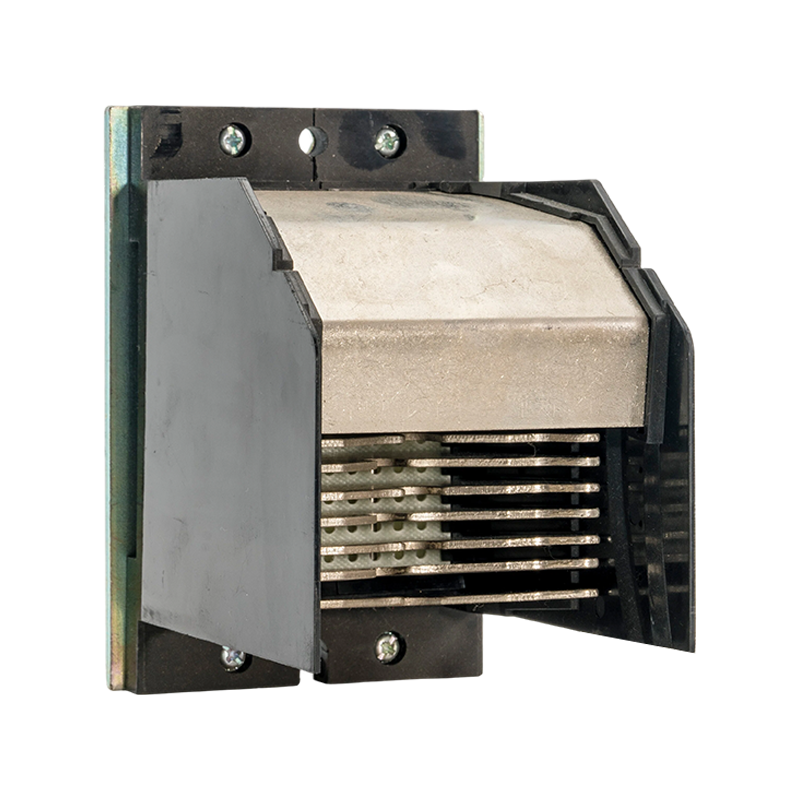
An MCCB Frame Arc Chute Assembly is a critical arc-extinguishing component installed around the contact system of a molded case circuit breaker. Its primary function is to control, split, cool, and extinguish the electrical arc generated when the MCCB contacts separate under load or fault conditions. A well-designed arc chute assembly helps move the arc away from the contact area and dissipate its energy before the circuit interruption process is completed.
For MCCB manufacturers, OEMs, switchgear producers, and electrical component distributors, the arc chute is not simply an insulating enclosure. Its internal geometry, plate arrangement, material characteristics, spacing, and installation accuracy can directly influence arc-extinguishing performance, interrupting capability, contact erosion, temperature behavior, and breaker service life.
As of 2026, the latest international standard is IEC 60947-2:2024, the sixth edition of the Low-voltage switchgear and controlgear – Part 2: Circuit-breakers. It applies within its scope to circuit breakers with rated voltages up to 1,000 V AC or 1,500 V DC and replaced the previous 2016 edition with Amendment 1:2019. The 2024 revision includes technical changes involving areas such as isolation suitability, dielectric testing, EMC, individual-pole breaking-capacity testing, and power-loss measurement. :contentReference[oaicite:0]{index=0}
2. How Does an MCCB Frame Arc Chute Assembly Work?
(1) Arc Generation During Contact Separation
When MCCB contacts separate while current is flowing, the electrical circuit does not immediately become an ideal open circuit. An arc can form between the separating contacts. During a short-circuit interruption, the electrical and thermal stress can be substantially greater than during normal switching. The arc chute therefore needs to cooperate with the contact system and operating mechanism to manage the arc effectively.
(2) Arc Movement and Splitting
The magnetic field generated by fault current and the geometry of the contact and arc chute system can drive the arc into the chute. Internal metal plates or other arc-control structures divide the arc into multiple smaller arc sections. Increasing the effective number of arc segments can help raise the total arc voltage and assist interruption, subject to the complete breaker design.
(3) Arc Cooling and Extinction
Once the arc enters the chute, heat is transferred into the surrounding structure while the arc is elongated and divided. The arc chute is designed to reduce the arc energy and support rapid deionization. The exact performance depends on the complete contact system, arc runner design, plate configuration, insulating structure, current level, voltage, and interruption characteristics.
3. Why Is the MCCB Frame Arc Chute Important for Circuit Breaker Performance?
An MCCB's interrupting performance depends on the coordinated operation of its trip mechanism, contacts, arc runners, arc chute, insulation system, and enclosure. The arc chute plays a particularly important role because it manages the high-energy arc created during contact separation.
- Arc control: Guides and divides the arc into controlled paths.
- Arc cooling: Transfers thermal energy away from the arc.
- Contact protection: Helps reduce excessive arc exposure and contact erosion.
- Insulation coordination: Helps control the arc and maintain appropriate internal clearances.
- Repeatable interruption: Supports consistent performance across qualified operating and fault conditions.
For example, if a breaker is designed for a 25 kA short-circuit interruption rating, its arc-control system must be engineered and validated for the corresponding electrical stress. It would be incorrect to assume that an arc chute designed for a lower-rated breaker can automatically provide the same interruption performance simply because its external dimensions appear similar.
4. Key Construction Features of an MCCB Frame Arc Chute
Important construction factors for specifying an MCCB frame arc chute assembly.
| Feature |
Typical Requirement |
Performance Impact |
| Arc plates |
Accurate spacing and stable positioning |
Arc splitting and energy management |
| Insulating frame |
Heat and electrical resistance |
Internal insulation and structural stability |
| Arc entry geometry |
Correct relationship with contacts and runners |
Arc transfer and interruption behavior |
| Mounting structure |
Consistent dimensional accuracy |
Assembly alignment and repeatability |
The specific number, thickness, spacing, and shape of arc plates must be determined through the breaker manufacturer's engineering design and validation. There is no universal arc chute geometry suitable for every MCCB frame or interrupting rating.
5. Materials Used in MCCB Frame Arc Chute Assemblies
(1) Arc-Splitting Plates
Arc plates are commonly manufactured from suitable ferromagnetic or other engineered metallic materials selected according to the arc-control design. Their magnetic and thermal characteristics influence how the arc is attracted, divided, cooled, and de-energized.
(2) Insulating Housing Materials
The supporting structure may use heat-resistant and electrically insulating engineering materials. Important properties can include dielectric strength, thermal stability, mechanical rigidity, flame performance, dimensional stability, and resistance to arc-related thermal stress.
(3) Material Compatibility
Material selection should not be considered independently from the breaker design. The arc chute, contacts, arc runners, terminal system, insulation barriers, and molded enclosure must work together. A material with good thermal resistance may still be unsuitable if its mechanical properties, dielectric performance, or manufacturing tolerances do not meet the application requirements.
For B2B buyers, consistent production quality is essential because an arc chute assembly is a safety-critical part of a complete MCCB. Manufacturing should begin with controlled drawings and approved materials, followed by precise forming, assembly, inspection, and validation.
- Confirm the MCCB frame size, pole configuration, voltage, current, and interruption requirements.
- Define arc chute geometry, plate specifications, insulation materials, and mounting dimensions.
- Control raw-material specifications and incoming inspection.
- Manufacture plates and insulating structures according to approved drawings and process parameters.
- Inspect plate spacing, dimensions, assembly alignment, surface condition, and mounting features.
- Conduct complete breaker validation under applicable electrical and mechanical test requirements.
For customized OEM production, sample approval is particularly important. A dimensional inspection can confirm whether the arc chute fits the frame, but only complete breaker testing can establish whether the final assembly meets its intended interruption and safety performance.
7. Jiangsu Kaiyuanfeng Electrical Machinery Manufacturing Co., Ltd. – MCCB Frame Arc Chute Assembly Manufacturer
Jiangsu Kaiyuanfeng Electrical Machinery Manufacturing Co., Ltd. is a MCCB Frame Arc Chute Assembly Manufacturer and wholesale supplier, established in Taizhou in August 2013 with an initial registered capital of 5 million yuan. The company is a manufacturer of key circuit breaker components integrating R&D, design, production, sales, and service.
Its arc chute assemblies are developed with attention to arc chute shape and arc-extinguishing performance, helping manufacturers integrate suitable arc-control structures into frame circuit breakers. Product development can be aligned with customer drawings, samples, specifications, and application requirements.
Jiangsu Kaiyuanfeng adheres to the core values of building a solid foundation through steadiness, expanding horizons through perseverance, and forging integrity with responsibility. The company follows the principles of integrity, win-win collaboration, and pioneering the future, while incorporating customer requirements into processes from R&D through manufacturing.
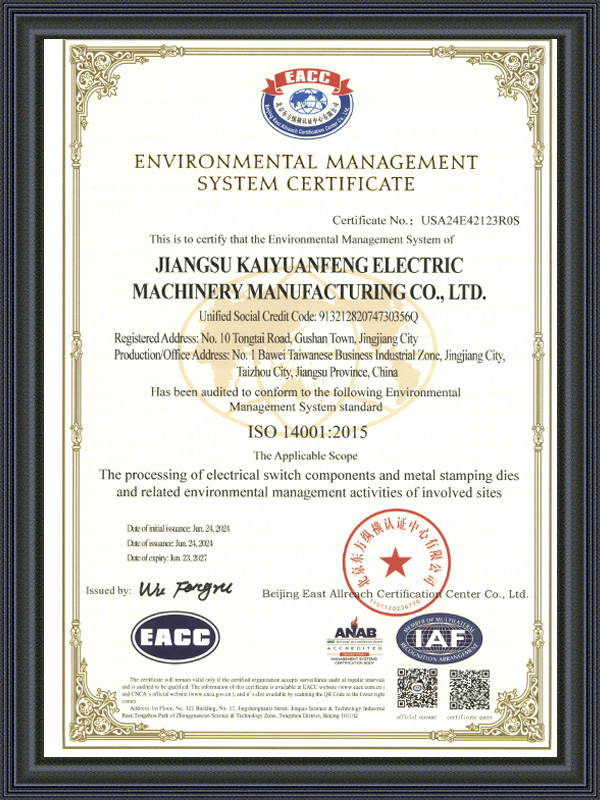
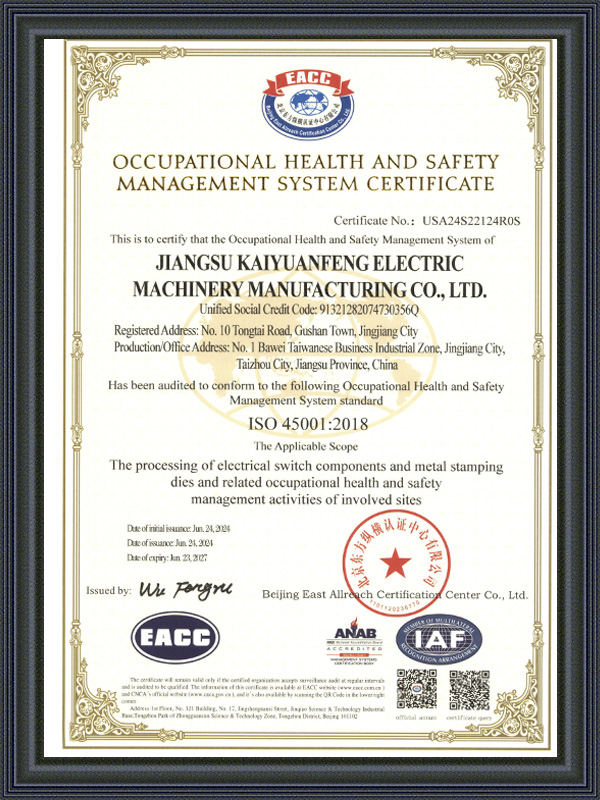
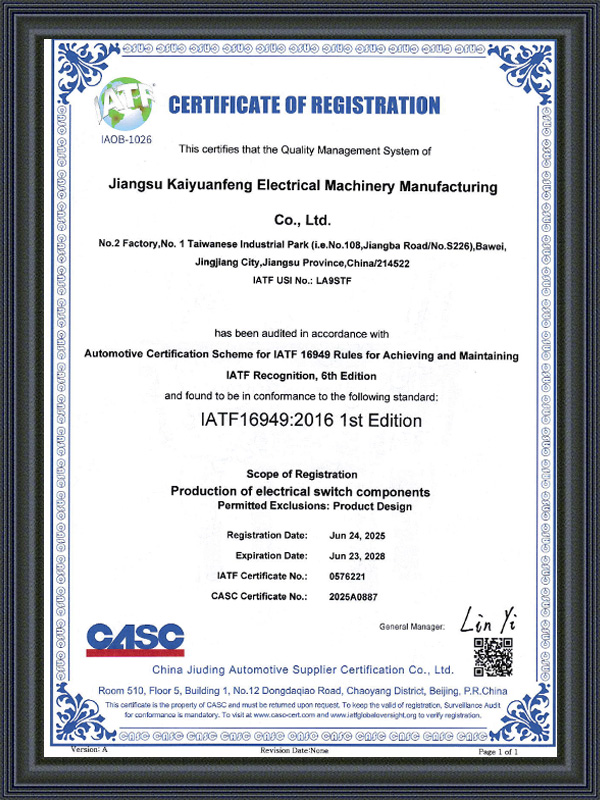
Its innovation is supported by 28 related patents addressing key industry challenges. The company has obtained ISO certification and implements a management system aligned with international standards to support operational efficiency and quality assurance.
With more than a decade of industry experience, Jiangsu Kaiyuanfeng focuses on reliable circuit breaker components and long-term B2B cooperation. OEM customers can provide drawings or samples for evaluation, while wholesale customers can discuss product specifications, quantities, packaging, and supply requirements. The company's long-term objective is to become a core supplier of key circuit breaker components and contribute to electrical system safety.
8. B2B Applications and Procurement of MCCB Frame Arc Chute Assemblies
MCCB frame arc chute assemblies are relevant to manufacturers of low-voltage circuit breakers, switchgear, distribution boards, industrial control equipment, electrical panels, machinery, power distribution systems, and related electrical products. For B2B procurement, the buyer should match the arc chute to the exact breaker frame and interruption requirements.
Typical B2B customer requirements for MCCB frame arc chute assemblies.
| Buyer Type |
Typical Requirement |
Supplier Capability |
| MCCB Manufacturer |
Stable arc-control performance |
OEM manufacturing and engineering support |
| Switchgear Factory |
Compatible breaker-frame components |
Drawing and sample-based production |
| Electrical Distributor |
Consistent wholesale supply |
Batch production and quality control |
| OEM/ODM Buyer |
Customized arc chute design |
Product development and mass production |
9. Frequently Asked Questions About MCCB Frame Arc Chute Assembly
Q1. What is an MCCB frame arc chute assembly used for?
An MCCB frame arc chute assembly is used to control and extinguish the electrical arc generated when circuit breaker contacts separate. It guides the arc into a controlled area, divides it through internal structures, transfers heat away from the arc, and supports rapid interruption. Its geometry must be matched to the complete breaker design, including contact system, arc runners, voltage, current, and required interruption performance.
Q2. How does an arc chute extinguish an MCCB arc?
An arc chute generally works by attracting the arc into the chute, elongating and dividing it with internal plates, and transferring heat away from the arc. The resulting increase in arc voltage and reduction in available arc energy can help the circuit current fall to zero and prevent the arc from re-establishing. Actual arc-extinguishing behavior depends on the complete MCCB design and must be confirmed through appropriate testing.
Q3. What materials are used to manufacture MCCB arc chute assemblies?
An MCCB arc chute can contain metallic arc-splitting plates and electrically insulating structural materials. The specific materials are selected according to arc energy, voltage, current, thermal stress, dielectric requirements, mechanical strength, and the manufacturing design. Buyers should request the supplier's approved material specification instead of choosing materials only according to general conductivity or temperature ratings.
Q4. Can an MCCB frame arc chute assembly be customized?
Yes. Customized arc chute assemblies can be developed for different MCCB frame sizes, contact arrangements, voltage ratings, current ratings, pole configurations, and interruption requirements. Customization may include overall dimensions, plate shape, plate quantity, plate spacing, insulating housing geometry, mounting structure, and arc-entry configuration. For OEM projects, providing a drawing, sample, or complete breaker specification is recommended.
Q5. How do I choose the right MCCB arc chute for a circuit breaker?
Start with the exact MCCB frame size, number of poles, rated operational voltage, rated current, short-circuit or interrupting rating, contact structure, and target market. Then verify the arc chute's physical dimensions, mounting points, arc-entry position, insulating structure, and material specifications. Most importantly, the arc chute must be validated as part of the complete circuit breaker. A component that physically fits a frame is not necessarily electrically suitable for its interruption rating.
Q6. What standards apply to MCCB arc chute assemblies?
For international low-voltage circuit breakers, IEC 60947-2:2024 is the current IEC standard within its defined scope, covering circuit breakers up to 1,000 V AC or 1,500 V DC. In the United States, UL Solutions identifies UL 489 for molded-case circuit breakers, molded-case switches, and circuit-breaker enclosures. The arc chute itself should be considered as part of the complete MCCB's design and certification rather than assuming that an isolated component has the same certification status as the finished breaker. :contentReference[oaicite:1]{index=1}
Q7. Why is arc chute shape important for MCCB interruption performance?
Arc chute shape determines how the arc enters, moves through, and interacts with the internal arc-splitting structure. Incorrect geometry can affect arc transfer, plate engagement, thermal dissipation, and insulation distances. For this reason, an arc chute should be designed together with the contacts and arc runners rather than treated as an independent replacement component.
Q8. What should I provide when requesting a quotation for an MCCB frame arc chute assembly?
For an accurate B2B quotation, provide the MCCB frame model, rated current, rated voltage, pole number, interrupting rating, drawing or sample, arc chute dimensions, plate specifications, material requirements, annual quantity, packaging requirements, and target delivery schedule. If the arc chute is part of a new breaker design, additional information about contact geometry and arc-control requirements can help the supplier evaluate manufacturability and engineering compatibility.
Q9. Why should MCCB manufacturers purchase arc chute assemblies directly from a factory?
Direct factory sourcing can improve communication between the buyer's engineering team and the manufacturing team, especially for customized arc chute geometry. It can also simplify sample approval, process adjustments, quality feedback, production scheduling, and long-term supply management. For OEM customers, direct communication is particularly valuable when the arc chute needs to be optimized together with the breaker contact system.
Q10. Can Jiangsu Kaiyuanfeng supply wholesale MCCB frame arc chute assemblies?
Yes. Jiangsu Kaiyuanfeng Electrical Machinery Manufacturing Co., Ltd. provides MCCB frame arc chute assemblies for OEM, ODM, wholesale, and circuit breaker component applications. Customers can provide drawings, samples, specifications, or application requirements for evaluation. With more than a decade of industry experience, 28 related patents, and an ISO-certified management system, the company focuses on engineering support, manufacturing consistency, and long-term B2B cooperation.

 English
  中文简体
中文简体  русский
  عربى
عربى