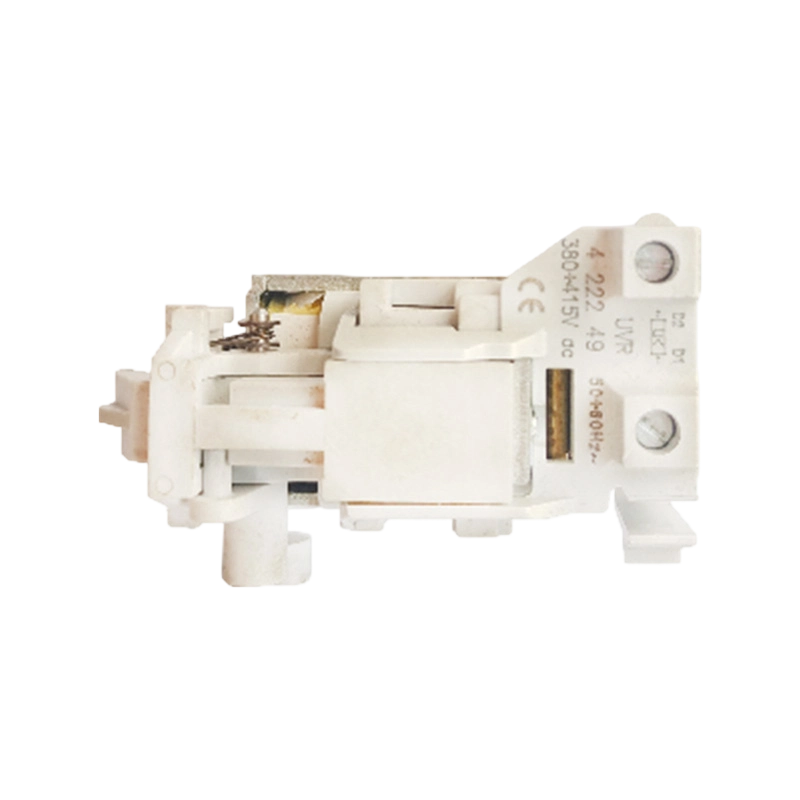
An Undervoltage Release for MCCB is an electrical accessory designed to monitor the control voltage of a molded case circuit breaker and automatically trip the breaker when the voltage falls below a defined level. Unlike a shunt trip release, which normally trips when an external voltage is applied, an undervoltage release operates when its control voltage decreases below the specified operating threshold.
The customizable undervoltage release monitors the voltage at the circuit breaker’s incoming terminals. When the operating voltage in the protected circuit drops to 35%–70% of the rated supply voltage, it can automatically trip the breaker, disconnecting power to the load and helping protect connected equipment from abnormal low-voltage conditions. The exact trip threshold depends on the specific MCCB and undervoltage release design.
The current IEC 60947-2:2024 standard covers low-voltage circuit breakers with rated voltages up to 1,000 V AC or 1,500 V DC within its scope. Published on September 18, 2024, the sixth edition replaced IEC 60947-2:2016 and its 2019 amendment. B2B buyers should therefore confirm the latest applicable standards and manufacturer specifications when sourcing MCCB accessories.
(1) Continuous Voltage Monitoring
An undervoltage release is normally connected to a dedicated control-voltage circuit. The release continuously monitors whether the supplied voltage remains within its operating range. This makes it suitable for systems where the loss or significant reduction of control voltage must automatically initiate circuit interruption.
(2) Automatic Tripping During Undervoltage
When the control voltage falls below the specified release threshold, the undervoltage mechanism operates the MCCB trip mechanism. For example, Schneider Electric states for certain MCCB undervoltage releases that tripping is guaranteed below 35% of rated voltage, while operation is not guaranteed between 35% and 70% and opening does not occur above 70% of rated voltage. :contentReference[oaicite:0]{index=0}
(3) Controlled Reclosing
An important characteristic of an undervoltage release is that the MCCB may not be allowed to close while the release remains insufficiently energized. For example, some Schneider Electric MCCB configurations allow closing only after the undervoltage release supply reaches approximately 85% of rated voltage. This prevents the main contacts from closing during an unresolved undervoltage condition. :contentReference[oaicite:1]{index=1}
3. Why Use an Undervoltage Release for MCCB?
(1) Protection Against Abnormal Low Voltage
Some electrical equipment can operate incorrectly or become unstable when supplied with insufficient voltage. Motors, contactors, control systems, and sensitive industrial equipment may be affected by abnormal voltage conditions. An undervoltage release can disconnect the affected circuit when the control voltage falls below the specified threshold.
(2) Fail-Safe Emergency Shutdown
An undervoltage release can provide fail-safe tripping because loss of its control supply can cause the MCCB to open. Schneider Electric specifically describes undervoltage release operation combined with an emergency-off button as a fail-safe tripping arrangement. :contentReference[oaicite:2]{index=2}
(3) Prevention of Uncontrolled Restart
In many configurations, the MCCB cannot be closed while the undervoltage release is not adequately energized. This feature can help prevent equipment from restarting unexpectedly after a power interruption or control-voltage failure. The exact behavior must be verified for the selected MCCB family. :contentReference[oaicite:3]{index=3}
4. Key Specifications of an MCCB Undervoltage Release
For electrical equipment manufacturers, panel builders, distributors, and system integrators, choosing the correct undervoltage release requires more than matching the MCCB current rating. The accessory must match the breaker series, mounting interface, control voltage, operating threshold, and control system.
Key technical parameters B2B buyers should verify when sourcing an undervoltage release for MCCB applications.
| Parameter |
What to Confirm |
B2B Importance |
| MCCB Compatibility |
Series, frame size, model, mounting position |
Ensures correct mechanical installation |
| Control Voltage |
AC/DC type, rated voltage and frequency |
Prevents control-circuit mismatch |
| Trip Threshold |
Specified operating range |
Determines when the MCCB opens |
| Closing Threshold |
Minimum voltage required for closing |
Helps prevent undervoltage restart |
| Installation |
Factory or field installation |
Affects OEM production and maintenance |
Available control voltages vary significantly by MCCB family. For example, Schneider Electric documentation for one PowerPact B-frame accessory family lists options including 24 V AC/DC, 48 V AC/DC, 110–130 V AC, 208–240 V AC, 380–415 V AC, 440–480 V AC, 125 V DC, and 250 V DC. These values are product-specific examples and should not be treated as universal industry ratings. :contentReference[oaicite:4]{index=4}
5. Undervoltage Release vs. Shunt Trip Release for MCCB
Although both accessories can cause an MCCB to open, they operate in fundamentally different ways. A shunt trip release generally trips when an external control voltage is deliberately applied to its coil. An undervoltage release, by contrast, continuously depends on its control voltage and trips when that voltage falls below its specified operating level.
Functional comparison of two common MCCB voltage-release accessories.
| Feature |
Undervoltage Release |
Shunt Trip Release |
| Operating Principle |
Trips when control voltage falls |
Trips when control voltage is applied |
| Typical Purpose |
Fail-safe undervoltage protection |
Remote or emergency tripping |
| Control Supply |
Normally continuously energized |
Normally energized only for trip command |
| Typical Application |
Power-loss and emergency shutdown |
Emergency stop and remote opening |
6. How to Select the Right Undervoltage Release for MCCB?
B2B purchasers should select the undervoltage release according to the complete MCCB and control-system specification. The following checklist can help reduce compatibility issues during OEM development and bulk procurement:
- Confirm the MCCB manufacturer, series, frame size, pole configuration, and exact model.
- Confirm the undervoltage release's AC or DC control voltage and frequency where applicable.
- Check the guaranteed trip range and minimum voltage required for breaker closing.
- Verify the mechanical mounting position, terminals, dimensions, and wiring arrangement.
- Determine whether instantaneous or time-delayed undervoltage operation is required.
- Request technical drawings, samples, inspection standards, and test documentation before mass production.
- Evaluate MOQ, lead time, production capacity, OEM customization, packaging, and after-sales support.
For example, if a release has a rated control voltage of 220 V and a guaranteed trip threshold below 35% Un, the 35% point is approximately 77 V. However, the actual operating behavior between 35% and 70% must be taken from the manufacturer's technical specification rather than calculated as a universal trip point. :contentReference[oaicite:5]{index=5}
7. Undervoltage Release for MCCB Manufacturer and Wholesale Supplier
Jiangsu Kaiyuanfeng Electrical Machinery Manufacturing Co., Ltd. is a Undervoltage Release for MCCB Manufacturer and Wholesale Undervoltage Release for MCCB supplier, established in Taizhou in August 2013 with an initial registered capital of 5 million yuan. The company is a manufacturer of key circuit breaker components, integrating R&D, design, production, sales, and service.
The company adheres to the core values of "building a solid foundation through steadiness, expanding horizons via perseverance, and forging integrity with responsibility" and follows the founding principle of integrity, win-win collaboration, and pioneering the future. Customer requirements are incorporated into processes from R&D to manufacturing to develop practical circuit breaker component solutions.
Jiangsu Kaiyuanfeng's innovation is supported by 28 related patents, addressing key industry challenges. The company has obtained ISO certification and implements a management system aligned with international standards to support operational efficiency and quality assurance.
With over a decade of industry experience, Jiangsu Kaiyuanfeng maintains a customer-centric approach and focuses on reliable products and attentive service. For electrical equipment manufacturers, panel builders, distributors, and system integrators, the company supports long-term B2B cooperation and customized MCCB component requirements.
8. Frequently Asked Questions About Undervoltage Release for MCCB
Q1. What is an undervoltage release for MCCB?
An undervoltage release is an MCCB accessory that monitors a control voltage and causes the breaker to trip when the voltage falls below its specified threshold. It is commonly used for undervoltage protection, fail-safe shutdown, emergency-off systems, and prevention of unintended restart after power loss.
Q2. At what voltage does an MCCB undervoltage release trip?
The exact threshold depends on the MCCB and accessory. A common specification for certain commercial MCCB undervoltage releases is that tripping is guaranteed below 35% of rated voltage, while the release may operate between 35% and 70% and does not trip above 70%. For example, Schneider Electric specifies this behavior for particular PowerPact products. It should not be assumed to apply identically to every manufacturer's UVR. :contentReference[oaicite:6]{index=6}
Q3. Can an MCCB close if the undervoltage release is not energized?
For many MCCB configurations, no. The undervoltage release can prevent the breaker from closing when its control voltage is insufficient. Schneider Electric documentation for several product families states that closing is permitted when the release supply reaches approximately 85% of rated voltage. This feature is commonly described as "kiss-free" because the main contacts are prevented from touching during an undervoltage condition. :contentReference[oaicite:7]{index=7}
Q4. What is the difference between an undervoltage release and a shunt trip?
An undervoltage release trips when its control voltage falls below the specified range and normally requires continuous energization. A shunt trip typically opens the MCCB when an external voltage is deliberately applied to its trip coil. Therefore, an undervoltage release is commonly selected for fail-safe operation, while a shunt trip is more suitable for deliberate remote or emergency opening.
Q5. What control voltage is available for MCCB undervoltage releases?
Available control voltages depend on the MCCB family and manufacturer. Current commercial examples include 24 V AC/DC, 48 V AC/DC, 110–130 V AC, 208–240 V AC, 380–415 V AC, 440–480 V AC, 125 V DC, and 250 V DC. These are examples from a specific Schneider Electric PowerPact B-frame accessory range and are not universal industry ratings. :contentReference[oaicite:8]{index=8}
Q6. Can an undervoltage release be used for emergency shutdown?
Yes. An undervoltage release can support emergency shutdown because the breaker can trip when the release control circuit is intentionally de-energized. Schneider Electric specifically describes undervoltage release combined with an emergency-off button as a fail-safe tripping arrangement. The complete emergency shutdown system must still be designed according to the applicable safety and electrical requirements. :contentReference[oaicite:9]{index=9}
Q7. Can an MCCB undervoltage release have a time delay?
Some undervoltage release designs can incorporate a time-delay function to avoid unnecessary tripping caused by short voltage dips or temporary disturbances. Schneider Electric documentation, for example, describes delayed undervoltage accessories with a 0.25-second delay for certain product families. Availability depends on the specific MCCB and accessory series. :contentReference[oaicite:10]{index=10}
Q8. How do I choose an undervoltage release for an MCCB?
First identify the exact MCCB series, frame size, and model. Then confirm the UVR control voltage, AC/DC type, frequency, trip threshold, closing threshold, mounting location, terminal configuration, and whether a time delay is required. For OEM and wholesale orders, buyers should also request drawings and samples and verify mechanical fit before mass production.
Q9. Is an undervoltage release required for every MCCB?
No. An undervoltage release is an optional accessory used when the electrical system requires automatic tripping during loss or significant reduction of control voltage, fail-safe shutdown, or controlled restart prevention. Standard MCCB overload and short-circuit protection does not automatically require a UVR. The need for one depends on the electrical design and application requirements.
Q10. What should wholesalers check before buying MCCB undervoltage releases in bulk?
Wholesale buyers should verify MCCB compatibility, control voltage, AC/DC specification, trip and closing thresholds, time-delay options, mechanical dimensions, terminal design, insulation performance, operating reliability, quality-control procedures, certification requirements, MOQ, lead time, packaging, and OEM customization capabilities. For large orders, sample qualification and batch consistency inspection should be completed before mass production.

 English
  中文简体
中文简体  русский
  عربى
عربى