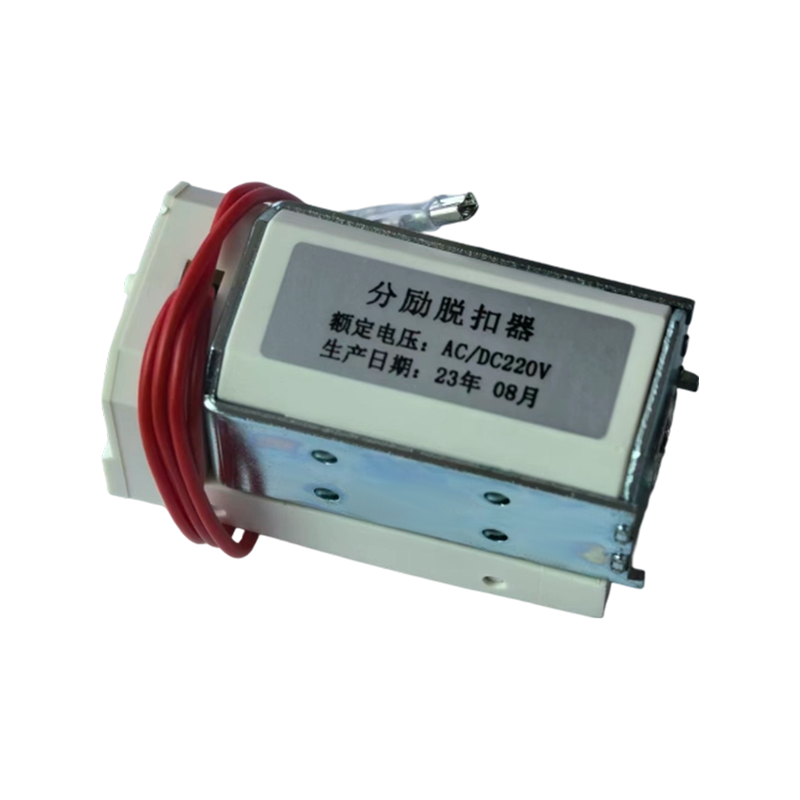
1. What Is an MCCB Shunt Trip Unit?
An MCCB shunt trip unit, also called a shunt trip release or shunt trip coil, is an electrical accessory installed inside or alongside a molded case circuit breaker (MCCB). It allows the breaker to be tripped remotely when an external control voltage is applied to the shunt trip circuit.
Unlike the normal thermal-magnetic or electronic protection mechanism, a shunt trip unit does not primarily detect overload or short circuit conditions. Instead, it receives a command from an external control system and converts the electrical signal into mechanical movement to open the circuit breaker. This makes it particularly useful for emergency shutdown, remote switching, fire protection systems, industrial automation, and power distribution control.
The latest edition of IEC 60947-2 is IEC 60947-2:2024, which applies to low-voltage circuit breakers up to 1,000 V AC or 1,500 V DC. When developing or sourcing an MCCB shunt trip accessory, manufacturers and buyers should therefore evaluate the accessory together with the complete circuit breaker system and applicable certification requirements. :contentReference[oaicite:0]{index=0}
2. How Does an MCCB Shunt Trip Unit Work?
(1) External Trip Signal
A shunt trip unit operates from an external control circuit. When the specified control voltage is applied to its terminals, the coil becomes energized and generates magnetic force. Schneider Electric describes this principle as an optional accessory that mechanically trips the circuit breaker when power is applied to the shunt trip terminals. :contentReference[oaicite:1]{index=1}
(2) Electromagnetic Actuation
The energized coil moves an internal plunger or actuator, which interacts with the MCCB operating mechanism. The mechanical movement releases the breaker mechanism and separates the main contacts.
(3) Fast Circuit Interruption
Once the trip mechanism is activated, the MCCB opens the power circuit. For example, published specifications for one current MCCB shunt trip family indicate a clearing time of less than 50 ms, demonstrating why shunt trip accessories are suitable for applications requiring rapid remote disconnection. :contentReference[oaicite:2]{index=2}
For B2B procurement, selecting an MCCB shunt trip unit requires more than matching the product name. The control voltage, breaker frame, installation method, operating mechanism, and certification requirements must all be checked before ordering.
Typical technical factors that B2B buyers should verify when sourcing MCCB shunt trip units.
| Specification |
Example Range or Requirement |
Importance |
| Control voltage |
24V, 48V, 110–130V, 208–240V, 380–480V AC/DC depending on model |
Must match the control power supply |
| Breaker type |
MCCB / frame-specific design |
Determines mechanical compatibility |
| Trip response |
Application and breaker dependent |
Important for emergency shutdown systems |
| Installation |
Factory-installed or field-installable |
Affects replacement and maintenance |
4. What Control Voltages Are Available for MCCB Shunt Trips?
Control voltage is one of the most important parameters when purchasing a shunt trip unit. Different MCCB platforms offer different voltage combinations. Current manufacturer documentation shows examples including 24V, 48V, 110–130V, 208–240V, 277V, 380–415V, and 440–480V AC, as well as 12V, 24V, 48V, 125V, and 250V DC options on specific product families. :contentReference[oaicite:3]{index=3}
For example, a 24V DC shunt trip cannot simply be replaced with a 220–240V AC coil because the electromagnetic characteristics, insulation system, and control circuit requirements are different. Before bulk purchasing, buyers should confirm the exact rated control voltage, AC or DC operation, frequency where applicable, and permissible operating range.
- Confirm AC or DC control power.
- Check the nominal control voltage.
- Verify the allowable voltage tolerance.
- Check pickup power and holding or seal-in power where specified.
- Match the coil with the exact MCCB model and frame.
5. Where Are MCCB Shunt Trip Units Used?
(1) Emergency Power Shutdown
Emergency stop circuits can use a shunt trip signal to disconnect selected electrical loads from a remote location. This can be valuable in factories, commercial buildings, machinery rooms, and other installations where manual access to the MCCB may be inconvenient.
(2) Fire and Safety Systems
Shunt trip accessories can be integrated into building safety and control systems where the electrical design requires remote opening of selected circuits. The actual application must follow the applicable local electrical, fire, and building codes.
(3) Industrial Automation
PLCs, relays, protection controllers, and other automation devices can provide the external signal required to trip the MCCB. This enables centralized control of electrical distribution equipment.
(4) Generator and Power Distribution Systems
In generator switchboards, distribution panels, and power management systems, a shunt trip unit can be used as part of a coordinated switching strategy. It can help disconnect a circuit following a control-system command or defined operating condition.
6. How to Choose an MCCB Shunt Trip Unit for B2B Projects
(1) Identify the Exact MCCB Model
Start with the manufacturer, product series, frame size, rated current, number of poles, and breaker configuration. Shunt trip units are often frame-specific, so a visually similar accessory may not be mechanically compatible.
(2) Verify Electrical Parameters
Confirm the rated voltage, AC/DC type, frequency, pickup characteristics, power consumption, and operating range. As one current manufacturer example, a B-frame shunt trip specification lists pickup power below 6 VA for AC and below 10 W for DC, with pickup occurring in less than 50 ms. These figures are model-specific rather than universal industry values. :contentReference[oaicite:4]{index=4}
(3) Confirm Mechanical Compatibility
Mounting location, actuator geometry, terminal arrangement, connector design, internal clearance, and operating stroke should be checked carefully. For OEM replacement projects, a technical drawing and sample approval process can significantly reduce installation problems.
(4) Check Compliance Requirements
Depending on the target market, the complete breaker and accessory combination may need to meet IEC, UL, CSA, or other applicable requirements. For international projects, buyers should request relevant test reports, certificates, product drawings, and quality documentation before approving a supplier.
7. MCCB Shunt Trip Unit Manufacturer and Wholesale Supplier
A shunt trip unit specifically designed for 1600A–6300A low-voltage frame circuit breakers is used to provide the circuit breaker with a fast tripping function. For OEMs, electrical distributors, switchgear manufacturers, panel builders, and maintenance companies, reliable shunt trip components are essential for building remote trip and emergency shutdown functions into large low-voltage distribution systems.
Jiangsu Kaiyuanfeng Electrical Machinery Manufacturing Co., Ltd. is a MCCB Shunt Trip Unit Manufacturer and Wholesale MCCB Shunt Trip Unit, established in Taizhou in August 2013 with an initial registered capital of 5 million yuan. The company specializes in key circuit breaker components and integrates R&D, design, production, sales, and service.
The company adheres to the core values of “building a solid foundation through steadiness, expanding horizons via perseverance, and forging integrity with responsibility,” while following the founding principles of integrity, win-win collaboration, and pioneering the future. Customer requirements are incorporated into product development and manufacturing processes to support practical application needs.
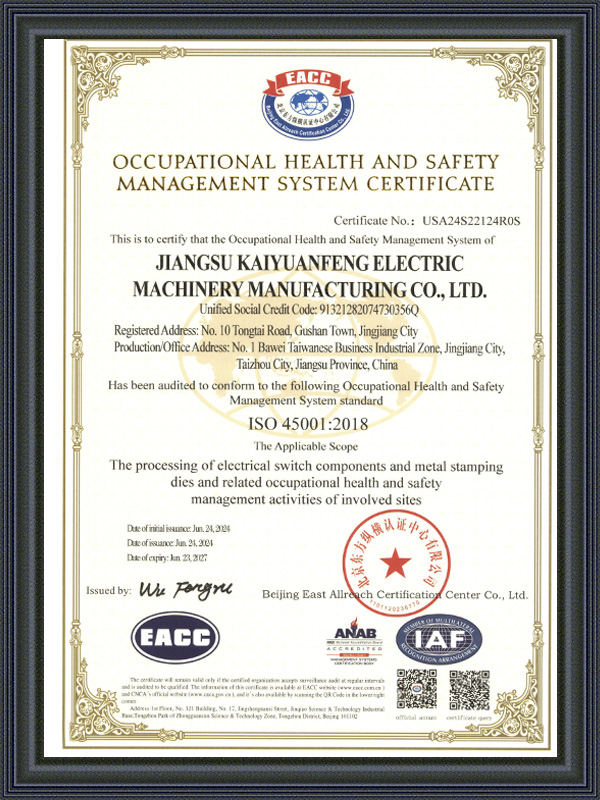
Its technical innovation is supported by 28 related patents addressing key industry challenges. The company has also obtained ISO certification and implements a management system aligned with international standards to support production efficiency and quality assurance.
With over 10 years of industry experience, Jiangsu Kaiyuanfeng Electrical Machinery Manufacturing Co., Ltd. focuses on reliable circuit breaker components, responsive technical service, and long-term B2B partnerships. Its goal is to become a core supplier of key circuit breaker components and contribute to safer and more dependable electrical systems.
8. Common Questions About MCCB Shunt Trip Units
Q1. What is an MCCB shunt trip unit used for?
An MCCB shunt trip unit is used to remotely trip or open a molded case circuit breaker when an external control voltage is applied. Typical applications include emergency shutdown, fire-related control circuits, industrial automation, generator systems, remote electrical isolation, and power distribution control. It is an optional accessory rather than the primary overload or short-circuit protection device.
Q2. How does an MCCB shunt trip work?
The shunt trip operates from an external electrical source. When the correct voltage is applied to the coil, the coil generates electromagnetic force that moves an internal actuator. This actuator releases the MCCB's mechanical trip mechanism, causing the main contacts to open. The exact operating sequence and coil behavior depend on the breaker design and accessory specification. :contentReference[oaicite:5]{index=5}
Q3. What voltage does an MCCB shunt trip use?
There is no single universal shunt trip voltage. Depending on the MCCB series, options can include 12V, 24V, 48V, 110–130V, 125V, 208–240V, 250V, 277V, 380–415V, and 440–480V. Both AC and DC versions are available for different breaker families. For example, current Schneider Electric documentation lists 24–480V AC options and 12–250V DC options for certain MCCB shunt trip ranges. :contentReference[oaicite:6]{index=6}
Q4. What is the difference between an MCCB shunt trip and an undervoltage release?
A shunt trip is generally activated by applying an external control voltage to intentionally trip the breaker. An undervoltage release, by contrast, monitors its control voltage and is designed to trip or prevent closing when the voltage falls below its specified operating level. Therefore, the two accessories have different control philosophies and should not be treated as interchangeable components.
Q5. Can an MCCB shunt trip unit be installed after the breaker is purchased?
Some MCCB product families provide field-installable shunt trip accessories, while others require factory configuration. For example, current PowerPacT accessory documentation identifies field-installable shunt trip catalog numbers for specific breaker frames. However, field installation must follow the exact manufacturer's instructions and applicable listing requirements. :contentReference[oaicite:7]{index=7}
Q6. Why does my MCCB shunt trip not trip the breaker?
Possible causes include incorrect control voltage, AC/DC mismatch, insufficient control power, loose wiring, damaged coil windings, incorrect accessory installation, mechanical interference, or an incompatible shunt trip model. Start by measuring the voltage at the shunt trip terminals during the trip command. Then verify the coil rating, wiring, installation position, and breaker mechanism according to the manufacturer's technical documentation.
Q7. How fast can an MCCB shunt trip unit trip a circuit breaker?
Trip performance varies according to the shunt trip accessory and the complete breaker mechanism. Some current MCCB accessory specifications report clearing times of less than 50 ms. However, buyers should distinguish between coil pickup time, mechanical opening time, and total clearing time when comparing products. A manufacturer’s tested specification should be used for engineering decisions rather than assuming that every shunt trip unit has the same response time. :contentReference[oaicite:8]{index=8}
Q8. How can I buy wholesale MCCB shunt trip units for 1600A–6300A circuit breakers?
For wholesale procurement, provide the supplier with the MCCB manufacturer, breaker series, frame size, rated current, control voltage, AC/DC requirement, mounting dimensions, connector information, and target market certification requirements. For OEM projects, supplying an original sample or technical drawing can make compatibility verification faster. Buyers should also evaluate sample approval, batch consistency, production capacity, inspection procedures, packaging, certifications, and after-sales technical support before placing a large-volume order.

 English
  中文简体
中文简体  русский
  عربى
عربى