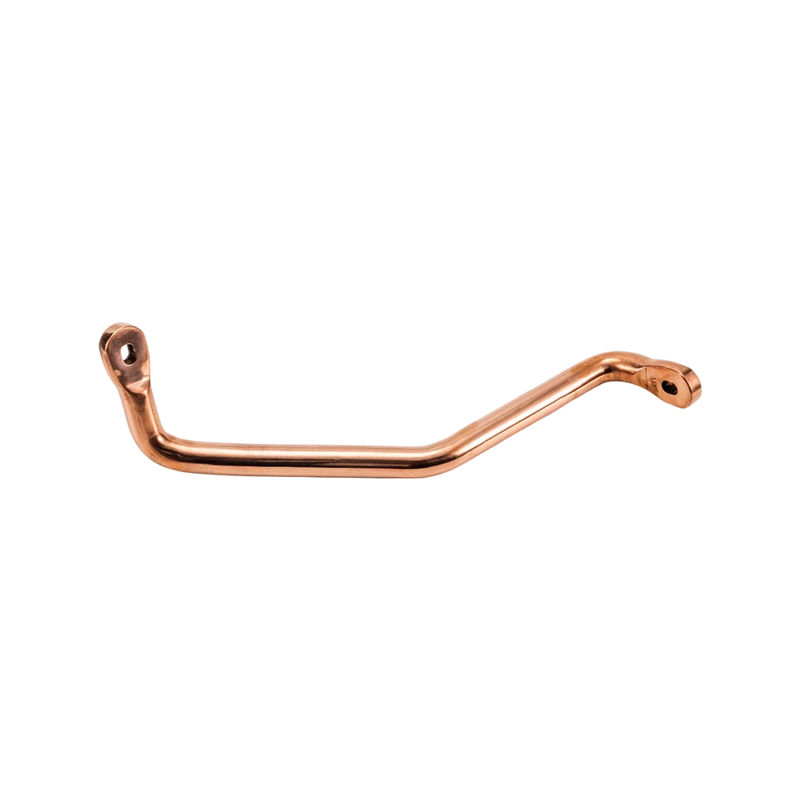
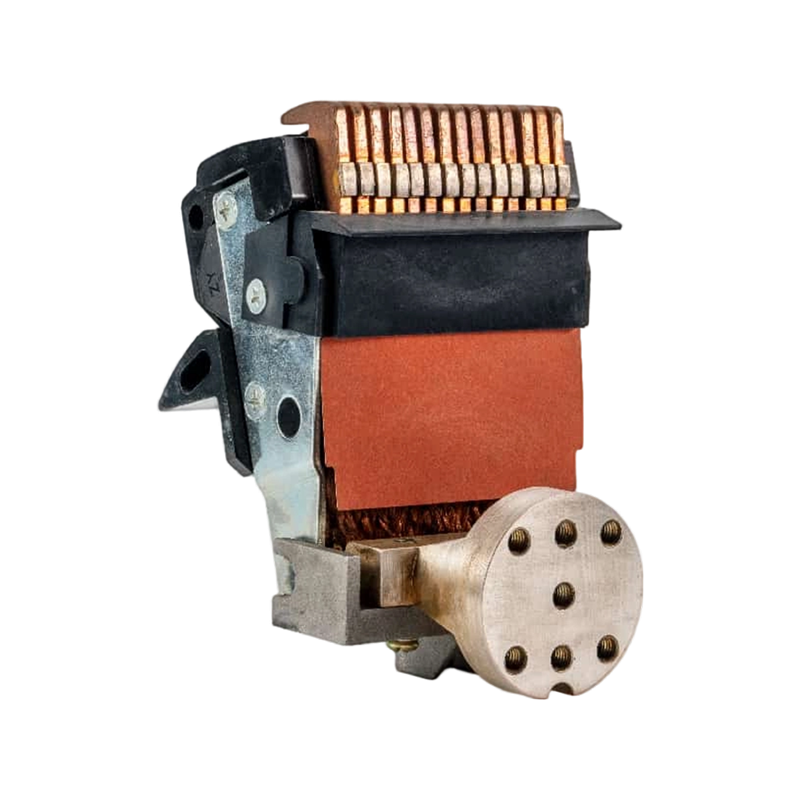
ACB Copper Busbar & Moving Contact Systems are critical conductive and switching assemblies used inside air circuit breakers (ACBs) to carry, connect, and interrupt high currents in low-voltage power distribution equipment. The system normally includes copper busbars, moving contacts, contact supports, conductive joints, springs, fasteners, and related connection components.
For OEMs, switchgear manufacturers, panel builders, and electrical component distributors, the quality of these parts directly affects current-carrying capability, contact resistance, temperature rise, mechanical reliability, and the service life of the complete ACB. The current IEC reference is IEC 60947-2:2024, the sixth edition for low-voltage circuit-breakers, covering equipment with rated voltages up to 1,000 V AC or 1,500 V DC under its specified scope.
2. Why Copper Busbars and Moving Contacts Matter in ACBs
(1) High Current-Carrying Performance
Copper is widely used for ACB current paths because of its excellent electrical conductivity and practical combination of conductivity, mechanical strength, machinability, and thermal performance. In high-current equipment, even a small increase in resistance can generate additional heat according to P = I²R.
For example, if a connection has a resistance of 20 μΩ and carries 2,000 A, the theoretical resistive loss at that point is approximately 80 W. Reducing the resistance to 10 μΩ cuts the calculated loss to approximately 40 W. This illustrates why contact pressure, surface treatment, joint geometry, and manufacturing consistency are important in ACB copper contact systems.
(2) Reliable Switching and Contact Pressure
The moving contact must maintain stable electrical contact during normal operation while moving accurately between open, closed, and tripped positions. Contact pressure, contact alignment, spring characteristics, contact surface condition, and mechanical tolerances all influence the switching performance.
(3) Short-Circuit and Thermal Requirements
ACB components must be designed as part of the complete breaker system rather than treated as isolated copper parts. Depending on the breaker design, the system may need to withstand substantial short-circuit stresses and repeated switching operations. Buyers should therefore evaluate the complete manufacturer's ratings, including Icu, Ics, Icw, rated current, insulation voltage, and applicable test requirements, rather than selecting a copper component only by dimensions.
3. Key Specifications for ACB Copper Busbar & Moving Contact Systems
Typical engineering factors that B2B buyers should confirm before purchasing ACB conductive assemblies.
| Specification |
What to Confirm |
B2B Importance |
| Copper Material |
Copper grade, conductivity and mechanical properties |
Controls electrical and thermal performance |
| Dimensions |
Length, width, thickness, holes and tolerances |
Ensures OEM compatibility and assembly accuracy |
| Surface Treatment |
Silver, nickel or other specified contact treatment |
Supports contact stability and corrosion resistance |
| Mechanical System |
Contact pressure, spring force and movement |
Affects switching reliability and service life |
4. Manufacturing Process and Quality Control
(1) Precision Copper Processing
Professional ACB component manufacturers typically use processes such as copper cutting, CNC machining, punching, bending, drilling, forming, deburring, and surface finishing. Dimensional consistency is particularly important for holes, contact faces, mounting points, and mating surfaces.
(2) Contact Surface Treatment
Depending on the design, contact areas can require specialized plating or finishing. Surface treatment can help control oxidation and maintain electrical contact characteristics. The correct treatment should be determined according to the current level, contact construction, operating environment, and OEM specification.
(3) Inspection and Assembly Verification
- Dimensional and tolerance inspection
- Copper material and surface inspection
- Contact alignment and mechanical movement verification
- Electrical resistance and conductivity-related checks where specified
- Final assembly and traceability inspection
For B2B procurement, the lowest unit price should not be the only selection criterion. A qualified supplier should be capable of matching the component to the customer's ACB structure, electrical ratings, installation dimensions, and production requirements.
- Provide the ACB model, rated current, voltage, and relevant electrical specifications.
- Submit drawings showing dimensions, hole positions, contact geometry, and tolerances.
- Confirm copper grade, plating, contact material, and required surface treatment.
- Discuss prototype sampling before mass production for customized components.
- Confirm inspection procedures, packaging, traceability, lead time, MOQ, and export documentation.
For example, a switchgear manufacturer purchasing 500 sets per month may benefit more from stable dimensional repeatability and controlled batch quality than from a small initial price reduction that causes assembly problems or field returns.
6. Jiangsu Kaiyuanfeng Electrical Machinery Manufacturing Co., Ltd. for ACB Copper Components
Jiangsu Kaiyuanfeng Electrical Machinery Manufacturing Co., Ltd. is an ACB Copper Busbar & Moving Contact Systems Manufacturer and wholesale supplier, established in Taizhou in August 2013 with an initial registered capital of 5 million yuan. The company is a manufacturer of key circuit breaker components, integrating R&D, design, production, sales, and service.
The company follows the core values of “building a solid foundation through steadiness, expanding horizons via perseverance, and forging integrity with responsibility” and the founding principle of “integrity, win-win collaboration, and pioneering the future.” Customer requirements are incorporated into processes from product development to manufacturing, supported by 28 related patents addressing industry challenges.
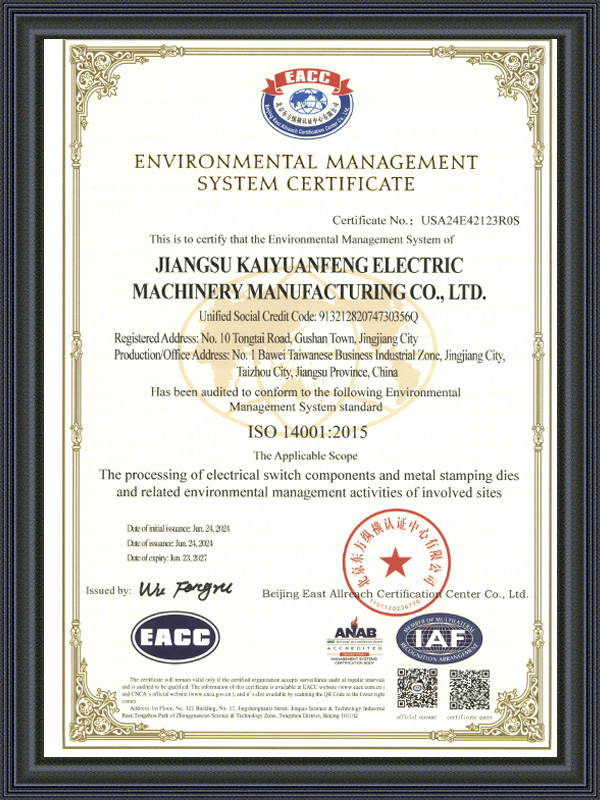
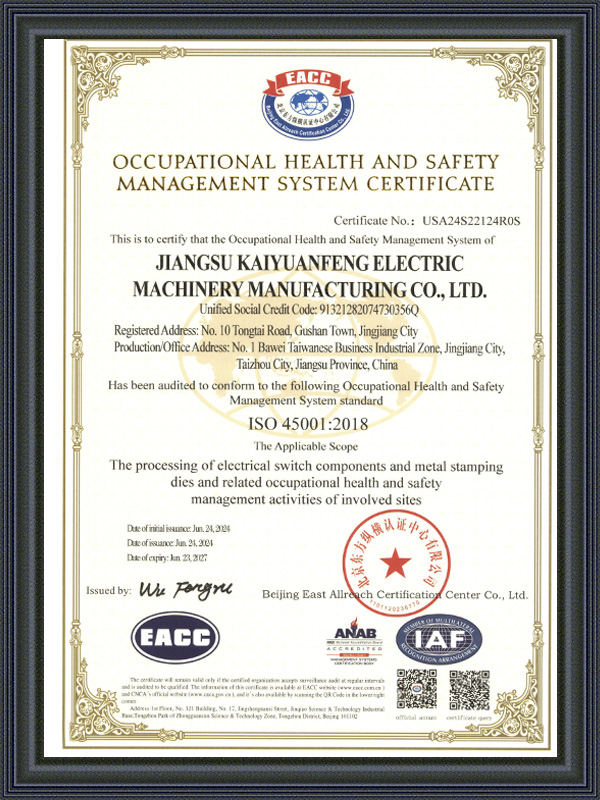
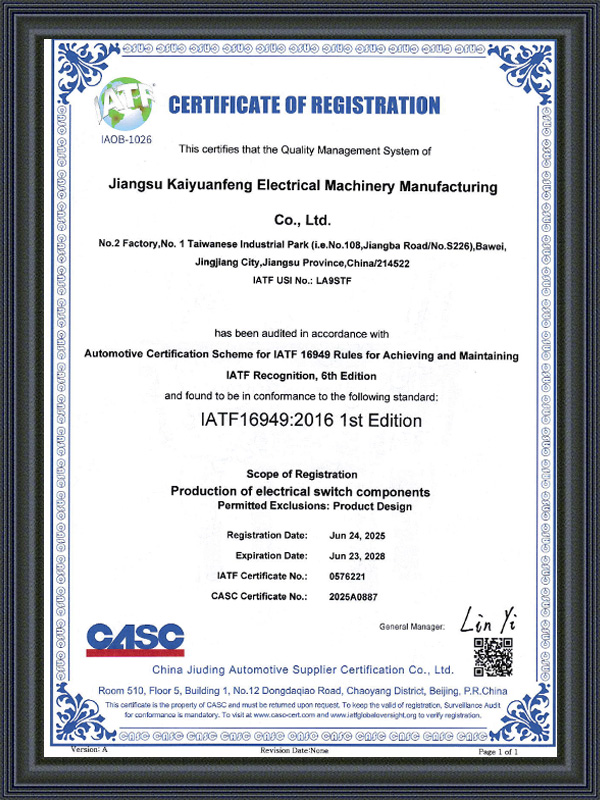
With ISO certification and a management system aligned with international standards, Jiangsu Kaiyuanfeng focuses on quality assurance and operational efficiency. With more than a decade of industry experience, the company supports OEM and customized requirements for customers seeking reliable circuit breaker component supply and long-term cooperation.
7. Common Questions About ACB Copper Busbar & Moving Contact Systems
Q1. What is an ACB copper busbar used for?
An ACB copper busbar provides a low-resistance conductive path between the circuit breaker's internal current-carrying sections and external electrical connections. Its dimensions, material, joint design, and surface condition must match the required current and thermal performance of the complete breaker.
Q2. What is the function of a moving contact in an ACB?
The moving contact establishes or interrupts the main electrical circuit as the ACB operates. It must move accurately, maintain suitable contact pressure when closed, and withstand the electrical and mechanical stresses associated with normal switching and fault interruption.
Q3. Why is copper commonly used for ACB busbars?
Copper offers high electrical conductivity together with good thermal and mechanical characteristics, making it practical for high-current conductive paths. However, the appropriate copper grade and cross-sectional dimensions must be selected according to the complete ACB design rather than conductivity alone.
Q4. How do I choose the correct ACB moving contact assembly?
Start with the ACB manufacturer, frame size, model, rated current, rated voltage, contact configuration, mounting dimensions, and existing assembly drawing. For OEM replacement or customized production, provide a technical drawing or physical sample so the supplier can verify dimensions, contact position, material, plating, and mechanical compatibility.
Q5. Can ACB copper busbars and moving contacts be customized?
Yes. B2B manufacturers commonly require customization of length, thickness, width, hole pattern, bending angle, contact geometry, surface treatment, and assembly configuration. OEM projects should normally begin with drawings, samples, or technical specifications before mass production.
Q6. What standards should buyers consider for ACB components?
The complete low-voltage circuit breaker should be evaluated against the applicable product standards and manufacturer specifications. As of 2026, IEC 60947-2:2024 is the current sixth edition for low-voltage circuit-breakers within its stated scope. Buyers should also confirm the applicable regional certification, test reports, electrical ratings, and OEM requirements for their target market.
Q7. What information should I provide when requesting an ACB copper contact quotation?
Provide the ACB model or application, rated current and voltage, material requirements, copper busbar dimensions, moving contact dimensions, drawings, surface treatment, annual or monthly quantity, packaging requirements, destination market, and required delivery schedule. More complete technical information allows the supplier to quote accurately and reduce sample revision cycles.
Q8. How can manufacturers reduce ACB copper component procurement risk?
Manufacturers can reduce procurement risk by selecting suppliers with in-house engineering capability, documented quality control, stable raw-material sourcing, prototype support, production traceability, and experience with customized circuit breaker components. For recurring orders, buyers should also establish approved drawings, inspection standards, sample confirmation procedures, and batch consistency requirements.

 English
  中文简体
中文简体  русский
  عربى
عربى