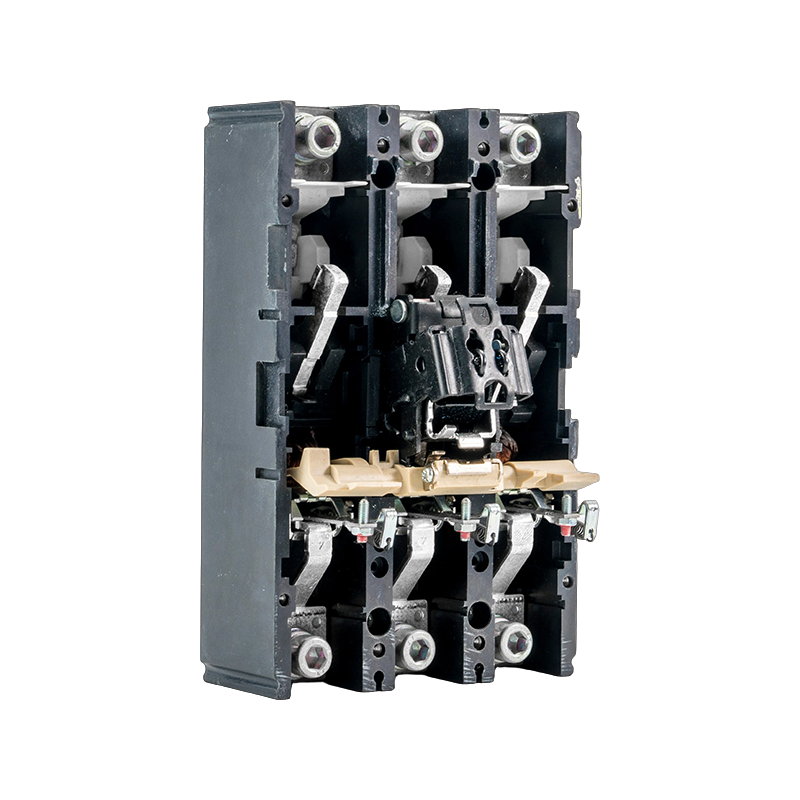
An MCCB Insulated Base Assembly is a structural and electrical insulation component installed inside a molded case circuit breaker (MCCB). It provides mechanical support for conductive parts such as contacts, terminals, and current-carrying assemblies while helping maintain electrical isolation between conductive components and the breaker housing.
For MCCB manufacturers, OEMs, and electrical component wholesalers, the insulated base is not simply a plastic support. It must combine high insulation performance, dimensional stability, mechanical strength, heat resistance, and reliable molding quality. Its geometry can directly affect creepage distances, clearances, contact positioning, assembly accuracy, and the overall safety of the finished breaker.
As of 2026, IEC 60947-2:2024 is the current IEC edition for low-voltage circuit breakers covered by the standard. It applies to circuit breakers whose main contacts are intended for circuits rated up to 1,000 V AC or 1,500 V DC. The standard establishes requirements and verification methods for circuit breakers, while the exact material and construction of an MCCB insulated base assembly remain dependent on the specific breaker design and applicable requirements.
2. Why Is the Insulated Base Important in an MCCB?
(1) Electrical Insulation
The primary function of an insulated base is to electrically separate conductive components. A properly engineered insulating structure helps prevent unintended current paths, flashover, and insulation failure under the operating conditions specified for the MCCB.
(2) Mechanical Support
The base also supports internal components and maintains their designed positions. During assembly, switching operations, transportation, and fault conditions, the component must maintain sufficient mechanical stability. Dimensional deformation can affect contact alignment and other critical internal clearances.
(3) Maintaining Creepage and Clearance
The geometry of the insulating base can be used to create insulating barriers, ribs, channels, and separation features. These features help maintain required creepage and clearance distances. The exact distances should be determined from the complete product design, rated voltage, pollution conditions, insulation coordination, and applicable standards rather than using one universal value.
3. Why Is BMC Material Commonly Used for MCCB Insulated Bases?
BMC, or Bulk Molding Compound, is a thermosetting composite material commonly formulated from resin, chopped glass fiber, mineral fillers, and additives. BMC is widely used for electrical components because engineered grades can provide strong electrical insulation, dimensional stability, mechanical strength, and heat resistance.
BMC is particularly suitable for complex molded components because it can be compression molded or processed using other thermoset molding techniques. Commercial BMC grades designed for electrical applications can offer properties such as UL94 V-0 flammability performance at specified thicknesses, but the exact rating always depends on the selected material grade and test conditions.
For example, one commercial electrical BMC grade lists UL94 V-0 at 1.5 mm and identifies circuit breakers among its target applications. This demonstrates why material certification should be checked at the specific grade and thickness required by the MCCB design rather than assuming all BMC materials have identical performance.
Typical performance considerations when selecting BMC for MCCB insulated base assemblies.
| BMC Property |
Importance for MCCB Bases |
| Electrical insulation |
Helps isolate conductive components and support insulation performance |
| Glass-fiber reinforcement |
Improves mechanical strength and dimensional stability |
| Thermal resistance |
Supports stable performance near heat-generating current-carrying parts |
| Low shrinkage |
Supports dimensional accuracy for internal assembly |
| Flame resistance |
Can support fire-safety requirements when the selected grade is properly certified |
4. What Should Manufacturers Consider When Designing an MCCB Insulated Base?
(1) Insulation Distance
Designers should consider creepage and clearance around terminals, contacts, conductive inserts, and other energized components. Insulating ribs and barriers can be incorporated into the molding design where necessary.
(2) Thermal Environment
MCCBs can generate heat around terminals and current-carrying components. The insulated base must therefore retain its mechanical and electrical properties under the expected operating temperature range. Material selection should be based on actual temperature-rise testing and the manufacturer's thermal design.
(3) Dimensional Accuracy
Mounting holes, locating bosses, ribs, slots, and contact-support surfaces must be manufactured consistently. For an OEM production line, dimensional variation in an insulated base can cause assembly difficulties or alter the position of internal conductive components.
(4) Mechanical Strength
The base must support internal components without cracking, excessive deformation, or loss of dimensional stability. Glass-fiber reinforcement in BMC can provide useful mechanical performance while maintaining electrical insulation properties.
5. What Quality Checks Are Important for MCCB Insulated Base Assemblies?
For B2B buyers, quality control should cover both the raw material and the finished molded component. Appearance alone is insufficient for an electrical insulation component because internal defects, dimensional deviations, or unsuitable material properties may not be visible.
- Verify BMC material grade and incoming material consistency.
- Check critical dimensions and mounting positions.
- Inspect for cracks, voids, flash, warpage, and molding defects.
- Verify applicable flammability and insulation requirements for the selected material grade.
- Perform mechanical and electrical tests according to the product specification.
- Maintain production-batch traceability for OEM and wholesale orders.
A supplier qualification program should also review tooling capability, molding-process control, inspection equipment, sample approval procedures, and long-term production capacity. These factors are especially important for MCCB manufacturers purchasing large quantities of identical components.
6. B2B Procurement Guide for MCCB Insulated Base Assemblies
When purchasing an MCCB insulated base assembly, buyers should provide enough technical information for the manufacturer to understand the complete application. The correct component depends on the breaker frame, internal layout, rated voltage, current-carrying system, mounting structure, and insulation requirements.
Key procurement information for OEM and wholesale MCCB insulated base assembly projects.
| Information to Confirm |
Why It Matters |
| MCCB frame and model |
Determines assembly geometry and compatibility |
| Rated voltage and current |
Helps define insulation and thermal requirements |
| BMC material grade |
Controls insulation, thermal, mechanical, and flame-performance characteristics |
| Technical drawing or sample |
Reduces dimensional and assembly compatibility risks |
| Annual quantity and MOQ |
Supports tooling, capacity, and pricing evaluation |
For international sourcing, buyers should additionally confirm packaging, sample approval, tooling ownership, production lead time, inspection documentation, material certificates, and quality acceptance criteria. A detailed specification helps prevent costly redesigns after mass production begins.
7. Jiangsu Kaiyuanfeng MCCB Insulated Base Assembly Manufacturer
Jiangsu Kaiyuanfeng Electrical Machinery Manufacturing Co., Ltd. is a MCCB Insulated Base Assembly Manufacturer and Wholesale MCCB Insulated Base Assembly supplier. Established in Taizhou in August 2013 with an initial registered capital of RMB 5 million, the company is a manufacturer of key circuit breaker components integrating R&D, design, production, sales, and service.
The company's MCCB insulated base assemblies use BMC material with high insulation performance, providing an engineering-oriented solution for internal circuit breaker insulation and structural support. BMC material selection can be matched to the specific electrical, thermal, mechanical, and dimensional requirements of an OEM project.
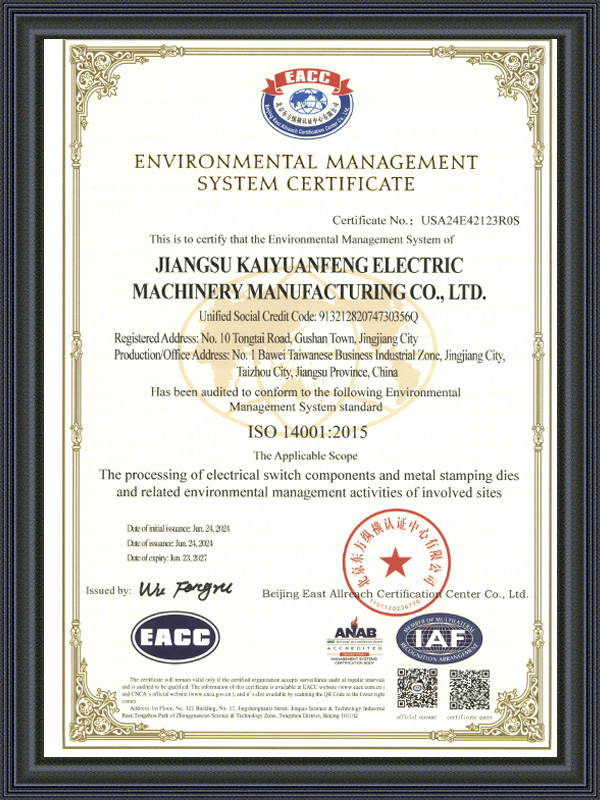
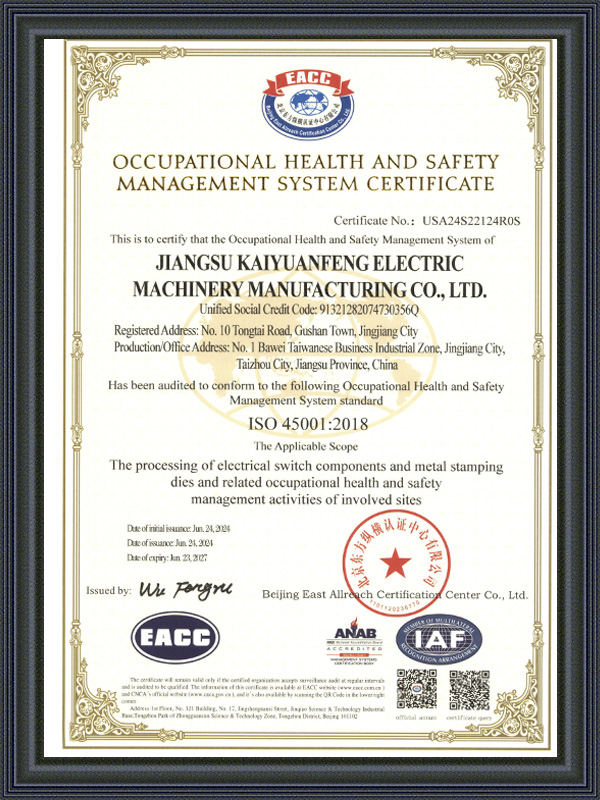
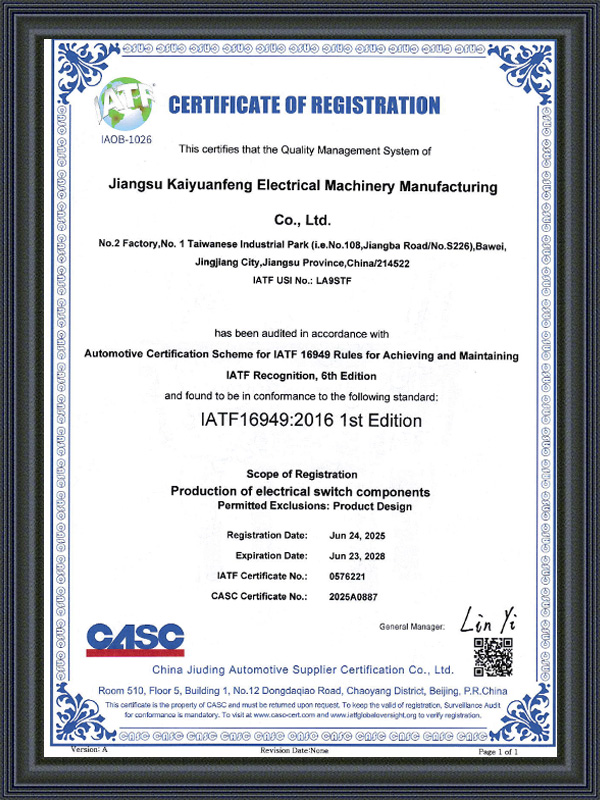
Jiangsu Kaiyuanfeng incorporates customer requirements into processes from product development to manufacturing. Its innovation capabilities are supported by 28 related patents, while its ISO-certified management system is designed to support operational efficiency and quality assurance.
With over a decade of industry experience, the company focuses on reliable products and attentive service to build long-term B2B partnerships. Its goal is to become a core supplier of key circuit breaker components and contribute to the safety and reliability of electrical systems.
8. How Can OEM Customers Customize an MCCB Insulated Base Assembly?
OEM and ODM customers can customize insulated base assemblies according to technical drawings, existing samples, or specific breaker requirements. Customization may involve overall dimensions, mounting holes, ribs, barriers, locating features, terminal supports, wall thickness, material grade, surface details, and packaging.
- Provide a CAD drawing, technical drawing, part number, or physical sample.
- Confirm MCCB frame size, rated voltage, rated current, and application.
- Specify BMC material grade and required insulation or flame-performance criteria.
- Define critical dimensions, tolerances, creepage, clearance, and mounting requirements.
- Approve prototype samples and complete necessary component or assembly tests.
- Confirm MOQ, annual demand, packaging, quality documentation, and delivery schedule.
This process is particularly valuable for MCCB manufacturers developing proprietary product platforms because the insulated base can be engineered together with the contacts, terminals, operating mechanism, and housing instead of being treated as an isolated plastic component.
9. Common Questions About MCCB Insulated Base Assemblies
Q1. What is an MCCB insulated base assembly?
An MCCB insulated base assembly is an insulating structural component used inside a molded case circuit breaker to support internal parts and electrically isolate conductive components. It can incorporate mounting features, insulation barriers, locating structures, ribs, and supports designed specifically for the breaker architecture.
Q2. What material is commonly used for MCCB insulated bases?
BMC, or Bulk Molding Compound, is a common material direction for electrical insulation components. It is a thermosetting composite typically based on resin, glass fiber, mineral fillers, and additives. Properly engineered BMC grades can provide electrical insulation, mechanical strength, thermal resistance, dimensional stability, and flame-retardant performance.
Q3. Why is BMC used in MCCB components?
BMC is suitable for MCCB applications because engineered grades can combine strong electrical insulation with mechanical and thermal performance. It can also be molded into complex geometries containing ribs, bosses, barriers, and mounting features. The specific grade should be selected according to the electrical, thermal, mechanical, and flammability requirements of the finished product.
Q4. What should I check when buying an MCCB insulated base assembly?
Buyers should check the BMC material grade, dimensional tolerances, insulation requirements, flame-performance requirements, mechanical strength, molding quality, mounting compatibility, and supplier quality-control system. For OEM applications, a technical drawing or physical sample should be used to verify all critical dimensions before mass production.
Q5. Can MCCB insulated base assemblies be customized?
Yes. OEM manufacturers can customize the base according to a drawing, sample, or complete breaker design. Common customization areas include dimensions, mounting holes, internal ribs, insulation barriers, locating features, wall thickness, BMC grade, and packaging. Prototype validation is recommended before high-volume production.
Q6. How is an MCCB insulated base tested?
Testing depends on the component specification and finished MCCB requirements. It may include dimensional inspection, visual inspection, material verification, mechanical testing, insulation-related testing, and verification of applicable flammability performance. The finished circuit breaker must ultimately satisfy the relevant product standard and its defined test program.
Q7. What is the latest IEC standard for MCCBs in 2026?
The current IEC edition is IEC 60947-2:2024. According to the IEC, this sixth edition applies to circuit breakers whose main contacts are intended for circuits with rated voltage not exceeding 1,000 V AC or 1,500 V DC, and it replaced the previous 2016 edition and its 2019 amendment. Regional regulations and product-specific certification requirements may also apply.
Q8. How do creepage and clearance affect an MCCB insulated base?
Creepage is the shortest distance along an insulating surface, while clearance is the shortest distance through air between conductive parts. The insulated base can incorporate barriers and ribs to help achieve the required distances. The correct values depend on factors such as working voltage, insulation system, pollution conditions, and applicable standards, so they should be determined during engineering design rather than copied from a generic specification.
Q9. Where can I buy wholesale MCCB insulated base assemblies?
B2B buyers can source MCCB insulated base assemblies directly from specialized circuit breaker component manufacturers such as Jiangsu Kaiyuanfeng Electrical Machinery Manufacturing Co., Ltd. Buyers should evaluate BMC material capability, tooling and molding experience, dimensional control, quality management, customization support, sample approval, MOQ, and long-term production capacity before placing a wholesale order.
Q10. How do I choose a reliable MCCB insulated base assembly manufacturer?
A reliable manufacturer should be able to provide consistent BMC material control, precision molding, stable dimensions, quality inspection, OEM customization, and technical support. For long-term B2B cooperation, buyers should also review ISO certification, tooling capabilities, sample-development procedures, production capacity, traceability, and the supplier's ability to maintain consistent quality across repeat orders.

 English
  中文简体
中文简体  русский
  عربى
عربى