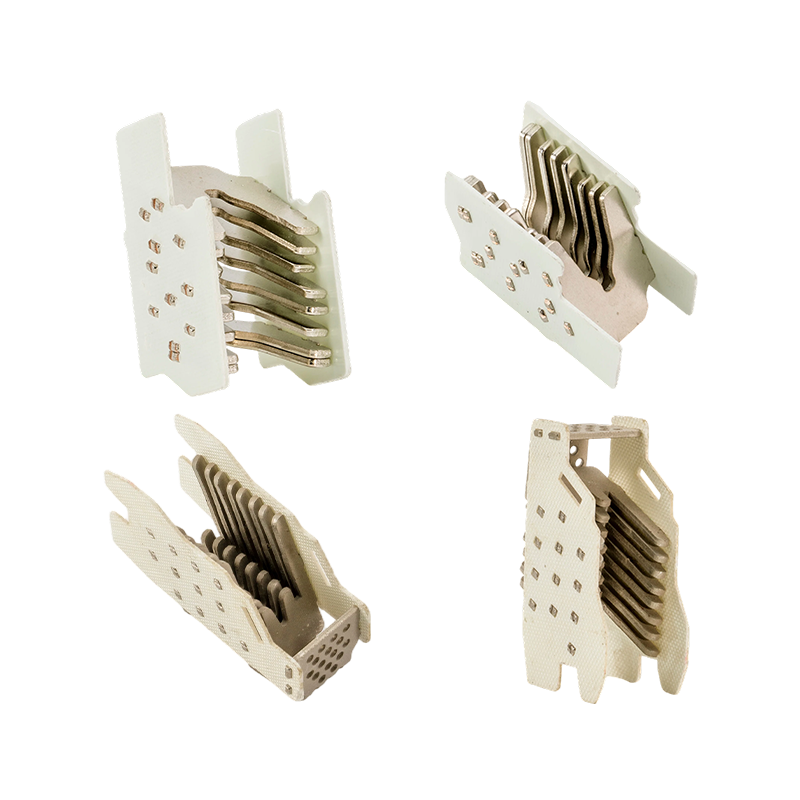
An MCCB Arc Chute Assembly is a critical internal component used in molded case circuit breakers to manage and extinguish the electrical arc generated when the main contacts separate during circuit interruption. It works together with the moving contact, stationary contact, operating mechanism, and molded insulating housing to help the MCCB interrupt overloads and short-circuit currents safely.
When an MCCB opens under load, the separation of electrical contacts does not instantly eliminate current. An arc can form between the contacts and release significant thermal energy. The arc chute provides a controlled structure that helps move, divide, cool, and de-ionize the arc, reducing the time and energy associated with the interruption process.
For OEM manufacturers, electrical distributors, and circuit breaker component wholesalers, arc chute design is therefore closely connected to interrupting performance, product reliability, thermal management, insulation coordination, and service life. The latest IEC edition applicable to low-voltage circuit breakers is IEC 60947-2:2024, which covers circuit breakers for circuits up to 1,000 V AC or 1,500 V DC under its scope.
2. How Does an MCCB Arc Chute Assembly Extinguish an Arc?
(1) Arc Movement
As the contacts separate, electromagnetic forces and the geometry of the internal breaker structure drive the arc toward the arc chute. Correct arc-runner and arc-chute geometry helps guide the arc into the intended area rather than allowing it to remain concentrated near the contact surfaces.
(2) Arc Splitting
The arc chute normally contains multiple metallic plates or other engineered components separated by insulating structures. These plates can divide the arc into smaller sections. Increasing the effective arc voltage through this process helps support interruption as the contacts move farther apart.
(3) Arc Cooling and De-Ionization
The arc chute also promotes heat dissipation and de-ionization of the conductive plasma. As the arc cools and the gas becomes less conductive, the circuit is better able to withstand the recovery voltage after current interruption.
(4) Limiting Arc Energy
The faster an arc is driven into an effective extinguishing structure, the better the breaker can control the duration and energy of the interruption. For this reason, arc chute geometry is an important part of the overall MCCB interruption system rather than an independent accessory.
3. What Are the Main Components of an MCCB Arc Chute Assembly?
Although construction varies by breaker design and rated performance, an arc chute assembly commonly combines arc splitter plates, insulating supports, side barriers, mounting structures, and arc-guiding features. Each element must work together to control the arc without compromising the internal insulation system.
Typical MCCB arc chute components and their functions.
| Component |
Main Function |
Key Requirement |
| Arc splitter plates |
Divide and cool the arc |
Heat resistance and dimensional consistency |
| Insulating supports |
Maintain plate spacing and electrical isolation |
High insulation and thermal stability |
| Arc guides |
Direct the arc toward the chute |
Accurate geometry and wear resistance |
| Mounting structure |
Positions the assembly inside the MCCB |
Dimensional accuracy and mechanical stability |
4. Why Is Arc Chute Geometry Important for MCCB Performance?
Arc chute geometry directly influences how efficiently an arc enters and travels through the extinguishing chamber. Plate spacing, plate length, entrance geometry, insulating barriers, and the relative position of the moving contact can all affect arc behavior.
A poorly matched arc chute can cause delayed arc movement, excessive local heating, contact erosion, or insufficient interruption performance. Conversely, an optimized design can help distribute thermal energy over multiple components and improve the repeatability of the interruption process.
For example, an MCCB designed for a 400 A application and a higher short-circuit rating may require substantially different arc-management characteristics from a compact 63 A breaker. Arc chute dimensions should therefore be developed around the actual MCCB frame, voltage, current, short-circuit capability, and contact system rather than selected only by physical size.
5. What Materials Are Used for MCCB Arc Chute Assemblies?
Arc chute assemblies typically combine heat-resistant metallic plates with electrically insulating structural materials. The selected materials must withstand short-duration but potentially severe thermal and electrical stresses generated during fault interruption.
- Metallic arc splitter plates for arc division, cooling, and de-ionization.
- Thermosetting insulating materials for structural supports and electrical isolation.
- Heat-resistant insulating components around the arc chamber.
- Engineered steel or other suitable conductive alloys for arc-control elements.
Material selection should consider dielectric strength, thermal stability, mechanical strength, arc erosion, flammability, manufacturing consistency, and compatibility with the complete breaker. A material that performs well in static insulation applications may not automatically be suitable for an arc chamber exposed to repeated interruption events.
For OEM and wholesale purchasing, buyers should evaluate arc chute assemblies based on technical compatibility, production consistency, and verified performance. Price is important, but a low-cost component that causes assembly problems or fails interruption testing can create significantly higher costs during production.
Key procurement factors for OEM and wholesale MCCB arc chute assemblies.
| Procurement Factor |
Why It Matters |
| MCCB frame and rated current |
Determines basic mechanical and electrical compatibility |
| Rated voltage and interruption rating |
Influences arc-management requirements |
| Arc chute dimensions |
Ensures proper fit and arc path alignment |
| Plate material and thickness |
Affects thermal and arc-control behavior |
| Insulating material |
Supports electrical isolation and thermal stability |
| Testing and quality documentation |
Supports supplier qualification and product verification |
For regular imports, buyers should also confirm MOQ, annual production capacity, tooling requirements, sample approval procedures, packaging, lead time, inspection standards, and batch traceability. These factors are especially relevant when the arc chute is used in a high-volume OEM MCCB platform.
7. How Is an MCCB Arc Chute Assembly Tested?
Testing of an arc chute assembly should be considered within the complete MCCB qualification system. The arc chute cannot be evaluated independently of the contact system, operating mechanism, housing, terminal configuration, and other components because interruption performance depends on their interaction.
- Dimensional inspection of plates, supports, and mounting features.
- Material and thickness verification for critical arc-control parts.
- Visual inspection for cracks, deformation, burrs, and molding defects.
- Mechanical fit and assembly verification.
- Temperature and thermal-performance evaluation where required.
- Complete MCCB short-circuit and interruption testing according to the applicable product standard.
For B2B buyers, a supplier capable of maintaining consistent dimensions and material properties across production batches can reduce the risk of variation in final breaker testing. Sample approval followed by controlled mass production is recommended for customized arc chute projects.
8. Jiangsu Kaiyuanfeng MCCB Arc Chute Assembly Manufacturer
Jiangsu Kaiyuanfeng Electrical Machinery Manufacturing Co., Ltd. is a MCCB Arc Chute Assembly Manufacturer and Wholesale MCCB Arc Chute Assembly supplier, established in Taizhou in August 2013 with an initial registered capital of RMB 5 million. The company specializes in key circuit breaker components and integrates R&D, design, production, sales, and service.
Its MCCB arc chute assemblies are developed with attention to arc chute shape optimization and improved arc extinguishing performance. The product-development approach considers the relationship between arc-control geometry, insulation structures, contact movement, and the overall MCCB architecture.
Jiangsu Kaiyuanfeng incorporates customer requirements into its processes from R&D to manufacturing. Its innovation capabilities are supported by 28 related patents, while its ISO-certified management system provides a structured approach to operational efficiency and quality assurance.
With over a decade of industry experience, the company focuses on reliable circuit breaker components and attentive B2B service. It aims to become a core supplier of key circuit breaker components and contribute to the reliability and safety of electrical systems.
9. How Can OEM Customers Customize an MCCB Arc Chute Assembly?
OEM customers may require customized arc chute assemblies for different MCCB frame sizes, current ratings, voltage classes, and interruption capabilities. Customization can involve plate dimensions, plate quantity, spacing, insulating supports, mounting geometry, arc-entry structure, materials, and overall assembly dimensions.
- Provide an existing arc chute, technical drawing, CAD file, or physical sample.
- Confirm MCCB frame size, rated current, rated voltage, and intended application.
- Specify the required short-circuit and interruption performance of the complete breaker.
- Define plate material, thickness, spacing, insulating material, and critical dimensions.
- Conduct prototype fitting and qualification before mass production.
- Confirm MOQ, annual demand, tooling, packaging, inspection, and delivery requirements.
For new MCCB development, arc chute design should be evaluated together with the contact system and operating mechanism. This engineering approach is more effective than selecting an arc chute based solely on external dimensions.
10. Common Questions About MCCB Arc Chute Assemblies
Q1. What is an MCCB arc chute assembly?
An MCCB arc chute assembly is an internal arc-management component that helps control and extinguish the electrical arc produced when the breaker contacts separate. It typically uses multiple arc splitter plates and insulating structures to divide, cool, and de-ionize the arc during circuit interruption.
Q2. What is the function of an arc chute in an MCCB?
The arc chute guides the arc away from the main contact area and helps divide and cool it. This increases the difficulty of maintaining the conductive arc and supports interruption of overload and short-circuit currents. Its performance depends on the complete MCCB design, including contact separation speed, magnetic forces, arc chute geometry, and insulation structure.
Q3. What materials are used to make MCCB arc chutes?
Arc chutes commonly combine metallic splitter plates with heat-resistant insulating materials. The metal plates must withstand arc-related thermal stress and support arc division, while the insulating components maintain spacing and electrical isolation. The exact materials depend on the MCCB voltage, current, interruption requirements, and design.
Q4. How does an MCCB arc chute extinguish an electrical arc?
When the contacts separate, the arc is driven toward the arc chute. The splitter plates divide the arc into multiple sections and help dissipate heat. This increases the effective arc voltage and promotes cooling and de-ionization. As the gas becomes less conductive and the contact gap increases, the circuit becomes capable of withstanding the recovery conditions after interruption.
Q5. Can an MCCB arc chute assembly be customized?
Yes. OEM arc chute assemblies can be customized according to breaker frame size, rated current, rated voltage, interruption requirements, contact geometry, and internal housing dimensions. Customization can include plate dimensions, quantity, spacing, materials, insulating supports, mounting features, and arc-guiding geometry. Prototype validation should be completed before mass production.
Q6. Why is arc chute geometry important in MCCBs?
Arc chute geometry determines how efficiently the arc enters, travels through, and interacts with the splitter plates. Incorrect spacing or positioning can reduce arc-control effectiveness, increase local heating, or cause problems during interruption testing. Optimized geometry should be developed around the complete MCCB rather than treated as a universal component specification.
Q7. How do I choose the correct MCCB arc chute assembly?
Start with the MCCB model, frame size, rated current, rated voltage, short-circuit rating, contact configuration, and available internal space. Then verify the arc chute's dimensions, plate material, thickness, spacing, mounting features, and insulation structure. For OEM projects, supplying a drawing or sample to the manufacturer is the most reliable way to establish compatibility.
Q8. What tests are required for an MCCB arc chute assembly?
Component-level inspection can include dimensional, material, visual, and mechanical checks. However, arc chute performance is ultimately validated as part of the complete MCCB through applicable electrical and interruption tests. IEC 60947-2:2024 provides the current IEC framework for low-voltage circuit breakers, while regional certification and customer-specific requirements may also apply.
Q9. Where can I buy wholesale MCCB arc chute assemblies?
B2B buyers can purchase MCCB arc chute assemblies directly from specialized circuit breaker component manufacturers such as Jiangsu Kaiyuanfeng Electrical Machinery Manufacturing Co., Ltd. When evaluating a supplier, buyers should consider arc chute design capability, manufacturing consistency, material control, inspection procedures, OEM customization, MOQ, production capacity, and long-term technical support.
Q10. What should I provide when requesting a quotation for an MCCB arc chute assembly?
A quotation request should ideally include the MCCB model, frame size, rated current, rated voltage, short-circuit rating, technical drawing or sample, arc chute dimensions, material requirements, estimated annual quantity, MOQ expectations, packaging requirements, and delivery destination. Providing this information allows the manufacturer to evaluate tooling, material, production process, testing requirements, and pricing more accurately.

 English
  中文简体
中文简体  русский
  عربى
عربى