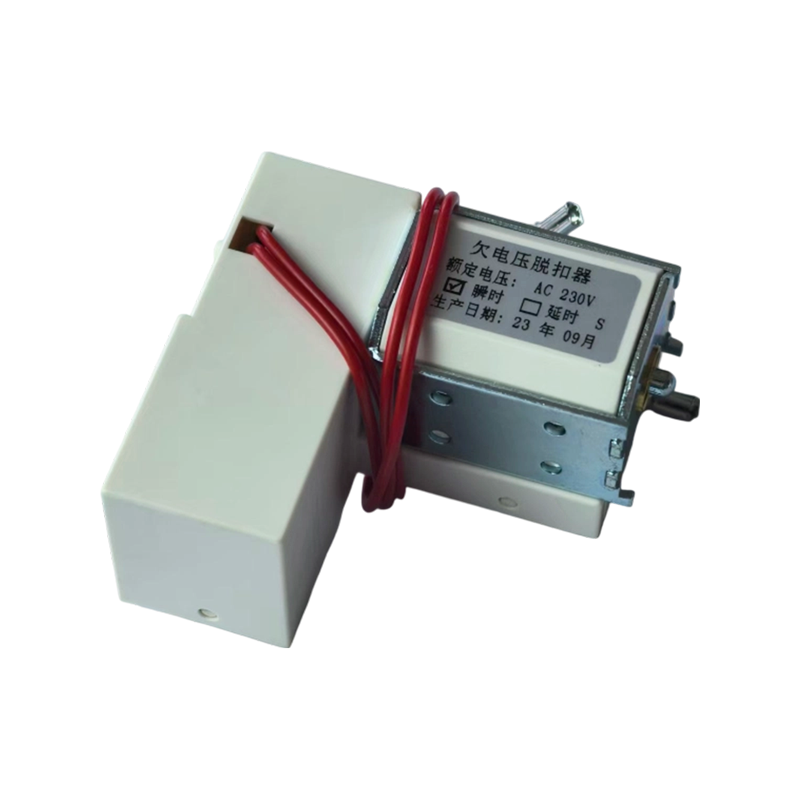
1. What Is an MCCB Undervoltage Trip Unit?
An MCCB undervoltage trip unit, also known as an undervoltage release or undervoltage trip device, is an accessory designed to monitor the control voltage of a molded case circuit breaker. When the control voltage drops below a specified threshold, the unit releases the breaker mechanism and causes the MCCB to trip or prevents the breaker from closing.
Unlike a shunt trip unit, which normally requires an intentional external energizing signal to trip the breaker, an undervoltage trip unit responds to the loss or significant reduction of its control voltage. This makes it valuable in industrial power distribution, motor control, emergency systems, generators, automation panels, and other installations where electrical equipment should not remain energized during an abnormal supply-voltage condition.
The latest IEC 60947-2:2024 standard covers circuit breakers for low-voltage applications up to 1,000 V AC or 1,500 V DC. When selecting an undervoltage accessory, B2B buyers should evaluate the complete breaker assembly, applicable product standard, control voltage, installation configuration, and target-market certification requirements.
(1) Continuous Control-Voltage Monitoring
The undervoltage unit is connected to a dedicated control circuit and normally remains energized while the control voltage is within its permitted operating range. The energized mechanism allows the breaker to remain closed or permits the breaker to be closed, depending on the specific product design.
(2) Voltage Drops Below the Operating Threshold
If the control voltage falls below the specified pickup or dropout level, the electromagnetic holding force is no longer sufficient to maintain the release mechanism. The undervoltage release then activates the breaker mechanism.
(3) MCCB Trips or Closing Is Prevented
The exact behavior depends on the breaker platform. In many designs, an undervoltage release causes the circuit breaker to open when the control voltage is lost and prevents the breaker from being closed until adequate voltage has returned. This fail-safe characteristic is useful when equipment must not restart automatically after a control-power interruption.
3. Key Specifications of MCCB Undervoltage Trip Units
For electrical distributors, panel builders, switchgear manufacturers, and OEM customers, choosing an undervoltage trip unit requires careful verification of electrical and mechanical parameters. The accessory must match the exact MCCB platform rather than simply matching the rated current.
Important technical parameters to verify before purchasing an MCCB undervoltage trip unit.
| Parameter |
Typical Consideration |
B2B Importance |
| Breaker frame |
1600A–6300A low-voltage frame breakers |
Determines mechanical compatibility |
| Control voltage |
24V, 48V, 110/120V, 220/240V AC/DC depending on model |
Must match the control power system |
| Undervoltage threshold |
Model-specific pickup and dropout levels |
Determines when the breaker responds |
| Installation |
Factory-installed or field-installable depending on breaker series |
Important for OEM and replacement projects |
Control-voltage characteristics are particularly important. For example, some current low-voltage breaker undervoltage releases operate at a nominal control voltage such as 24V, 48V, 100–130V, or 200–250V AC/DC, while the actual pickup and dropout thresholds are defined by the individual manufacturer and product family. These figures should never be assumed to be universal.
4. Why Use an Undervoltage Trip Unit in an MCCB?
(1) Protection Against Unexpected Low Voltage
Voltage instability can create operational problems for electrical equipment. An undervoltage release can disconnect the associated circuit when the control voltage falls outside the specified range, reducing the risk associated with unintended operation.
(2) Preventing Uncontrolled Restart
One important advantage is controlled restarting. If an industrial motor or machine loses control power, an undervoltage release can keep the MCCB from being reclosed until the required control voltage has returned. This can help prevent unexpected equipment startup after a power interruption.
(3) Integration With Safety and Control Systems
The undervoltage trip unit can be integrated into control architectures used in factories, switchboards, generator systems, and automated distribution equipment. Its operation can be coordinated with control relays, PLC systems, power management equipment, and other protective devices.
(4) Suitable for Large-Frame Circuit Breakers
For high-current applications such as 1600A–6300A low-voltage frame circuit breakers, remote and automatic control functions become increasingly important. A properly matched undervoltage release provides an additional control layer without replacing the MCCB's primary overload and short-circuit protection functions.
5. How to Select an MCCB Undervoltage Trip Unit for B2B Applications?
(1) Identify the Exact Circuit Breaker Model
Start by identifying the MCCB or low-voltage frame breaker manufacturer, series, frame size, rated current, number of poles, fixed or drawout configuration, and mechanism type. A 1600A accessory from one breaker family should not be assumed to fit another 1600A breaker.
(2) Confirm the Control Voltage and Frequency
Check whether the undervoltage release requires AC or DC power and confirm the nominal voltage. For AC applications, frequency can also be relevant. For example, a 220–240V AC coil designed for 50/60 Hz is fundamentally different from a 24V DC release.
(3) Check Pickup and Dropout Characteristics
The undervoltage threshold determines how the accessory responds to voltage fluctuations. Buyers should request the manufacturer's exact pickup and dropout specifications instead of using a generic percentage. For example, if a hypothetical 220V control circuit has a dropout threshold of 70%, the corresponding threshold would be approximately 154V; however, the actual value must come from the tested product specification.
(4) Verify Mechanical and Electrical Installation
Mounting dimensions, terminals, connector arrangement, actuator geometry, wiring access, and internal clearances must be checked before installation. For OEM replacement orders, providing an original accessory sample, product drawing, or detailed photographs can help the manufacturer verify compatibility.
(5) Consider Certification and Quality Control
For international procurement, buyers should evaluate the relevant IEC, UL, CSA, or other market-specific requirements. Sample testing, incoming inspection, batch traceability, insulation testing, electrical endurance testing, and production consistency should also be considered for large-volume orders.
6. MCCB Undervoltage Trip Unit Manufacturer and Wholesale Supplier
A dedicated undervoltage trip unit for 1600A–6300A low-voltage frame circuit breakers is used to provide the circuit breaker with additional undervoltage protection. For electrical distributors, switchgear manufacturers, panel builders, OEMs, and industrial maintenance companies, a reliable undervoltage accessory can support safer control and more predictable circuit breaker operation.
Jiangsu Kaiyuanfeng Electrical Machinery Manufacturing Co., Ltd. is a MCCB Undervoltage Trip Unit Manufacturer and Wholesale MCCB Undervoltage Trip Unit, established in Taizhou in August 2013 with an initial registered capital of 5 million yuan. The company specializes in key circuit breaker components and integrates R&D, design, production, sales, and service.
The company adheres to the core values of “building a solid foundation through steadiness, expanding horizons via perseverance, and forging integrity with responsibility,” and follows the founding principle of integrity, win-win collaboration, and pioneering the future. Customer requirements are incorporated throughout the R&D and manufacturing process to support practical product development.
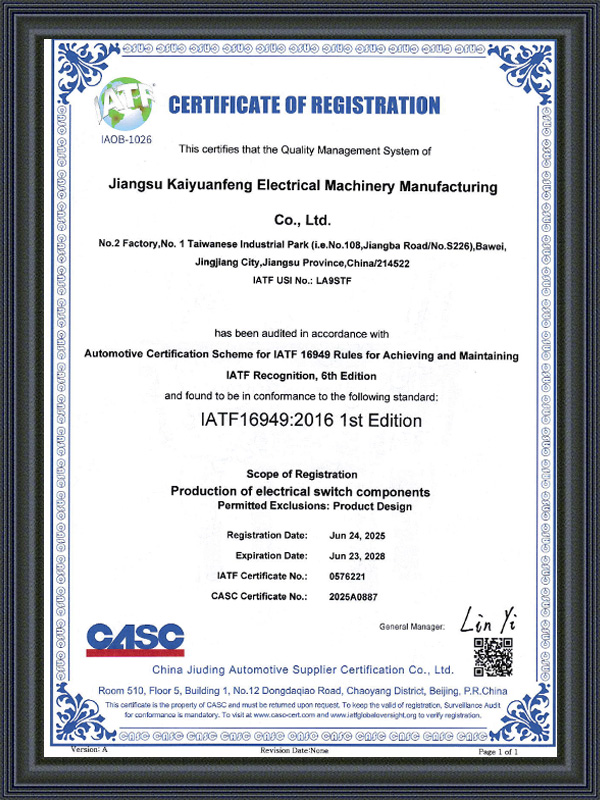
Its technological innovation is supported by 28 related patents, addressing key challenges in circuit breaker component development. The company has also obtained ISO certification and implements a management system aligned with international standards to support operational efficiency and quality assurance.
With over a decade of industry experience, Jiangsu Kaiyuanfeng Electrical Machinery Manufacturing Co., Ltd. maintains a customer-focused approach and provides reliable circuit breaker components for long-term B2B cooperation. Its development goal is to become a core supplier of key circuit breaker components while contributing to safer and more dependable electrical systems.
7. Common Questions About MCCB Undervoltage Trip Units
Q1. What is an MCCB undervoltage trip unit used for?
An MCCB undervoltage trip unit monitors a dedicated control voltage and responds when that voltage falls below the manufacturer's specified operating level. Depending on the breaker design, it can trip an already closed MCCB and prevent the breaker from closing until the control voltage returns to an acceptable level. It is commonly used for industrial equipment, motors, switchboards, generators, automated distribution systems, and applications where uncontrolled restarting must be avoided.
Q2. How does an MCCB undervoltage release work?
The undervoltage release is normally energized by its control supply. When the voltage decreases below the specified dropout threshold, the electromagnetic holding force changes and the release mechanism actuates the MCCB. The breaker then trips or its closing mechanism is prevented from operating, depending on the product design. The exact voltage thresholds and operating sequence are model-specific.
Q3. What voltage does an MCCB undervoltage trip unit use?
There is no universal voltage for all MCCB undervoltage trip units. Depending on the breaker series, control supplies can include 24V, 48V, 110/120V, 220/240V, and other AC or DC ratings. Some product families offer multiple control-voltage options. Buyers should always verify the exact rated voltage and operating range using the accessory nameplate and manufacturer's technical documentation.
Q4. What is the difference between an MCCB undervoltage trip and a shunt trip?
The main difference is the way the trip command is generated. A shunt trip normally trips the MCCB when an external voltage is intentionally applied to its coil. An undervoltage trip unit normally depends on the presence of its control voltage and responds when that voltage falls below the specified level. Therefore, a shunt trip is generally an energized-to-trip device, while an undervoltage release provides a voltage-dependent trip and closing-interlock function.
Q5. Can an MCCB undervoltage release prevent automatic restart?
Yes, depending on the circuit breaker design and control scheme. When control voltage is lost, the undervoltage release can cause the MCCB to open and may prevent it from being reclosed until sufficient control voltage is restored. This can be useful for industrial machinery and motor circuits where automatic restart after a power interruption could create operational or safety risks.
Q6. Why does my MCCB undervoltage trip unit keep tripping?
Repeated tripping can result from an unstable control power supply, excessive voltage drop in the control wiring, incorrect coil voltage, loose terminals, inadequate power capacity, damaged components, or an unsuitable undervoltage release. Measure the control voltage directly at the accessory terminals under operating conditions and compare it with the manufacturer's specified operating range. Also inspect wiring, terminals, connectors, and the breaker mechanism.
Q7. Can I install an MCCB undervoltage trip unit on an existing circuit breaker?
Some MCCB and frame circuit breaker families allow field installation of undervoltage releases, while others require the accessory to be installed or configured at the factory. Compatibility depends on the exact breaker series, frame size, mechanism, internal accessory space, and electrical configuration. For retrofit projects, confirm the manufacturer's installation instructions and use the specified accessory rather than attempting to modify the breaker mechanism.
Q8. How do I choose an undervoltage trip unit for a 1600A–6300A circuit breaker?
First identify the exact frame circuit breaker model, rated current, control voltage, AC/DC requirement, and fixed or drawout configuration. Then verify the undervoltage release's mounting dimensions, terminals, actuator design, pickup and dropout thresholds, operating characteristics, and applicable certifications. For wholesale or OEM orders, provide the supplier with an original sample or technical drawing whenever possible. This allows the manufacturer to verify mechanical and electrical compatibility before mass production.
Q9. Where can I buy wholesale MCCB undervoltage trip units?
Electrical distributors, switchgear manufacturers, panel builders, OEMs, and maintenance companies can source undervoltage trip units from specialized circuit breaker component manufacturers. For bulk procurement, buyers should evaluate not only unit price but also technical compatibility, sample approval, production capacity, quality control, certifications, packaging, lead time, customization capability, and after-sales technical support. For 1600A–6300A low-voltage frame circuit breakers, Jiangsu Kaiyuanfeng Electrical Machinery Manufacturing Co., Ltd. provides dedicated undervoltage trip units for B2B customers seeking reliable circuit breaker component solutions.

 English
  中文简体
中文简体  русский
  عربى
عربى