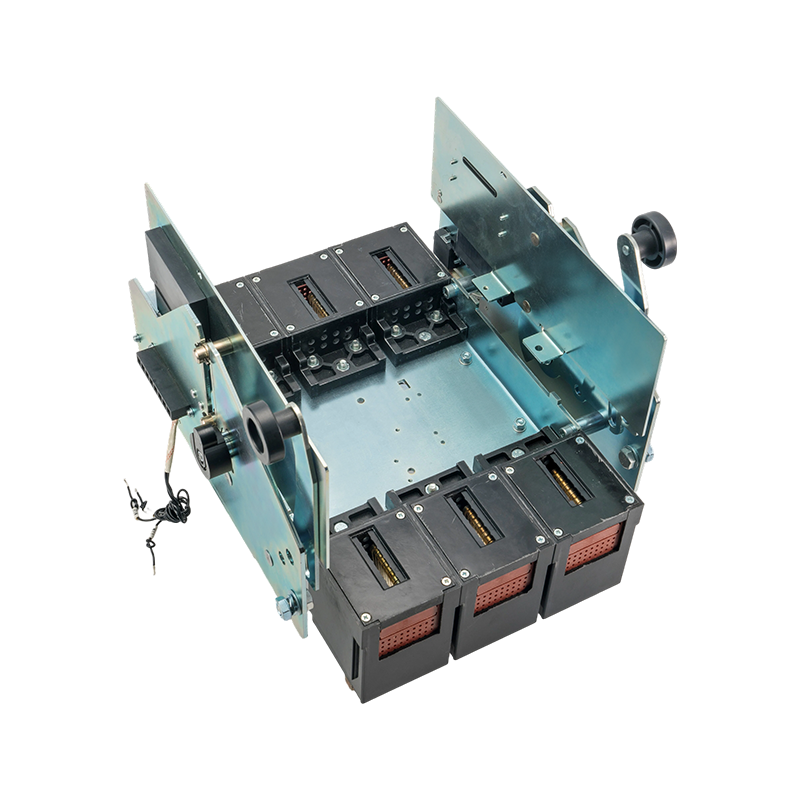
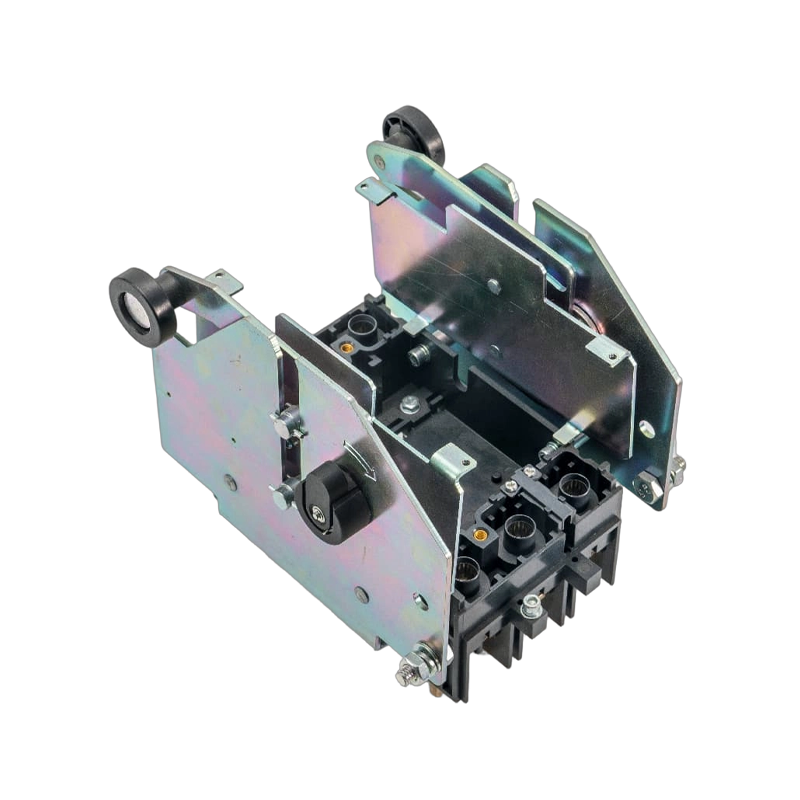
A Withdrawable Unit for MCCB is a mechanical and electrical accessory system designed to allow a molded case circuit breaker to be moved between defined operating, test, disconnected, and withdrawn positions without removing the complete circuit breaker assembly from the switchboard. Compared with a conventional fixed MCCB installation, a withdrawable configuration provides greater flexibility for inspection, maintenance, replacement, and circuit management.
For electrical panel manufacturers, switchgear OEMs, industrial facilities, commercial buildings, data centers, and system integrators, withdrawable MCCB solutions can make maintenance more structured and reduce the need to dismantle permanent power connections. The exact operating positions and interlocking functions depend on the MCCB series and withdrawable mechanism design.
When selecting a withdrawable unit, buyers should evaluate the complete system rather than the mechanism alone. MCCB frame size, rated current, pole configuration, connection arrangement, enclosure dimensions, insulation requirements, mechanical interlocking, and applicable certification all need to be considered before production or installation.
2. How Does a Withdrawable MCCB Unit Work?
(1) Fixed Mounting and Guide Structure
A withdrawable system normally uses a dedicated base, guide, cradle, chassis, or operating mechanism that supports the MCCB and controls its movement. The mechanical structure guides the breaker into the correct position and helps maintain repeatable alignment between the circuit breaker and its electrical connections.
(2) Connection and Disconnection
As the MCCB moves through its designated positions, the main circuit connections are engaged or separated according to the manufacturer's design. A properly engineered mechanism should provide controlled movement and prevent incorrect positioning. The operator should always follow the manufacturer's specified operating sequence and electrical safety procedures.
(3) Interlocking Function
Interlocking is one of the most important functions of a withdrawable MCCB system. Mechanical or electrical interlocks can be designed to prevent unsafe operating sequences, such as moving a breaker under conditions that are not permitted by the equipment design. For B2B switchgear applications, the interlocking logic should be verified against the complete panel design rather than evaluated as an isolated component.
For example, a withdrawable mechanism may be designed with defined connected, test, disconnected, and withdrawn positions. These positions allow maintenance teams to identify the condition of the circuit breaker more clearly and can help standardize service procedures across multiple panels.
3. What Are the Benefits of a Withdrawable Unit for MCCB?
Key benefits of withdrawable MCCB mechanisms for industrial and commercial switchgear applications.
| Benefit |
B2B Application Value |
| Maintenance flexibility |
Allows compatible breakers to be moved or serviced without rebuilding the complete panel assembly. |
| Reduced downtime potential |
Can simplify breaker replacement and maintenance procedures when spare units are available. |
| Interlocking |
Supports controlled operating sequences and can prevent inappropriate mechanical operations. |
| Modular design |
Useful for standardized switchboards and repeat production of electrical panels. |
The primary business value is service efficiency. In a manufacturing facility with multiple MCCBs, a standardized withdrawable design can make breaker replacement more systematic. If a spare compatible breaker is prepared in advance, maintenance teams may be able to replace the affected breaker without redesigning or rewiring the entire power distribution assembly.
Withdrawable construction can also be valuable for equipment OEMs. Instead of developing different panel structures for each maintenance scenario, manufacturers can standardize the mechanical interface around a compatible withdrawable platform. This can simplify production, spare-parts management, and field servicing across larger project volumes.
4. What Should Buyers Check When Selecting a Withdrawable MCCB Unit?
- MCCB compatibility: Confirm the exact breaker manufacturer, series, frame size, and mechanical dimensions.
- Rated current: Verify the current rating of the MCCB and ensure that the withdrawable connection system is appropriate for the application.
- Rated voltage: Check the AC or DC operating voltage and the requirements of the target market.
- Number of poles: Confirm whether the application requires 2-pole, 3-pole, 4-pole, or another configuration.
- Operating positions: Determine whether the design requires connected, test, disconnected, or withdrawn positions.
- Interlocking requirements: Specify mechanical, electrical, or safety interlocks required by the panel design.
- Connection structure: Verify primary contacts, terminal arrangement, conductor orientation, and installation dimensions.
- Material and quality: Evaluate metal strength, wear resistance, insulation components, dimensional tolerance, and contact reliability.
- Certification: Confirm applicable IEC, UL, RoHS, or other market-specific compliance requirements.
For OEM and wholesale buyers, drawings and samples can significantly reduce sourcing risks. Providing the MCCB model number, dimensional drawing, installation environment, annual purchasing volume, and destination market enables the manufacturer to evaluate the mechanism more accurately.
5. Withdrawable MCCB vs. Fixed MCCB: Which Is Better?
Comparison between withdrawable and fixed MCCB installation configurations.
| Feature |
Withdrawable MCCB |
Fixed MCCB |
| Maintenance |
Designed for easier controlled withdrawal and servicing |
Normally requires direct disconnection of the breaker |
| Mechanical complexity |
Higher due to guides, mechanisms, and interlocks |
Simpler mounting structure |
| Initial investment |
Typically higher because of additional hardware |
Generally lower for basic installations |
| Service flexibility |
High for equipment requiring frequent maintenance |
Better suited to applications with limited intervention |
There is no universal answer to which configuration is better. A fixed MCCB can be more economical for simple distribution panels where the breaker is rarely removed. A withdrawable MCCB is often more attractive where maintenance accessibility, modularity, spare-breaker replacement, and controlled operating positions provide measurable operational benefits.
6. Custom Withdrawable Device for MCCB Applications
Drawout Device (Customizable) Drawout devices feature comprehensive functionality, simple installation, and can be used with circuit breakers to implement various interlocking functions.
For B2B projects, customization can be important because MCCB frames, panel dimensions, breaker connection arrangements, and interlocking requirements can vary significantly between product platforms. A customized withdrawable device can be developed around the customer's specified mechanical dimensions, operating requirements, and compatible circuit breaker configuration.
Jiangsu Kaiyuanfeng Electrical Machinery Manufacturing Co., Ltd. is a Withdrawable Unit for MCCB Manufacturer and Wholesale Withdrawable Unit for MCCB, established in Taizhou in August 2013 with an initial registered capital of 5 million yuan. It is a manufacturer of key circuit breaker components, integrating R&D, design, production, sales, and service.
The company adheres to the core values of "building a solid foundation through steadiness, expanding horizons via perseverance, and forging integrity with responsibility", and upholds the founding principle of "integrity, win-win collaboration, and pioneering the future". Guided by the philosophy that "technological innovation drives progress and quality service supports development", customer requirements are incorporated into processes from R&D through manufacturing.
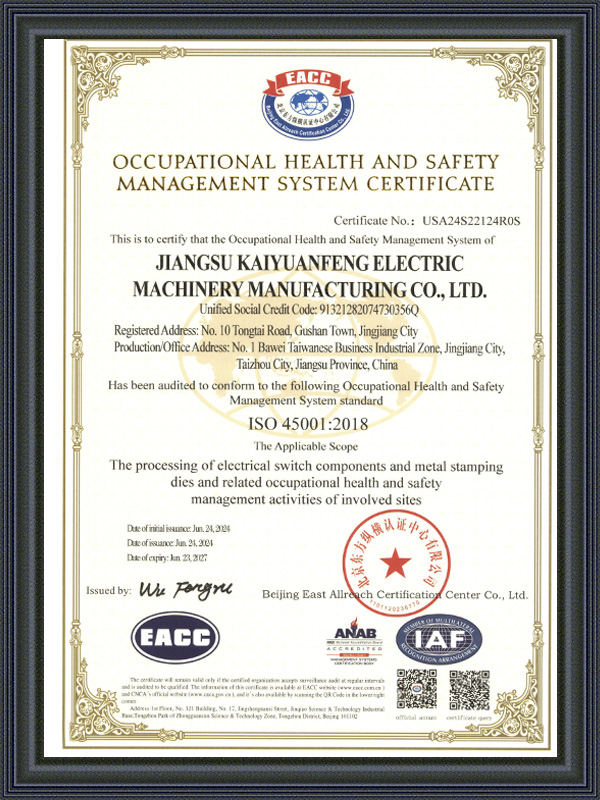
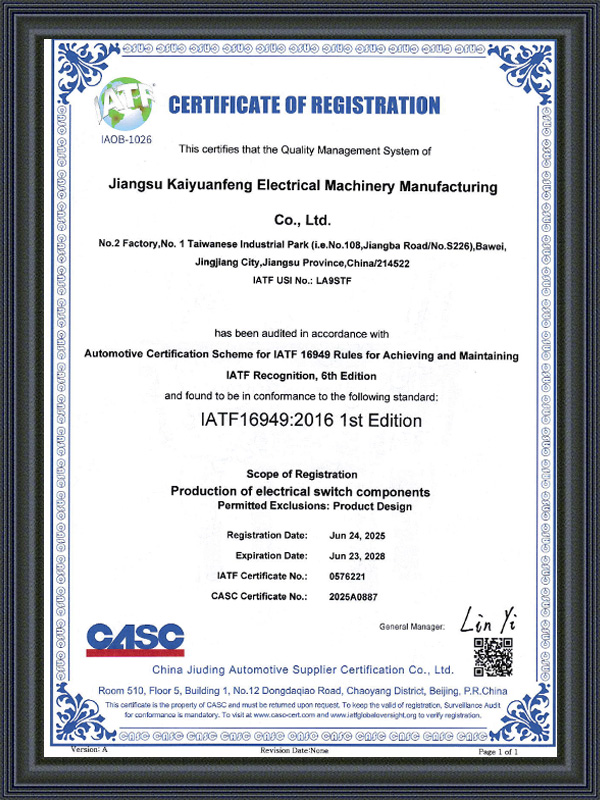
The company's innovation is supported by 28 related patents, addressing key industry challenges in circuit breaker component development. It has also obtained ISO certification and implements a management system aligned with international standards to support operational efficiency and quality assurance.
With over a decade of industry experience, Jiangsu Kaiyuanfeng Electrical Machinery Manufacturing Co., Ltd. maintains a customer-centric approach and focuses on reliable products and attentive service. For OEMs, wholesalers, switchgear manufacturers, panel builders, and electrical distributors, the company can support project-based sourcing and customized development of withdrawable MCCB components.
7. Common Questions About Withdrawable Units for MCCB
Q1. What is a withdrawable unit for MCCB?
A withdrawable unit for MCCB is a mechanical mounting and connection system that allows a compatible molded case circuit breaker to move between predefined positions. It can include a cradle, chassis, guide mechanism, primary connection system, and mechanical or electrical interlocking components. The purpose is to make circuit breaker maintenance, replacement, isolation, and inspection more convenient than with a conventional fixed installation.
Q2. What is the difference between a withdrawable MCCB and a drawout MCCB?
The terms are often used interchangeably in the electrical industry, although the exact terminology depends on the manufacturer. Both generally describe an MCCB configuration that can be moved from its connected position to a disconnected or withdrawn position using a dedicated mechanism. Buyers should focus on the manufacturer's specified operating positions, interlocking system, connection structure, and compatible breaker models rather than relying only on the terminology.
Q3. What are the advantages of a withdrawable MCCB?
The main advantages include easier maintenance, controlled breaker isolation, faster replacement potential, modular panel construction, and additional interlocking possibilities. These features are particularly valuable for industrial distribution systems where electrical equipment may require regular inspection or where maintaining a spare compatible MCCB can help reduce service disruption.
Q4. Can a withdrawable unit be used with any MCCB?
No. A withdrawable mechanism is normally designed for a specific MCCB series, frame size, pole configuration, and connection arrangement. Even two MCCBs with the same nominal current rating may have different dimensions and terminal structures. Before ordering, B2B buyers should provide the exact MCCB model, technical drawings, photographs, or samples so the manufacturer can confirm mechanical and electrical compatibility.
Q5. Is a withdrawable MCCB better for industrial applications?
A withdrawable MCCB can be highly suitable for industrial applications where maintenance accessibility, replacement efficiency, and equipment modularity are important. For example, a factory with several distribution panels may benefit from standardized withdrawable mechanisms and compatible spare breakers. However, fixed MCCBs can remain more economical for simple circuits that rarely require breaker removal. The best choice depends on lifecycle cost, maintenance requirements, panel design, and safety procedures.
Q6. What interlocking functions can a withdrawable MCCB device provide?
Depending on the design, a withdrawable device can support interlocking between the circuit breaker position and its operating condition. It may be engineered to restrict movement during prohibited conditions or coordinate the breaker with other equipment. Custom mechanisms can be developed for specific switchgear requirements. Because interlocking affects electrical safety, the exact function should always be verified against the manufacturer's technical documentation and the complete switchgear design.
Q7. What standards apply to withdrawable MCCB systems?
The applicable requirements depend on the complete MCCB and switchgear assembly, voltage level, installation environment, and destination market. IEC 60947-2:2024 is the current IEC standard covering circuit breakers within its defined low-voltage scope, including circuit breakers up to 1,000 V AC or 1,500 V DC. In the United States, MCCBs are commonly evaluated under UL 489. Buyers should confirm the exact certification requirements for the finished equipment rather than assuming that an individual mechanical accessory carries the same certification as the complete circuit breaker.
Q8. How can I order a customized withdrawable unit for MCCB?
For customized sourcing, provide the MCCB model, frame size, rated current, rated voltage, number of poles, panel dimensions, connection structure, required operating positions, interlocking requirements, material specifications, target quantity, and destination market. Technical drawings and physical samples can make the engineering evaluation more accurate. For OEM and wholesale orders, also specify expected annual demand and packaging requirements so the manufacturer can evaluate production capacity and long-term supply.

 English
  中文简体
中文简体  русский
  عربى
عربى