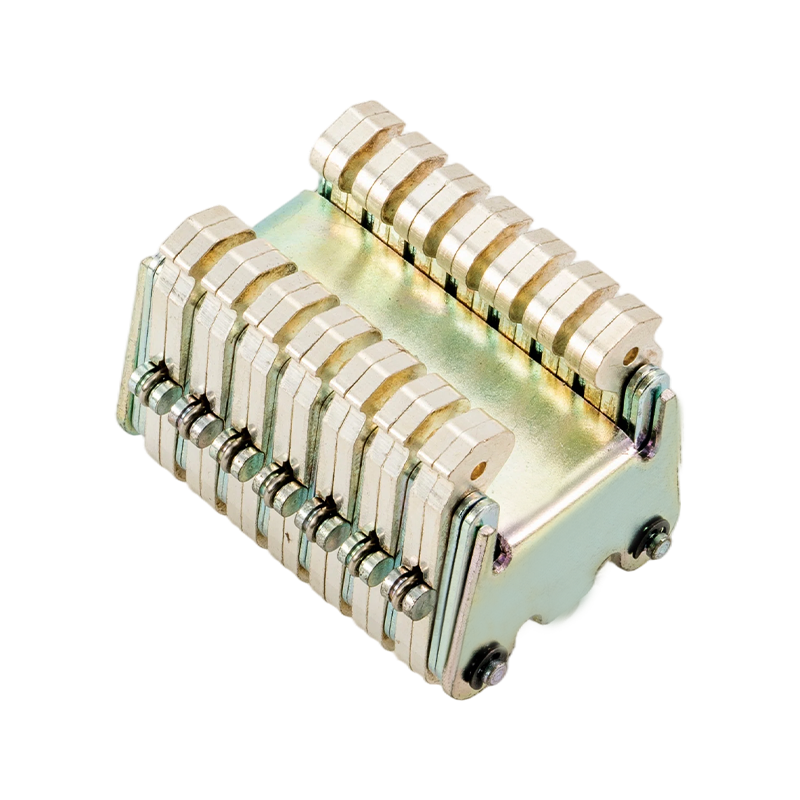
An MCCB Bridge Contact Assembly is a conductive mechanical assembly used inside a molded case circuit breaker (MCCB) to establish and maintain an electrical connection between corresponding stationary contact points during the ON state. It is typically integrated with the moving contact system and operating mechanism, allowing the breaker to carry normal load current and interrupt the circuit when the contacts separate.
For circuit breaker manufacturers, OEMs, panel builders, and electrical component distributors, the bridge contact assembly is more than a simple copper component. Its geometry, contact pressure, conductivity, surface condition, mechanical strength, and dimensional consistency can directly influence contact resistance, temperature rise, switching reliability, and service life.
The current international reference for low-voltage circuit breakers is IEC 60947-2:2024, the sixth edition published in September 2024. It applies to circuit breakers with rated voltages up to 1,000 V AC or 1,500 V DC within its defined scope. In North American applications, MCCBs are commonly evaluated against UL 489, covering molded-case circuit breakers, molded-case switches, and circuit-breaker enclosures.
2. Why Is the MCCB Bridge Contact Assembly Important?
(1) Stable Current-Carrying Performance
The bridge contact creates a low-resistance electrical path when the MCCB is closed. Even a small increase in contact resistance can become important at high operating currents because electrical heat generation follows the relationship P = I²R. For example, at 400 A, an additional 100 μΩ of resistance produces approximately 16 W of localized heat. This demonstrates why contact surface quality and dimensional accuracy matter in high-current MCCB designs.
(2) Reliable Switching and Contact Pressure
A properly engineered bridge contact assembly must maintain sufficient contact force while accommodating repeated opening and closing operations. Excessive pressure can increase mechanical wear, while insufficient pressure may cause unstable electrical contact, localized heating, or premature surface degradation.
(3) Support for Short-Circuit Performance
During a short-circuit event, MCCB contacts are exposed to very high electromagnetic forces and severe thermal stress. The bridge contact assembly therefore needs suitable mechanical strength, accurate positioning, and compatibility with the complete contact system. The actual short-circuit rating must always be verified as part of the complete breaker design rather than inferred from the contact material alone.
3. Key Specifications for Wholesale MCCB Bridge Contact Assemblies
When purchasing bridge contact assemblies in bulk, engineering teams should evaluate the component according to the final MCCB design instead of selecting solely by nominal dimensions. Important specifications include material, conductivity, plating, contact geometry, mounting dimensions, operating mechanism compatibility, and production tolerances.
Typical engineering factors for specifying MCCB bridge contact assemblies.
| Specification |
What Buyers Should Check |
Why It Matters |
| Base material |
Copper grade, conductivity, mechanical strength |
Affects current carrying and thermal performance |
| Contact surface |
Contact material, plating, surface finish |
Influences contact resistance and wear |
| Dimensions |
Hole position, thickness, width, overall geometry |
Ensures assembly compatibility |
| Mechanical performance |
Contact force, alignment, operating endurance |
Supports reliable switching |
4. Materials and Manufacturing Considerations
(1) Copper and Copper Alloys
Copper is widely used for conductive components because it combines high electrical conductivity with good manufacturability. Depending on the MCCB architecture, different copper grades or copper alloys may be selected to balance conductivity, hardness, strength, and forming performance.
(2) Contact Material and Surface Treatment
The actual contact interface may use a dedicated contact material or surface treatment designed for the electrical and mechanical requirements of the breaker. Plating and surface finishing can help control oxidation, wear, and contact resistance, but the appropriate specification depends on the MCCB's current rating, switching duty, environmental conditions, and certification requirements.
(3) Precision Manufacturing
Stamping, bending, machining, riveting, welding, and assembly may all be involved depending on the design. For OEM production, dimensional consistency is especially important. A bridge contact that is only slightly misaligned can influence contact pressure or create uneven electrical loading across multiple poles.
For B2B buyers, supplier evaluation should focus on engineering capability and repeatable quality rather than unit price alone. A reliable supplier should be able to provide dimensional drawings, material specifications, production samples, inspection records, and traceable quality-control procedures when required.
- Confirm the exact MCCB frame, pole configuration, and compatible contact mechanism.
- Define copper or alloy grade and required surface treatment.
- Confirm critical dimensions, tolerances, mounting holes, and contact geometry.
- Request samples before mass production when the component is customized.
- Review inspection procedures for dimensions, appearance, assembly consistency, and electrical performance where applicable.
- Verify the component against the applicable complete-breaker certification and test requirements.
IEC 60947-2:2024 has introduced and revised several technical requirements, including changes related to isolation suitability, dielectric testing, ground-fault overcurrent releases, individual-pole breaking-capacity testing, EMC, and measurement of power loss. Therefore, component suppliers should work from the latest applicable technical documentation supplied by the breaker manufacturer.
6. Jiangsu Kaiyuanfeng Electrical Machinery Manufacturing Co., Ltd. – MCCB Bridge Contact Assembly Manufacturer
Jiangsu Kaiyuanfeng Electrical Machinery Manufacturing Co., Ltd. is a manufacturer and wholesale supplier of MCCB Bridge Contact Assembly, established in Taizhou in August 2013 with an initial registered capital of 5 million yuan. The company specializes in key circuit breaker components and integrates R&D, design, production, sales, and service.
The company follows the core values of building a solid foundation through steadiness, expanding horizons through perseverance, and forging integrity with responsibility. Its operating philosophy emphasizes integrity, win-win collaboration, technological innovation, and customer-oriented service. Customer requirements are incorporated into processes ranging from product development and engineering to manufacturing and quality control.
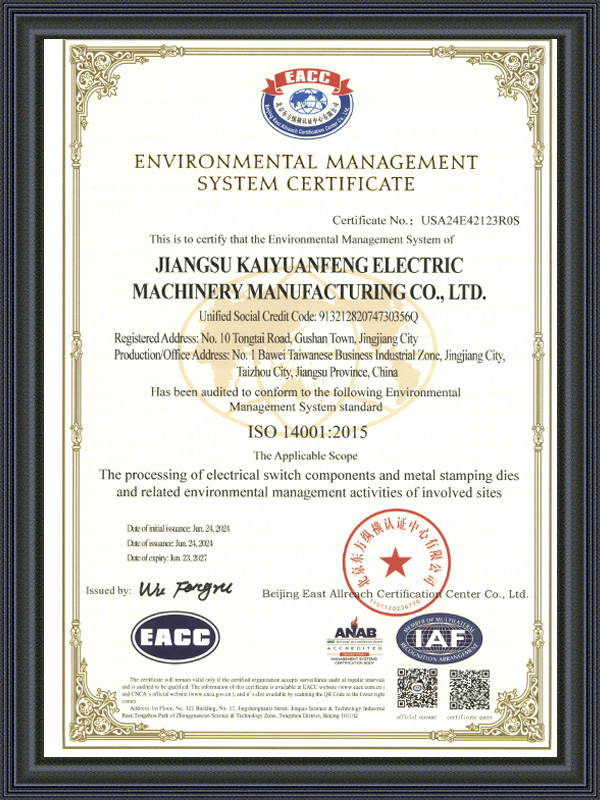
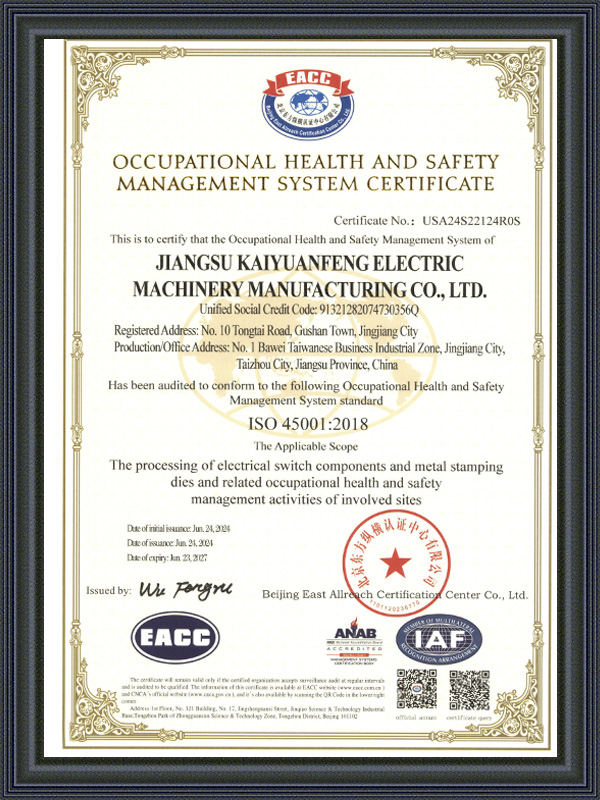
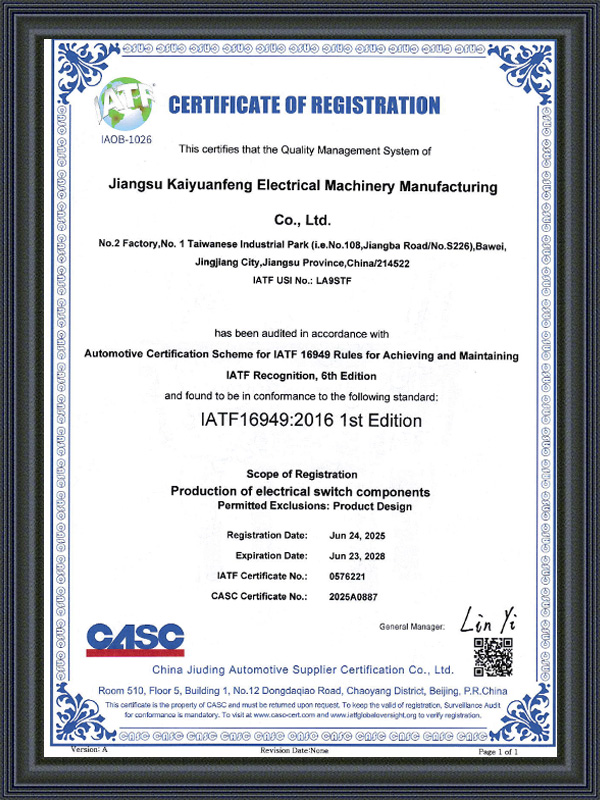
With 28 related patents supporting its innovation activities and an ISO-certified management system aligned with international standards, the company focuses on improving process consistency and quality assurance. With more than a decade of industry experience, Jiangsu Kaiyuanfeng Electrical Machinery Manufacturing Co., Ltd. serves customers seeking reliable MCCB components and long-term OEM or wholesale cooperation.
For customized bridge contact assemblies, buyers can provide drawings, samples, MCCB frame specifications, material requirements, or application information. This allows the engineering team to evaluate dimensions, contact structure, production processes, and quality-control requirements before volume production.
7. MCCB Bridge Contact Assembly Applications and B2B Procurement
MCCB bridge contact assemblies are relevant to manufacturers and distributors of low-voltage power distribution equipment, industrial control systems, switchboards, electrical panels, building power systems, machinery, renewable-energy equipment, and other applications using molded case circuit breakers.
Typical B2B customer requirements when sourcing bridge contact assemblies.
| Buyer Type |
Typical Requirement |
Supplier Capability |
| MCCB Manufacturer |
Stable quality and repeatable dimensions |
OEM production and process control |
| Electrical Distributor |
Consistent wholesale supply |
Batch production and quality assurance |
| Panel Builder |
Compatible replacement or assembly components |
Customized dimensions and specifications |
| OEM/ODM Buyer |
Design adaptation and long-term supply |
Engineering support from sample to mass production |
8. Frequently Asked Questions About MCCB Bridge Contact Assembly
Q1. What does an MCCB bridge contact assembly do?
An MCCB bridge contact assembly provides the conductive connection between contact points when the breaker is closed. It works together with moving contacts, stationary contacts, springs, the operating mechanism, and arc-control components. Its electrical and mechanical performance affects current conduction, contact resistance, temperature rise, switching reliability, and overall breaker performance.
Q2. What material is commonly used for MCCB bridge contacts?
Copper and copper alloys are common choices for conductive MCCB components because of their combination of electrical conductivity, mechanical strength, and manufacturability. However, the correct material depends on the breaker design, current rating, contact structure, temperature requirements, mechanical duty, and surface-treatment specification. Buyers should follow the OEM engineering specification rather than selecting material only by conductivity.
Q3. How does contact resistance affect MCCB performance?
Contact resistance generates heat according to P = I²R. For example, at 400 A, 100 μΩ of resistance corresponds to approximately 16 W of heat at that connection. This is why consistent contact pressure, clean contact surfaces, suitable materials, accurate assembly, and stable manufacturing tolerances are important for high-current MCCB applications.
Q4. How do I choose a wholesale MCCB bridge contact assembly supplier?
Choose a supplier that can demonstrate relevant manufacturing experience, stable raw-material control, dimensional inspection, process traceability, engineering support, and consistent batch quality. For customized components, request drawings and samples for approval before mass production. It is also important to ensure that the component is designed and tested as part of the complete MCCB in accordance with the applicable market standard.
Q5. Can an MCCB bridge contact assembly be customized?
Yes. Depending on the manufacturer's capabilities, bridge contact assemblies can be customized according to drawings or samples. Common customization factors include copper grade, thickness, width, hole location, contact geometry, plating, surface treatment, bending dimensions, and assembly configuration. A complete technical drawing and the intended MCCB frame information can significantly improve quotation and sample-development accuracy.
Q6. What standards apply to MCCB bridge contact assemblies?
The applicable requirements depend on the market and complete breaker design. IEC 60947-2:2024 is the current IEC standard for low-voltage circuit breakers within its scope, covering equipment up to 1,000 V AC or 1,500 V DC under specified conditions. In the United States, UL Solutions identifies UL 489 as the standard used for molded-case circuit breakers, molded-case switches, and circuit-breaker enclosures. Component requirements should therefore be evaluated within the certification and testing framework of the complete MCCB.
Q7. What information should I provide when requesting an MCCB bridge contact assembly quotation?
For an accurate B2B quotation, provide the MCCB model or frame size, pole number, rated current, available drawings or samples, material requirements, surface treatment, annual or order quantity, target market, packaging requirements, and required delivery schedule. If the component is part of a new MCCB design, also provide the relevant contact-system requirements so the supplier can assess manufacturability and engineering compatibility.
Q8. Why is dimensional accuracy important for an MCCB bridge contact assembly?
Dimensional accuracy determines whether the bridge contact assembly fits correctly with the operating mechanism and contact system. Incorrect hole positions, thickness, bending angles, or contact alignment can change contact pressure and increase resistance or mechanical wear. For mass production, controlling critical dimensions consistently across batches is therefore essential to maintaining reliable MCCB assembly performance.

 English
  中文简体
中文简体  русский
  عربى
عربى