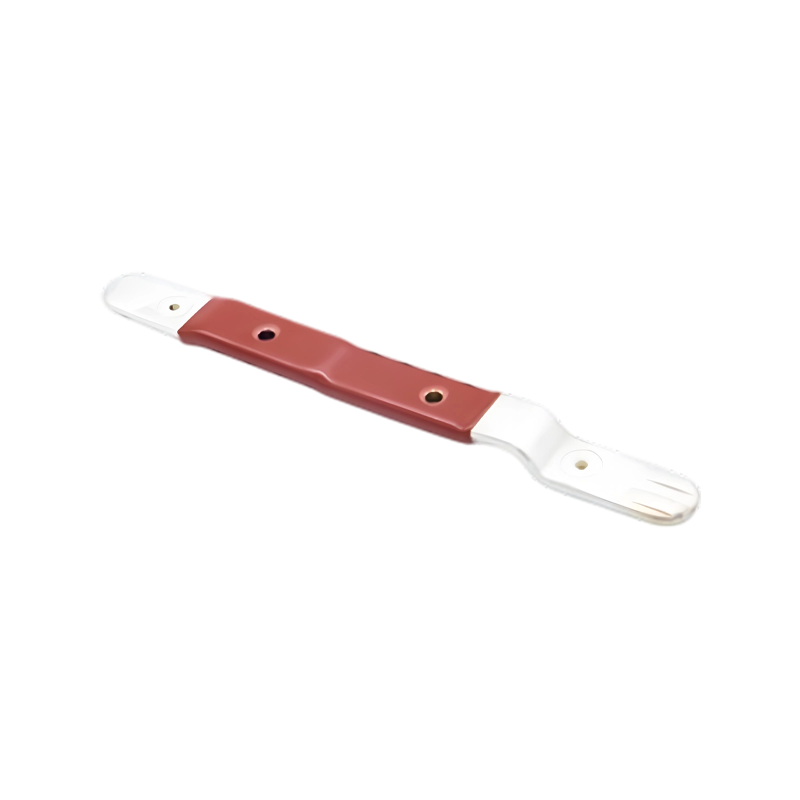
RMU Disconnect Knife Contacts are precision conductive components used in Ring Main Units (RMUs) and medium-voltage switchgear to establish or separate electrical connections during switching operations. Often integrated into disconnectors, load-break switches, or related switching mechanisms, knife contacts provide a controlled conductive interface between stationary and moving contact sections.
For OEM switchgear manufacturers, electrical equipment distributors, utility contractors, and replacement-parts suppliers, contact quality directly influences contact resistance, temperature rise, switching reliability, mechanical endurance, and long-term service performance. Current IEC requirements for AC disconnectors and earthing switches above 1 kV are covered by IEC 62271-102:2018 with Amendment 1:2022, while metal-enclosed switchgear assemblies up to and including 52 kV are addressed by IEC 62271-200:2021 with Amendment 1:2024.
2. Why Are Disconnect Knife Contacts Important in RMUs?
(1) Stable Electrical Conductivity
The contact interface must provide a low-resistance electrical path when the RMU is in the connected position. Copper and copper alloys are commonly selected for conductive components because they combine good electrical conductivity with mechanical strength and manufacturability. Surface treatment such as silver plating may also be specified according to the contact design and operating environment.
The relationship between current and resistive heating can be expressed as P = I²R. For example, at 630 A, a 20 μΩ contact resistance produces approximately 7.9 W of theoretical resistive loss at that interface, while 10 μΩ produces about 4.0 W. Although actual RMU performance depends on the complete assembly, this example demonstrates why consistent contact pressure and surface quality matter.
(2) Reliable Mechanical Switching
A knife contact must move smoothly and accurately between connected and disconnected positions. Contact alignment, spring force, insertion depth, contact geometry, dimensional tolerance, and operating mechanism compatibility all affect switching performance. Poor alignment can increase wear and contact resistance, potentially reducing the service life of the switching assembly.
(3) Support for Safe Isolation
Disconnectors have an important role in providing an isolating function within medium-voltage equipment. IEC 62271-102 includes requirements related to isolating distance, position indication, mechanical interlocking, testing, and other functional characteristics. Therefore, the knife contact should always be designed as part of the complete RMU switching system rather than treated as an independent copper component.
Key technical factors B2B buyers should confirm when sourcing RMU disconnect knife contacts.
| Parameter |
Typical Requirement to Confirm |
Why It Matters |
| Rated Voltage |
RMU system voltage and insulation requirements |
Determines suitability for the complete switchgear |
| Rated Current |
For example, 200 A, 400 A, 630 A or project-specific values |
Influences conductor size and thermal performance |
| Contact Material |
Copper, copper alloy, plating and contact material |
Affects conductivity, wear and corrosion resistance |
| Dimensions |
Thickness, width, length, holes, bending and tolerances |
Ensures mechanical and electrical compatibility |
4. Manufacturing Process of RMU Knife Contacts
(1) Copper and Alloy Processing
Professional manufacturers can use cutting, punching, CNC machining, bending, forming, drilling, deburring, and other precision processes according to the contact design. For OEM production, dimensional repeatability is particularly important because even small variations in the contact interface can influence insertion force and electrical performance.
(2) Contact Surface Treatment
The contact surface may require plating or other controlled finishing processes. The appropriate treatment depends on current rating, contact pressure, environmental conditions, operating frequency, and the electrical and mechanical design of the RMU. Buyers should specify plating thickness, coverage, substrate material, and inspection requirements when these parameters are critical to the application.
(3) Inspection and Assembly Control
- Dimensional and tolerance inspection
- Material and surface-treatment verification
- Contact alignment and mating inspection
- Mechanical movement and operating-force checks where required
- Electrical resistance or related performance testing according to the customer's specification
5. How to Select an RMU Disconnect Knife Contact Supplier?
B2B purchasers should evaluate RMU knife contacts based on technical compatibility, manufacturing capability, quality consistency, and total procurement cost rather than unit price alone. A supplier that can provide engineering support and customized production can reduce the risk of repeated sample modifications and assembly problems.
- Provide the RMU model, rated voltage, rated current, and application environment.
- Submit engineering drawings showing dimensions, hole positions, contact geometry, and tolerances.
- Specify copper or alloy requirements, plating, surface finish, and corrosion-resistance expectations.
- Request samples for dimensional and assembly verification before bulk production.
- Confirm MOQ, production capacity, quality inspection, packaging, delivery schedule, and export documentation.
For example, if an RMU manufacturer purchases 1,000 contact sets per month, a supplier with stable process control can provide significantly more value than a low-cost supplier that generates a 2% dimensional rejection rate. At 1,000 sets, a 2% rejection rate represents 20 sets requiring rework, replacement, or additional inspection in a single month.
6. Jiangsu Kaiyuanfeng Electrical Machinery Manufacturing Co., Ltd. for RMU Disconnect Knife Contacts
Jiangsu Kaiyuanfeng Electrical Machinery Manufacturing Co., Ltd. is a RMU Disconnect Knife Contacts Manufacturer and Wholesale RMU Disconnect Knife Contacts supplier, established in Taizhou in August 2013 with an initial registered capital of 5 million yuan. The company specializes in key circuit breaker components and integrates R&D, design, production, sales, and service.
The company adheres to the core values of “building a solid foundation through steadiness, expanding horizons via perseverance, and forging integrity with responsibility” and the founding principle of “integrity, win-win collaboration, and pioneering the future.” Customer requirements are incorporated into processes from R&D through manufacturing, while technological innovation is supported by 28 related patents addressing key industry challenges.
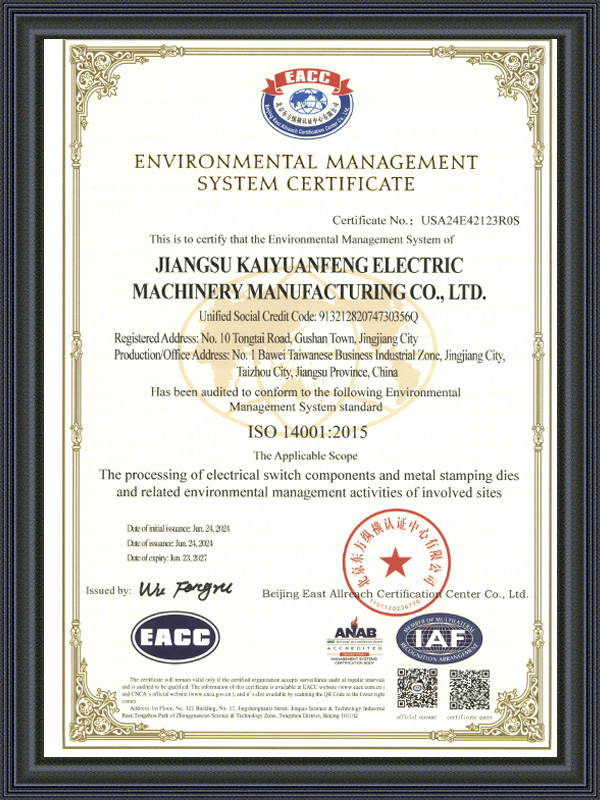
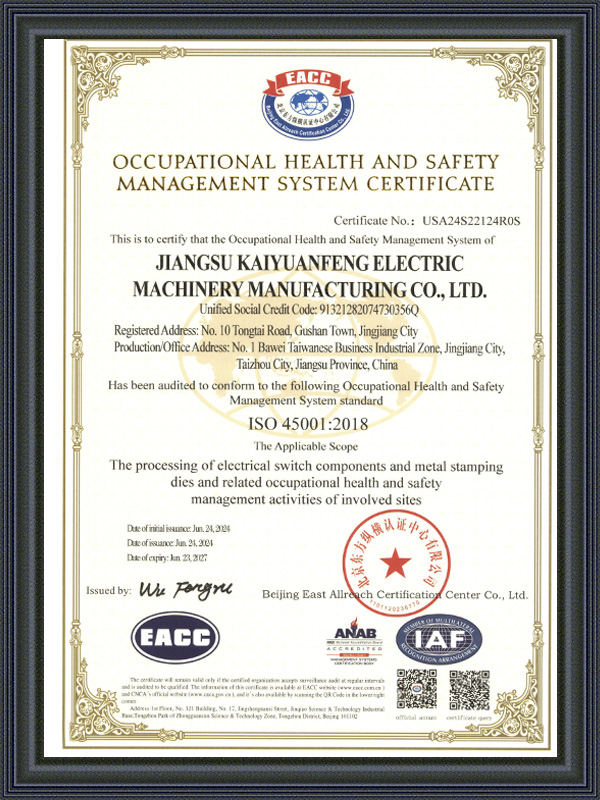
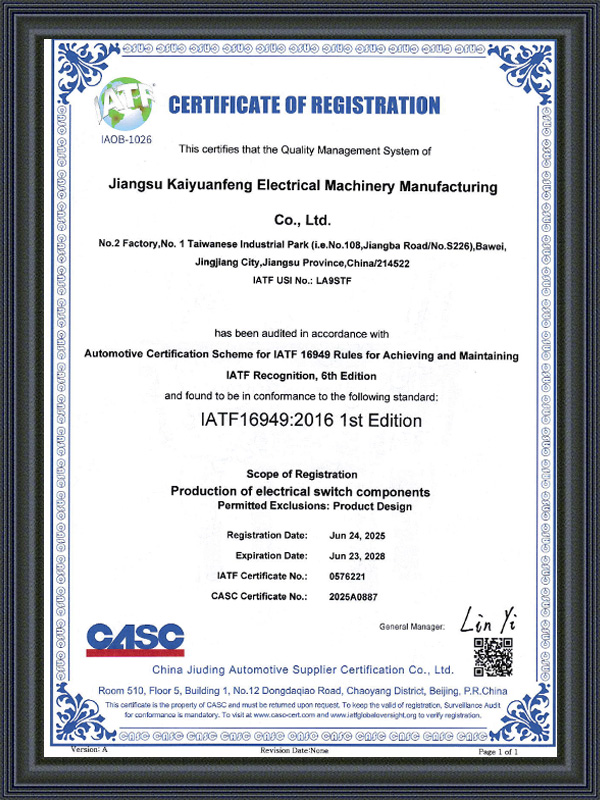
Jiangsu Kaiyuanfeng has obtained ISO certification and implements a management system aligned with international standards to support operational efficiency and quality assurance. With more than a decade of industry experience, the company focuses on reliable circuit breaker components, customized manufacturing, attentive service, and long-term B2B partnerships.
7. Common Questions About RMU Disconnect Knife Contacts
Q1. What are RMU disconnect knife contacts used for?
RMU disconnect knife contacts are used to establish or separate conductive paths inside medium-voltage Ring Main Units and related switchgear. They work with stationary contacts and the operating mechanism to provide controlled electrical connection and disconnection. Their geometry, contact pressure, material, and surface finish must match the complete RMU design.
Q2. What material is commonly used for RMU knife contacts?
Copper and copper alloys are common choices because of their combination of electrical conductivity, mechanical strength, and manufacturability. Depending on the design, the contact area may receive silver or another specified surface treatment. The correct material should be selected according to current rating, mechanical requirements, environmental conditions, and OEM specifications.
Q3. How do I choose the correct RMU disconnect contact?
Confirm the RMU brand and model, rated voltage, rated current, contact structure, dimensions, mounting configuration, contact material, plating, and operating mechanism. For replacement or OEM production, supplying a detailed drawing or physical sample is strongly recommended because visually similar contacts can have different insertion depths, hole positions, spring requirements, and mating dimensions.
Q4. Can RMU disconnect knife contacts be customized?
Yes. Customized RMU knife contacts can be manufactured according to drawings, samples, or technical specifications. Common customization requirements include contact length, width, thickness, bending angle, hole location, contact profile, copper grade, surface treatment, and assembly configuration. OEM buyers should confirm tolerances and inspection criteria before mass production.
Q5. Why does contact resistance matter in an RMU?
Contact resistance determines how much heat is generated when current passes through the connection. Since resistive loss follows P = I²R, higher current magnifies the effect of resistance. For example, reducing a theoretical 20 μΩ resistance to 10 μΩ at 630 A reduces the calculated resistive loss from approximately 7.9 W to 4.0 W at that connection. Actual results depend on the complete assembly and test conditions.
Q6. Which IEC standard applies to RMU disconnectors and knife contacts?
For AC disconnectors and earthing switches above 1 kV, buyers should consider IEC 62271-102:2018 with Amendment 1:2022. For AC metal-enclosed switchgear and controlgear assemblies above 1 kV and up to and including 52 kV, IEC 62271-200:2021 with Amendment 1:2024 is the current IEC publication. The exact compliance requirements depend on the complete equipment, voltage level, installation conditions, and applicable local regulations.
Q7. What information should I send to a manufacturer for an RMU contact quotation?
For an accurate quotation, provide the RMU model, rated voltage and current, contact drawings, dimensions, material, surface-treatment requirements, annual or monthly quantity, sample requirements, packaging, destination country, and delivery schedule. If drawings are unavailable, photographs plus a physical sample and detailed measurements can help the manufacturer evaluate the component.
Q8. What should I check when buying RMU knife contacts wholesale?
Wholesale buyers should check material consistency, dimensional tolerances, plating quality, contact alignment, mechanical fit, batch traceability, inspection procedures, MOQ, production capacity, lead time, packaging, and technical support. For recurring orders, an approved drawing and defined inspection standard can help maintain consistent quality between production batches and reduce the risk of field or assembly failures.

 English
  中文简体
中文简体  русский
  عربى
عربى