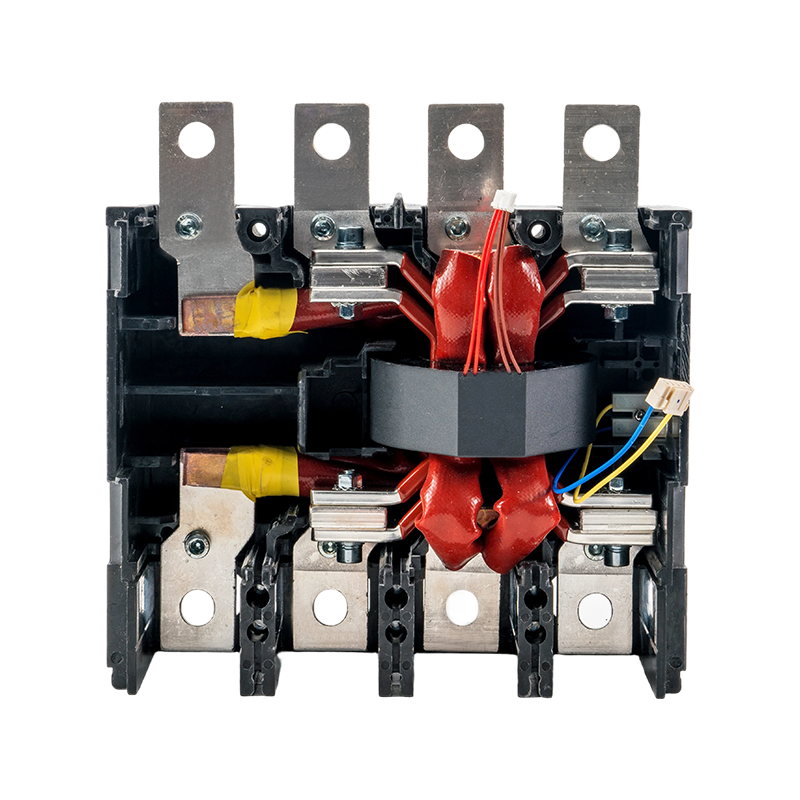
An RCD Leakage Protection Module for MCCB is an accessory designed to add residual current protection to a compatible molded case circuit breaker. RCD technology detects current flowing through an unintended path, such as leakage to earth, and can initiate a trip when the residual current reaches the module's specified operating threshold. This extends the protection function of an MCCB beyond conventional overload and short-circuit protection.
For electrical panel manufacturers, industrial automation companies, switchgear OEMs, commercial building contractors, and electrical distributors, integrating residual current protection with an MCCB can help create a more comprehensive protection solution. The module must be matched to the MCCB's frame, poles, rated current, voltage, trip mechanism, and installation structure.
RCD protection should not be confused with overload protection. An MCCB thermal-magnetic or electronic trip unit primarily addresses excessive current, while residual current protection focuses on current imbalance associated with leakage to earth. In a properly engineered system, these functions work together rather than replacing one another.
2. How Does an RCD Leakage Protection Module Work with MCCB?
(1) Residual Current Detection
The module monitors the current balance of the circuit through an appropriate sensing arrangement. Under normal conditions, the current flowing through the conductors is balanced. When part of the current returns through an unintended path, such as protective earth, a residual current is detected.
(2) Leakage Current Evaluation
When the detected residual current reaches the configured or specified operating threshold, the RCD module sends a trip command to the MCCB mechanism. Depending on the product design, the protection system may provide instantaneous or time-delayed residual current protection for different applications.
(3) MCCB Tripping
The MCCB opens its contacts to interrupt the affected circuit. This coordinated operation allows one protection assembly to address multiple electrical hazards. For example, an MCCB can provide protection against a 250 A overload while the residual current module may be configured for a much lower leakage-current threshold appropriate to the system and applicable protection requirements.
The exact trip threshold, time delay, sensing method, frequency range, and compatibility must always be verified from the technical specification of the specific RCD module and MCCB combination.
3. Why Add Residual Current Protection to an MCCB?
Comparison of common protection functions in an MCCB system with an RCD leakage protection module.
| Protection Function |
Primary Purpose |
Typical Application Value |
| Overload protection |
Protects against excessive sustained current |
Cable and equipment protection |
| Short-circuit protection |
Interrupts high fault current |
Protection against severe electrical faults |
| Residual current protection |
Detects current leakage to earth |
Additional protection against leakage-related hazards |
The key advantage is complementary protection. An overload of 180 A on a 160 A MCCB, for example, is fundamentally different from a 30 mA residual current caused by an insulation fault. The first is an overcurrent condition; the second involves current leaving the intended circuit path. Combining suitable protection functions helps engineers address both scenarios.
For industrial equipment manufacturers, an integrated RCD module can also reduce the need for separate protection devices where the MCCB platform supports the required configuration. This can help simplify panel architecture, provided that coordination, certification, creepage and clearance, wiring, and thermal requirements are properly evaluated.
- MCCB compatibility: Confirm the exact MCCB series, frame size, rated current, pole configuration, and trip mechanism.
- Residual operating current: Select the appropriate residual current threshold according to the application, system design, and applicable regulations.
- Time delay: Determine whether instantaneous or selective/time-delayed residual current protection is required.
- Rated voltage: Check the AC voltage, frequency, and system configuration supported by the module.
- Number of poles: Ensure that the sensing and protection architecture matches the 2-pole, 3-pole, 4-pole, or other MCCB configuration.
- Installation method: Verify internal mounting space, connection terminals, mechanical interface, and operating mechanism compatibility.
- Temperature performance: Evaluate temperature rise, enclosure conditions, ambient temperature, and current-carrying performance.
- Certification: Confirm IEC, UL, RoHS, or other compliance requirements according to the destination market and final equipment.
For OEM and wholesale procurement, buyers should provide the manufacturer's MCCB model number and technical drawing whenever possible. A module that appears mechanically similar may still have different electrical characteristics, trip interfaces, or sensing requirements.
5. What Applications Use MCCB RCD Leakage Protection Modules?
RCD leakage protection modules can be considered for a broad range of low-voltage distribution and equipment protection applications where residual current protection is required in conjunction with MCCB overcurrent protection.
- Industrial motor control and distribution panels
- Commercial building distribution boards
- Manufacturing equipment and machine control panels
- HVAC and building services electrical systems
- Power distribution equipment requiring additional earth-leakage protection
- OEM switchgear and customized circuit breaker assemblies
The correct residual current threshold depends on the intended protection objective. Values such as 30 mA, 100 mA, 300 mA, or higher may appear in different RCD applications, but the appropriate setting must be determined by the electrical system designer based on the applicable standard, equipment characteristics, leakage currents, and coordination requirements. These values should not be treated as universally interchangeable.
6. Customized RCD Residual Current Module Assemblies for MCCB
RCD residual current module assemblies (customized) feature a compact design with innovative insulation treatment and connection methods, supporting consistent insulation performance and low temperature rise.
For B2B customers, customized construction can be important because MCCB internal space, mounting interfaces, electrical terminals, and trip mechanisms differ among product families. An engineered module can be developed around the customer's specified MCCB model, electrical parameters, installation dimensions, and production requirements.
Jiangsu Kaiyuanfeng Electrical Machinery Manufacturing Co., Ltd. is a RCD Leakage Protection Module for MCCB Manufacturer and Wholesale RCD Leakage Protection Module for MCCB, established in Taizhou in August 2013 with an initial registered capital of 5 million yuan. It is a manufacturer of key circuit breaker components, integrating R&D, design, production, sales, and service.
The company adheres to the core values of "building a solid foundation through steadiness, expanding horizons via perseverance, and forging integrity with responsibility", and upholds the founding principle of "integrity, win-win collaboration, and pioneering the future". Guided by the philosophy that "technological innovation drives progress and quality service supports development", customer requirements are incorporated into processes from R&D through manufacturing.
Its innovation is supported by 28 related patents, addressing key industry challenges in circuit breaker component development. The company has obtained ISO certification and implements a management system aligned with international standards to support operational efficiency and quality assurance.
With over a decade of industry experience, Jiangsu Kaiyuanfeng Electrical Machinery Manufacturing Co., Ltd. maintains a customer-centric approach, focusing on reliable products and attentive service to build long-term partnerships. The company aims to become a core supplier of key circuit breaker components and support customers seeking reliable RCD module assemblies for MCCB OEM and wholesale applications.
7. Common Questions About RCD Leakage Protection Modules for MCCB
Q1. What is an RCD leakage protection module for MCCB?
An RCD leakage protection module for MCCB is an accessory assembly that detects residual current and can cause a compatible molded case circuit breaker to trip when the residual current reaches its specified operating level. It adds residual current protection to the MCCB's existing overcurrent and short-circuit protection functions. The module is normally designed for a specific MCCB family and should be selected according to the manufacturer's technical specifications.
Q2. What is the difference between an MCCB and an RCD?
An MCCB primarily protects electrical circuits from overloads and short circuits, while an RCD focuses on residual current caused by current flowing through an unintended path. An RCD module integrated with or connected to a compatible MCCB can combine these protection functions in one coordinated assembly. However, the exact capabilities depend on the specific MCCB and RCD module design.
Q3. What residual current rating should I choose for an MCCB RCD module?
There is no single residual current rating suitable for every application. Depending on the protection objective and local requirements, RCD products may use thresholds such as 30 mA for certain additional protection applications or higher values such as 100 mA and 300 mA for other system protection purposes. The correct selection depends on the installation standard, equipment leakage current, system grounding arrangement, coordination requirements, and protection objective. Engineers should select the threshold based on the complete electrical design rather than simply choosing the lowest value.
Q4. Can an RCD module be installed on any MCCB?
No. RCD modules are typically designed for specific MCCB series, frame sizes, pole configurations, and trip mechanisms. The sensing circuit, internal installation space, electrical connection, and mechanical trip interface must all be compatible. Before purchasing in bulk, OEMs and wholesalers should provide the exact MCCB model, drawings, electrical specifications, and sample where available so the manufacturer can verify compatibility.
Q5. Does an RCD leakage module protect against short circuits?
The residual current function itself is not a replacement for short-circuit protection. An MCCB provides the appropriate overcurrent and short-circuit protection when correctly selected and rated. The RCD module adds a separate residual current protection function. For example, a high-current short circuit and a relatively small earth leakage are electrically different fault conditions and require different detection and interruption characteristics.
Q6. What standards apply to RCD leakage protection modules for MCCB?
The applicable standards depend on the product architecture, MCCB, final assembly, voltage, and destination market. For low-voltage circuit breakers, IEC 60947-2:2024 is the current IEC standard for circuit breakers within its scope, including products rated up to 1,000 V AC or 1,500 V DC. Other standards may apply to residual current devices or assemblies depending on their exact function. In North America, MCCB products are commonly evaluated under UL 489. Manufacturers and buyers should confirm the applicable standards for the complete product configuration and target market.
Q7. What should I provide when requesting a quote for an MCCB RCD module?
For an accurate B2B quotation, provide the MCCB manufacturer and model, frame size, rated current, rated voltage, number of poles, frequency, required residual current threshold, time-delay requirements, installation method, connection dimensions, target certification, annual quantity, and destination market. Technical drawings, existing samples, and photographs can further improve compatibility evaluation. For OEM projects, providing annual demand and customization requirements also helps manufacturers assess production capacity and long-term supply.
Q8. How can I buy customized RCD leakage protection modules for MCCB wholesale?
Wholesale buyers should first confirm MCCB compatibility and technical requirements before discussing quantity and pricing. A professional supplier should be able to evaluate drawings or samples, confirm the mechanical and electrical interface, discuss materials and insulation treatment, and provide appropriate quality documentation. For recurring orders, buyers should also evaluate dimensional consistency, temperature-rise performance, inspection procedures, production capacity, packaging, delivery reliability, and after-sales technical support. This approach is more suitable for OEM and long-term electrical component procurement than comparing unit price alone.

 English
  中文简体
中文简体  русский
  عربى
عربى