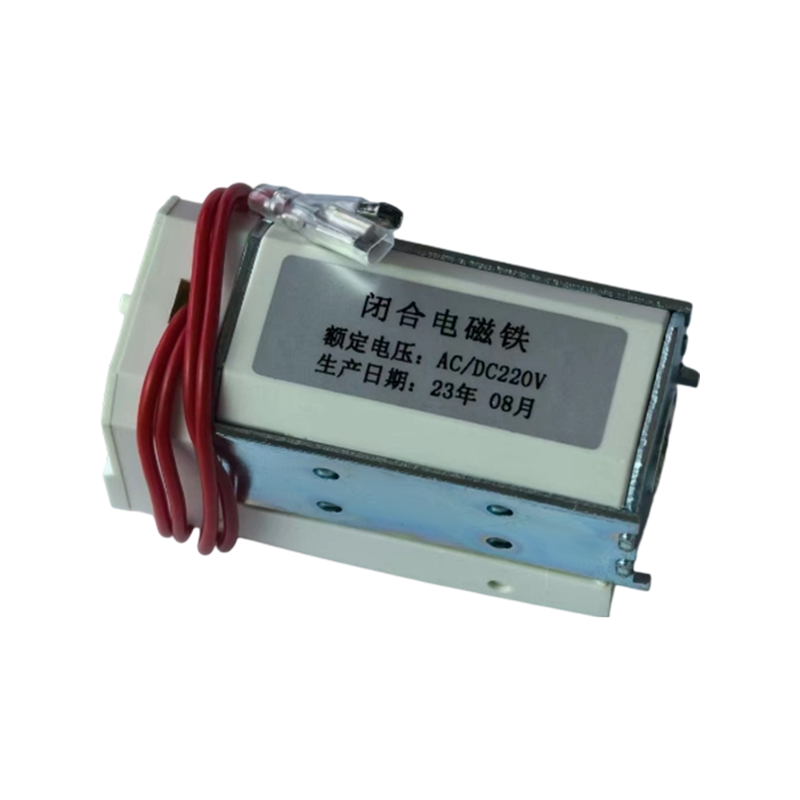
A closing electromagnet for circuit breakers is an electrical operating component that converts an electrical control signal into mechanical force to close a circuit breaker. It is especially important in low-voltage air circuit breakers (ACBs) and frame circuit breakers used in power distribution, industrial control, data centers, and critical infrastructure.
For large-frame circuit breakers rated from 1600A to 6300A, manual operation alone is often unsuitable for remote or automated switching. A closing electromagnet enables the breaker to receive a controlled electrical closing command, allowing integration with automatic transfer systems, PLCs, power management systems, generator control panels, and remote operation systems.
In practical applications, the closing electromagnet works together with the breaker’s stored-energy mechanism. The closing command normally becomes effective only when the mechanism is charged and the breaker is in a condition that permits closing. This interlocking approach helps prevent inappropriate closing operations and supports reliable system control.
2. How Does a Circuit Breaker Closing Electromagnet Work?
(1) Electrical Closing Command
When the control circuit sends a closing signal, the coil of the electromagnet is energized. The resulting magnetic field generates mechanical movement that releases or actuates the breaker’s closing mechanism.
(2) Mechanical Energy Release
Large frame circuit breakers typically use a stored-energy spring mechanism. The electromagnet does not normally provide all of the mechanical energy required to move the main contacts. Instead, it triggers the mechanism so that the stored spring energy can rapidly complete the closing operation.
(3) Closing Feedback
After the closing operation, auxiliary contacts and control electronics can provide status feedback to the control system. This allows PLCs, building management systems, automatic transfer switches, and energy management platforms to verify whether the breaker has actually reached the required position.
For example, Schneider Electric’s current MasterPact MTZ documentation specifies that its XF closing voltage release operates when energized if the spring mechanism is charged, with a minimum pulse duration of 200 ms. This illustrates why the closing coil must be selected according to the complete breaker mechanism and control circuit rather than treated as a generic solenoid.
3. Key Specifications for 1600A–6300A Closing Electromagnets
When purchasing a closing electromagnet for a low-voltage frame circuit breaker, B2B buyers should evaluate electrical, mechanical, and installation parameters simultaneously. A correct voltage rating alone does not guarantee compatibility.
Key parameters buyers should verify before selecting a closing electromagnet.
| Parameter |
Typical Selection Consideration |
Why It Matters |
| Breaker frame |
1600A–6300A |
Determines mechanical and installation compatibility |
| Control voltage |
24V, 48V, 110/120V, 220/240V AC/DC depending on design |
Must match the control power supply |
| Operating mode |
Pulse or specified control signal |
Prevents incorrect coil energization |
| Mechanical interface |
Mounting and actuator geometry must match |
Ensures reliable closing action |
4. Why Is Fast Closing Important for Large Circuit Breakers?
Fast and repeatable closing is important in power distribution systems where switching operations may need to be coordinated with generators, busbars, transfer systems, and other electrical equipment. A dependable closing electromagnet reduces the dependence on manual operation and enables centralized control.
- Supports remote electrical closing commands.
- Improves automation compatibility for industrial switchboards.
- Facilitates automatic transfer and power restoration applications.
- Reduces the need for repeated manual operation of large-frame breakers.
- Allows breaker status to be coordinated with PLC and power management systems.
For OEMs and electrical component distributors, the most valuable characteristic is not simply “fast closing,” but repeatable closing performance under the specified control voltage and mechanical conditions.
(1) Confirm the Circuit Breaker Frame Size
First identify the breaker manufacturer, series, frame size, rated current, fixed or drawout configuration, and mechanism type. For this product range, the target application is specifically 1600A–6300A low-voltage frame circuit breakers.
(2) Confirm the Control Voltage
Control voltages vary by breaker platform and project design. Current industrial breaker accessories can be available in ranges such as 24V AC/DC, 48V AC/DC, 100–130V AC/DC, and 200–250V AC/DC. Always verify the actual coil marking and breaker documentation before ordering.
(3) Check the Mechanical Interface
The mounting hole position, actuator stroke, terminal arrangement, connector design, and interaction with the stored-energy mechanism should be checked against the original component. These dimensions are particularly important for OEM replacement and aftermarket applications.
(4) Evaluate Quality and Production Consistency
For distributors purchasing hundreds or thousands of components, batch consistency can be more important than the lowest unit price. Buyers should request product drawings, electrical specifications, inspection procedures, sample testing, and traceability information before placing a bulk order.
6. Closing Electromagnet Manufacturer and Wholesale Supplier
A dedicated closing electromagnet for 1600A–6300A low-voltage frame circuit breakers is designed to provide the circuit breaker with a fast closing function. For OEMs, panel builders, electrical distributors, and circuit breaker manufacturers, sourcing directly from a specialized component manufacturer can simplify customization, technical communication, and bulk procurement.
Jiangsu Kaiyuanfeng Electrical Machinery Manufacturing Co., Ltd. is a Closing Electromagnet for Circuit Breakers Manufacturer and Wholesale Closing Electromagnet for Circuit Breakers, established in Taizhou in August 2013 with an initial registered capital of 5 million yuan. The company specializes in key circuit breaker components and integrates R&D, design, production, sales, and service.
The company follows the core values of “building a solid foundation through steadiness, expanding horizons via perseverance, and forging integrity with responsibility,” while emphasizing integrity, win-win collaboration, and continuous innovation. Customer requirements are incorporated throughout the R&D and manufacturing process.
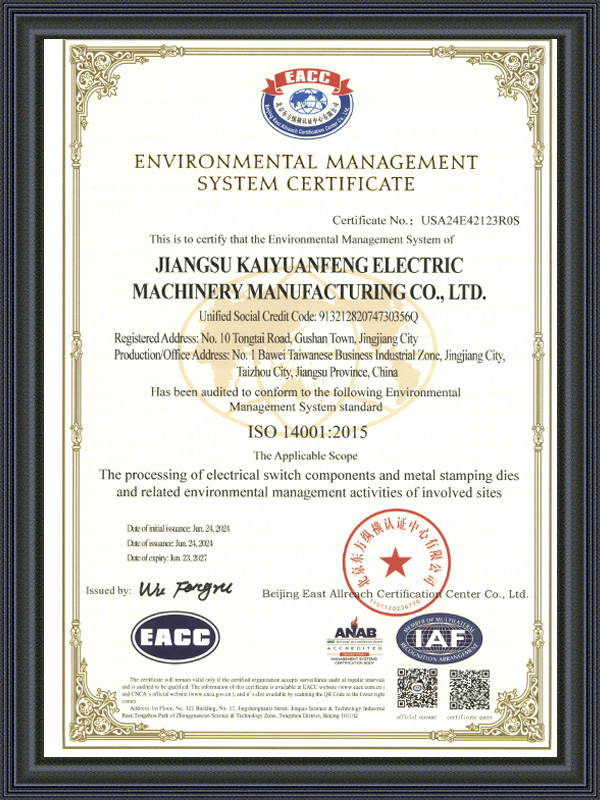
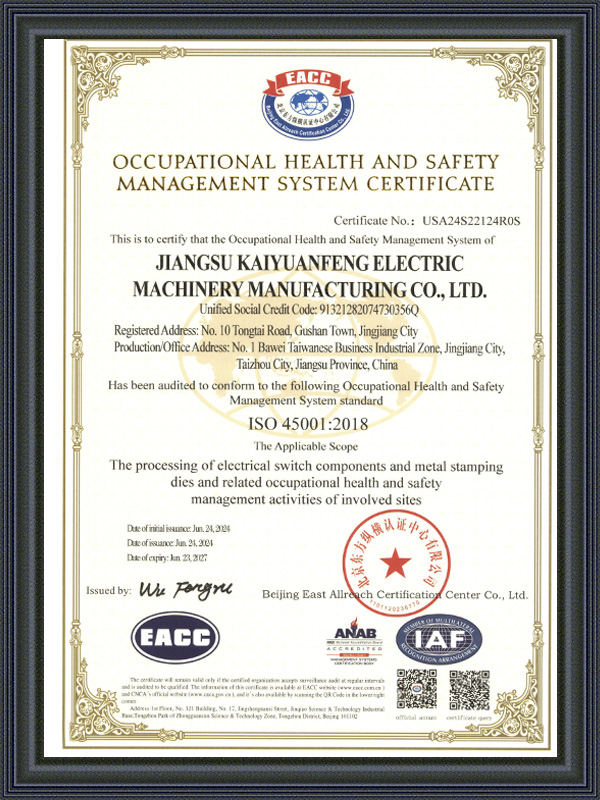
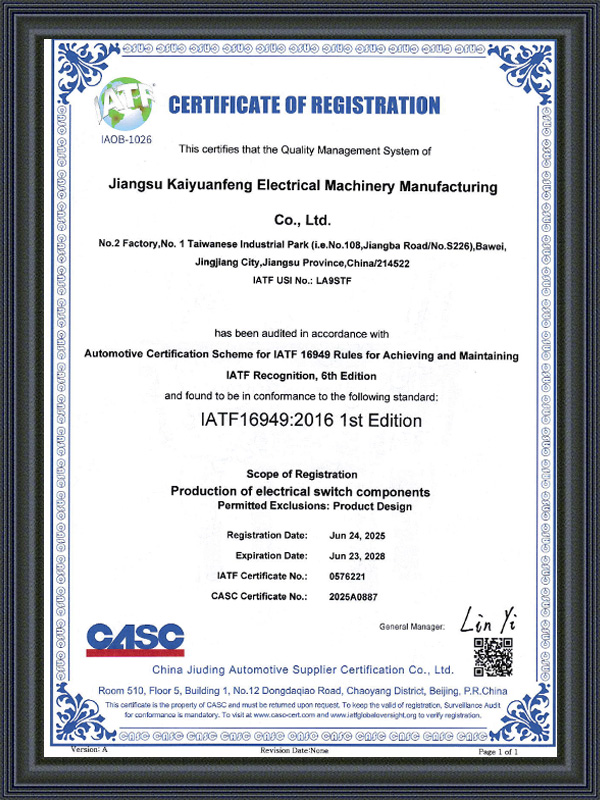
With 28 related patents supporting its technical innovation and an ISO-certified management system aligned with international standards, Jiangsu Kaiyuanfeng Electrical Machinery Manufacturing Co., Ltd. focuses on quality assurance, production efficiency, and consistent component performance. With more than 10 years of industry experience, the company serves customers seeking reliable circuit breaker components and long-term OEM/ODM cooperation.
7. Common Questions About Closing Electromagnets for Circuit Breakers
Q1. What does a closing electromagnet do in a circuit breaker?
A closing electromagnet receives an electrical control signal and actuates the breaker’s closing mechanism. In a large-frame circuit breaker, it normally triggers a pre-charged spring mechanism rather than supplying the entire mechanical closing energy itself. It is commonly used for remote control, automatic switching, generator systems, and industrial power distribution.
Q2. What is the difference between a closing electromagnet and a shunt trip coil?
A closing electromagnet is designed to close a circuit breaker when the correct closing conditions are satisfied, while a shunt trip or opening coil is designed to open the breaker when an opening command is received. They perform opposite functions and generally cannot be substituted for each other without matching the complete breaker mechanism.
Q3. What control voltages are available for circuit breaker closing electromagnets?
The available voltage depends on the circuit breaker platform. Common industrial control supplies include 24V, 48V, 110/120V, and 220/240V AC or DC, while some breaker families provide additional voltage options. For example, current large-frame breaker accessory ranges include 24V AC/DC through 200–250V AC/DC options. The exact voltage must always be confirmed against the breaker model and coil nameplate.
Q4. Can a closing electromagnet be customized for an OEM circuit breaker?
Yes. OEM customization may include the coil voltage, mounting dimensions, terminals, connector configuration, actuator geometry, insulation requirements, and mechanical interface. For a replacement project, buyers should provide the original electromagnet, breaker model, technical drawing, photographs, or detailed dimensional data so the manufacturer can verify compatibility before mass production.
Q5. Why does a circuit breaker closing electromagnet fail to close the breaker?
Common causes include incorrect control voltage, insufficient control power, damaged coil windings, poor terminal connections, an uncharged closing spring, mechanical obstruction, incorrect installation, or a breaker interlock preventing closing. A professional troubleshooting process should check the control voltage first, then verify the coil, spring-charging mechanism, auxiliary contacts, interlocks, and mechanical movement.
Q6. How do I choose a closing electromagnet for a 1600A to 6300A circuit breaker?
Start with the breaker manufacturer and exact series, then confirm the frame size, rated current, fixed or drawout configuration, closing mechanism, control voltage, mounting dimensions, connector type, and operating requirements. For B2B procurement, request samples and technical drawings before ordering in bulk. A specialized manufacturer can also verify the component against the original breaker accessory to reduce compatibility risks.
Q7. Where can I buy a wholesale closing electromagnet for circuit breakers?
OEMs, switchboard manufacturers, electrical distributors, and maintenance companies can purchase closing electromagnets directly from specialized circuit breaker component manufacturers. For large-volume projects, it is advisable to compare technical compatibility, sample approval, production capacity, quality control, certifications, customization capability, packaging, and after-sales support rather than comparing unit price alone. Jiangsu Kaiyuanfeng Electrical Machinery Manufacturing Co., Ltd. provides closing electromagnets for 1600A–6300A low-voltage frame circuit breakers and supports B2B cooperation for customers requiring reliable circuit breaker components.

 English
  中文简体
中文简体  русский
  عربى
عربى