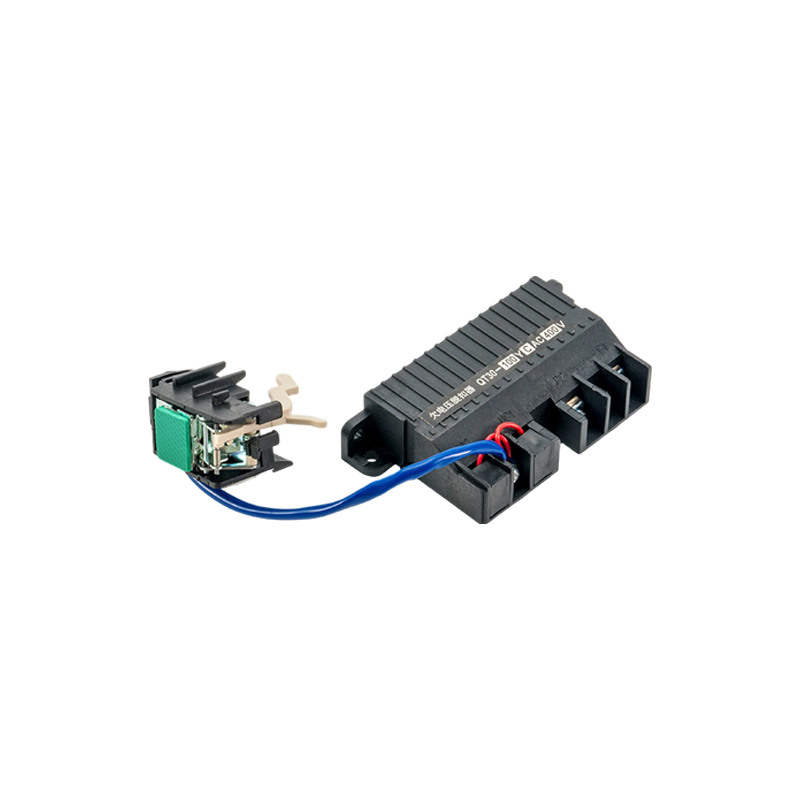
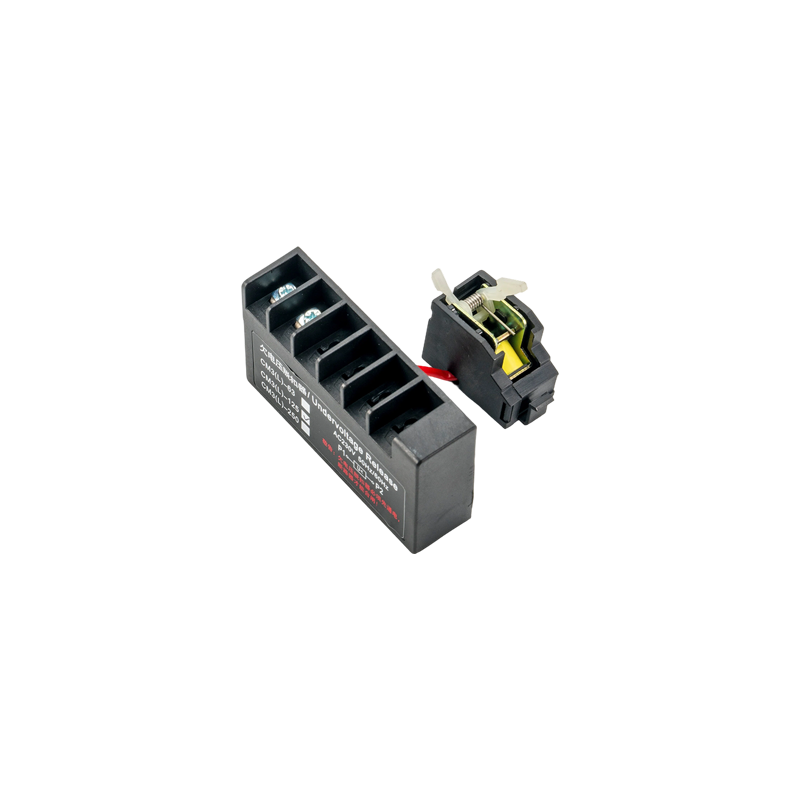
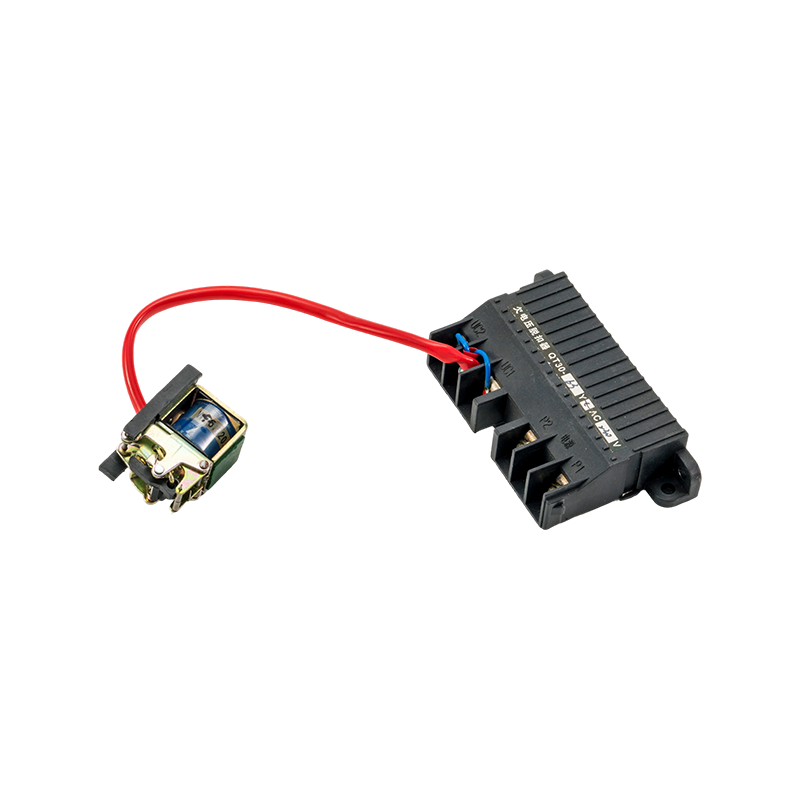
An MCCB undervoltage release is an electrical accessory designed to monitor a circuit breaker's control voltage and initiate tripping when the voltage falls below a specified level. It is commonly used with molded case circuit breakers (MCCBs) in industrial power distribution, machinery, commercial buildings, HVAC systems, and automated electrical panels.
The undervoltage release monitors the voltage at the circuit breaker's incoming line terminals. When the operating voltage in the protected circuit drops to 35%-70% of the supply voltage, it automatically trips the circuit breaker, severing power to the load and protecting connected electrical equipment from damage caused by low voltage. The exact operating threshold depends on the specific product design and should be confirmed against the applicable technical datasheet.
Unlike a shunt release, which normally trips an MCCB when an external voltage signal is applied, an undervoltage release responds to the loss or reduction of its control voltage. This makes it useful when the breaker must not remain closed during an unacceptable voltage condition or when automatic disconnection is required.
2. How Does an MCCB Undervoltage Release Work?
(1) Voltage Monitoring
The undervoltage release contains a mechanism that continuously monitors its specified control voltage. Under normal operating conditions, the release remains energized and permits the MCCB to maintain its operating state, subject to the breaker design and closing mechanism.
(2) Voltage Drop Detection
When the monitored voltage falls below the release's specified operating threshold, the internal mechanism changes state. Depending on the product design, this condition can cause the MCCB to trip or prevent the breaker from closing until the required voltage has been restored.
(3) Load Disconnection
Once the MCCB trips, the main circuit contacts open and disconnect the downstream load. This can help prevent equipment from continuing to operate under an abnormal supply condition. For example, a motor control panel supplied at 400 V may experience a substantial voltage disturbance. If the undervoltage protection system detects an unacceptable condition, it can initiate the appropriate breaker operation according to its configured specifications.
- Protection against abnormal voltage: It can help disconnect loads when the monitored voltage falls below the specified operating range.
- Automatic circuit interruption: The breaker can respond to an undervoltage condition without requiring manual intervention.
- Improved equipment protection: Motors, control equipment, and other loads can be isolated when the system detects an unacceptable voltage condition.
- Better system control: The release can be incorporated into industrial control and power-distribution architectures.
- Useful for automatic restart strategies: Depending on the MCCB design, the undervoltage release can help ensure that equipment does not restart unexpectedly after a power interruption.
For B2B applications, these functions are especially valuable in systems where unexpected motor restart or operation during unstable voltage conditions could cause equipment damage, production interruption, or operational risk.
4. MCCB Undervoltage Release vs Shunt Release: What Is the Difference?
Although both are MCCB internal accessories, an undervoltage release and shunt release have different control principles. Selecting the correct accessory is therefore important for OEM equipment manufacturers, panel builders, electrical distributors, and system integrators.
Key differences between MCCB undervoltage releases and shunt releases.
| Feature |
Undervoltage Release |
Shunt Release |
| Main trigger |
Loss or reduction of control voltage |
Application of a specified trip signal |
| Typical purpose |
Voltage-dependent protection and control |
Remote or emergency tripping |
| Typical application |
Motors, machinery, distribution systems |
Emergency shutdown, fire systems, automation |
| Control philosophy |
Breaker operation depends on voltage availability |
External command initiates tripping |
Neither accessory should be selected based solely on appearance or rated current. The MCCB series, accessory interface, control voltage, operating characteristics, and intended control logic must all be verified.
5. How Should B2B Buyers Select an MCCB Undervoltage Release?
For bulk procurement, the correct undervoltage release should be selected according to both electrical and mechanical requirements. A release that has the correct voltage but does not match the MCCB's internal accessory interface is not a suitable replacement.
- Confirm MCCB compatibility: Provide the exact manufacturer, product series, frame size, pole configuration, and model number.
- Confirm rated control voltage: Verify whether the application requires AC or DC control power and the exact nominal voltage.
- Check operating threshold: Review pickup, dropout, and trip thresholds specified by the manufacturer.
- Evaluate reset behavior: Confirm whether the MCCB can be reclosed automatically or manually after the control voltage returns.
- Check dimensions and terminals: Verify mounting location, wiring terminals, clearances, and accessory dimensions.
- Review supplier quality: For OEM projects, consider sample testing, production consistency, inspection procedures, certification, packaging, MOQ, and delivery capacity.
For example, an OEM producing 300 electrical control cabinets with three MCCBs per cabinet may require approximately 900 undervoltage release units. At this volume, even a small compatibility issue can affect hundreds of finished assemblies, making sample validation and supplier quality control important procurement steps.
6. What Are the Key Technical Parameters of an MCCB Undervoltage Release?
Before purchasing, electrical engineers and procurement teams should review the release's technical specifications rather than relying on general voltage ranges. Important parameters normally include rated control voltage, operating threshold, power consumption, response characteristics, mounting method, and compatible MCCB series.
Technical parameters commonly reviewed when sourcing MCCB undervoltage releases.
| Parameter |
B2B Purchasing Consideration |
| Rated control voltage |
Must match the control power supply |
| Dropout/trip threshold |
Determines when undervoltage protection operates |
| Pickup threshold |
Determines whether the release permits normal operation |
| Power consumption |
Important for control-circuit and power-supply sizing |
| MCCB compatibility |
Ensures correct mechanical and electrical installation |
| Operating environment |
Important for temperature, humidity, vibration, and installation conditions |
The numerical specifications vary significantly between MCCB families. Therefore, the exact values should be confirmed from the current manufacturer's technical documentation before engineering approval or mass procurement.
7. Jiangsu Kaiyuanfeng Electrical Machinery Manufacturing Co., Ltd. MCCB Undervoltage Release Manufacturing
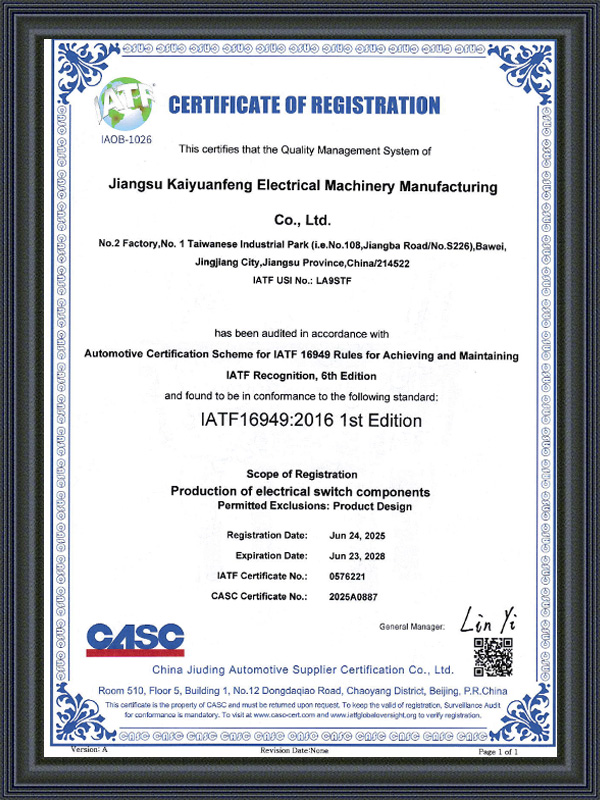
Jiangsu Kaiyuanfeng Electrical Machinery Manufacturing Co., Ltd. is a MCCB Undervoltage Release Manufacturer and Wholesale MCCB Undervoltage Release, established in Taizhou in August 2013 with an initial registered capital of 5 million yuan. It is a manufacturer of key circuit breaker components, integrating R&D, design, production, sales, and service.
The company adheres to the core values of "building a solid foundation through steadiness, expanding horizons via perseverance, and forging integrity with responsibility", and upholds the founding principle of "integrity, win-win collaboration, and pioneering the future". Guided by the philosophy that "technological innovation drives progress and quality service supports development", customer needs are incorporated into processes from R&D to manufacturing.
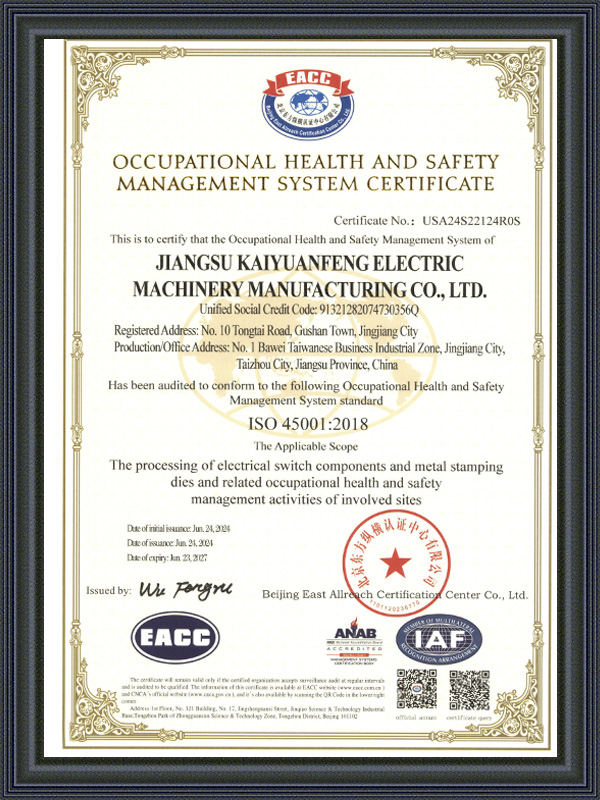
Its innovation is supported by 28 related patents, addressing key industry challenges. The company has obtained ISO certification and implements a management system aligned with international standards to support operational efficiency and quality assurance.
With over a decade of industry experience, Jiangsu Kaiyuanfeng Electrical Machinery Manufacturing Co., Ltd. maintains a customer-centric approach, focusing on reliable products and attentive service to build long-term partnerships. Moving forward, the company aims to become a core supplier of key circuit breaker components, contributing to electrical system safety.
8. Common Questions About MCCB Undervoltage Releases
Q1. What is an MCCB undervoltage release?
An MCCB undervoltage release is an accessory that monitors a specified control voltage and causes the circuit breaker to trip or prevents it from closing when the voltage falls below its defined operating threshold. It is commonly used for voltage-dependent circuit protection, industrial machinery, power distribution systems, and control panels where operation under insufficient voltage is undesirable.
Q2. How does an MCCB undervoltage release work?
The release uses an internal electromagnetic mechanism to monitor its control voltage. When the voltage is within the specified range, the mechanism permits the MCCB to operate normally. If the voltage falls below the specified dropout or trip threshold, the release changes state and can initiate breaker tripping or prevent closing, depending on the design. Exact thresholds and timing vary by product series.
Q3. What voltage range causes an MCCB undervoltage release to trip?
The operating range depends on the specific release. The stated product application may use a trip range of approximately 35%-70% of the supply voltage, but this should not be treated as a universal specification. Different manufacturers and MCCB series can have different pickup, dropout, and operating thresholds. Always verify the current product datasheet before engineering or purchasing.
Q4. What is the difference between an MCCB undervoltage release and shunt trip?
An undervoltage release responds to a reduction or loss of its control voltage, while a shunt release normally trips the MCCB when an external voltage signal is deliberately applied to its coil. The undervoltage release is therefore suitable for voltage-dependent control and protection, whereas the shunt release is commonly used for remote, emergency, or externally commanded tripping.
Q5. Can an MCCB undervoltage release prevent the breaker from closing?
Depending on the MCCB and release design, an undervoltage release can prevent the breaker from being closed while the required control voltage is unavailable. This feature can be useful for preventing equipment from being energized unexpectedly after a power interruption. The exact closing and reset behavior must be confirmed in the manufacturer's technical documentation.
Q6. Can an MCCB undervoltage release be used to protect motors?
An undervoltage release can be incorporated into motor power-distribution systems where the project requires the MCCB to respond to an unacceptable control-voltage condition. It can help prevent a motor circuit from remaining energized or restarting unexpectedly after a voltage interruption. However, motor protection normally requires a complete protection scheme that may include overload, short-circuit, phase-loss, and other dedicated protective functions as required by the application.
Q7. How do I choose the correct MCCB undervoltage release?
First identify the MCCB manufacturer, series, frame size, pole configuration, and exact model. Then check the compatible undervoltage accessory, rated control voltage, AC/DC requirement, pickup and dropout thresholds, power consumption, mounting position, terminal arrangement, and environmental requirements. For OEM applications, provide the MCCB model and technical drawing to the supplier so mechanical and electrical compatibility can be confirmed before mass production.
Q8. What should wholesalers check before buying MCCB undervoltage releases in bulk?
Wholesale buyers should evaluate MCCB compatibility, control-voltage options, operating thresholds, mechanical dimensions, terminal configuration, quality consistency, inspection procedures, certification, packaging, MOQ, lead time, and customization capability. For large orders, sample testing is recommended before mass production. For example, if a distributor needs 2,000 units, validating representative samples against the target MCCB can help identify compatibility issues before the complete batch is delivered.

 English
  中文简体
中文简体  русский
  عربى
عربى