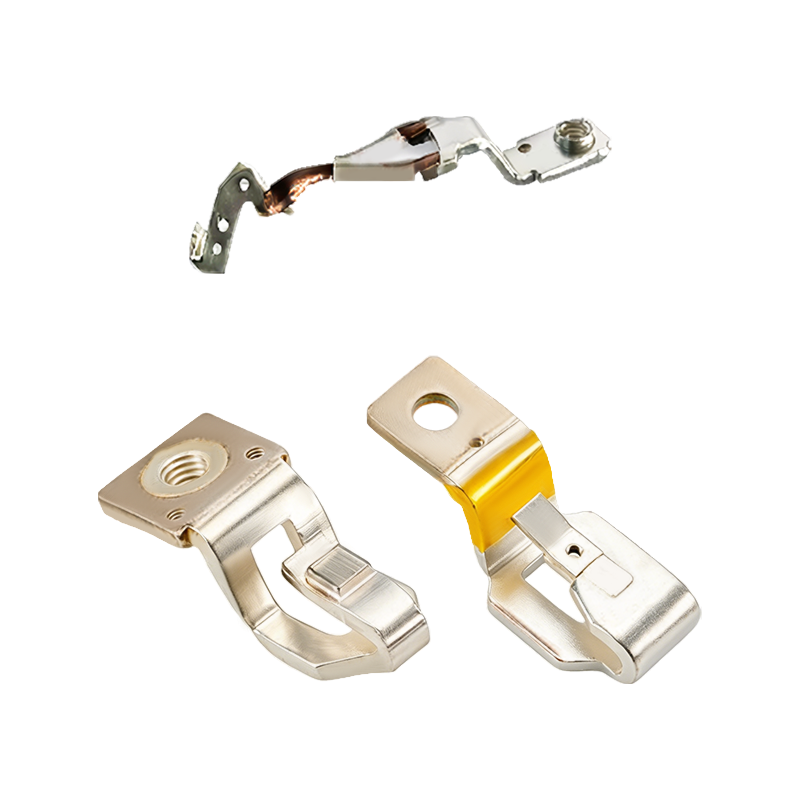
An MCCB Stationary Contact Assembly is a key current-carrying component inside a molded case circuit breaker (MCCB). It forms the fixed side of the main electrical contact system and works with the moving contact to establish or interrupt the current path when the breaker is switched on or trips during a fault.
For B2B circuit breaker manufacturers, the stationary contact assembly is more than a stamped metal part. Its electrical conductivity, contact surface quality, welding strength, dimensional accuracy, heat resistance, and mechanical stability can directly influence contact resistance, temperature rise, switching reliability, and service life.
The latest applicable international reference is IEC 60947-2:2024, the sixth edition of the low-voltage circuit-breaker standard. It applies to circuit breakers with main contacts connected to circuits rated up to 1,000 V AC or 1,500 V DC. The 2024 edition replaced the 2016 edition and introduced a number of technical revisions. However, the exact geometry, material combination, and manufacturing process of an MCCB stationary contact assembly are generally product-specific rather than defined as one universal dimension by IEC 60947-2.
2. How Does a Stationary Contact Assembly Work in an MCCB?
(1) Establishing the Main Current Path
When an MCCB is in the ON position, the moving contact presses against the stationary contact. The resulting contact interface provides the electrical path through the breaker. A well-designed stationary contact assembly helps maintain stable electrical conduction while minimizing localized heating.
(2) Supporting Reliable Circuit Interruption
During overload or short-circuit interruption, the contacts separate and an electrical arc can form. Contact materials and geometry therefore need to withstand electrical and thermal stress. In practical MCCB manufacturing, contact-tip material, contact pressure, alignment, and welding quality are important design variables.
(3) Maintaining Stable Electrical Performance
Even small increases in contact resistance can generate additional heat. For example, at a hypothetical current of 400 A, a total contact resistance of 100 μΩ would produce approximately 16 W of I²R loss at that interface. This illustrates why low and consistent resistance is an important engineering target, although the actual allowable resistance must be established from the breaker design, rated current, temperature-rise requirements, and applicable tests.
3. What Materials Are Used for MCCB Stationary Contacts?
Stationary contact assemblies commonly combine a conductive carrier with a contact tip or contact area engineered for switching performance. Copper and copper alloys are widely used for current-carrying structures because of their electrical and thermal conductivity. Contact tips may use silver-based or other specialized contact materials depending on the breaker rating, switching duty, and design requirements.
Typical material considerations for MCCB stationary contact assemblies; exact specifications depend on the breaker design.
| Component |
Common Material Direction |
Main Requirement |
| Current-carrying base |
Copper or copper alloy |
Conductivity, strength, dimensional stability |
| Contact tip |
Silver-based or engineered contact alloy |
Switching durability and arc resistance |
| Joining area |
Resistance-welded or other qualified joint |
Weld strength and electrical continuity |
Material selection should be based on the complete electrical and mechanical duty rather than material price alone. For OEM projects, buyers should specify the required base material, contact material, thickness, hardness, surface treatment, and joining method in the technical drawing or quality agreement.
4. Why Is Contact Welding Quality Important for MCCB Manufacturing?
Contact welding is one of the most important manufacturing steps when a contact tip is joined to the current-carrying base. Poor welding can create weak mechanical bonding, inconsistent electrical resistance, voids, cracks, or localized heating. These defects may become more significant during repeated switching or high-current fault interruption.
For mass production, buyers should evaluate more than appearance. Important quality-control indicators can include weld strength, electrical continuity, contact resistance, dimensional accuracy, contact-tip positioning, and metallographic inspection where required.
- Stable welding parameters and repeatable electrode pressure.
- Consistent contact-tip position and welding area.
- Inspection of weld strength and electrical continuity.
- Traceability for raw materials and production batches.
- Process capability monitoring for high-volume OEM production.
5. What Should B2B Buyers Check When Sourcing MCCB Stationary Contact Assemblies?
For circuit breaker factories, sourcing a stationary contact assembly should begin with the application requirements and engineering drawings. A supplier that can only provide a generic copper contact may not be suitable for an OEM or replacement project requiring precise compatibility.
Key procurement checkpoints for industrial MCCB stationary contact assembly sourcing.
| Item to Confirm |
Why It Matters |
| Material and thickness |
Determines conductivity, strength, thermal behavior, and manufacturability |
| Contact-tip specification |
Affects switching and wear performance |
| Welding method and strength |
Ensures stable mechanical and electrical connection |
| Dimensional tolerance |
Ensures correct installation and contact alignment |
| Testing and documentation |
Supports incoming inspection, traceability, and quality audits |
For overseas procurement, it is also useful to clarify annual demand, MOQ, packaging, sampling procedures, delivery lead time, quality acceptance criteria, and whether the supplier can support customized tooling. These details can significantly reduce qualification time for OEM and private-label MCCB programs.
Jiangsu Kaiyuanfeng Electrical Machinery Manufacturing Co., Ltd. is a professional MCCB Stationary Contact Assembly Manufacturer and Wholesale MCCB Stationary Contact Assembly supplier. Established in Taizhou in August 2013 with an initial registered capital of RMB 5 million, the company focuses on key circuit breaker components and integrates R&D, design, production, sales, and service.
The company specializes in current-carrying components for molded case circuit breakers, featuring high spot welding rates and reliable weld strength. Its manufacturing approach is designed around the needs of circuit breaker manufacturers requiring stable component quality and repeatable production.
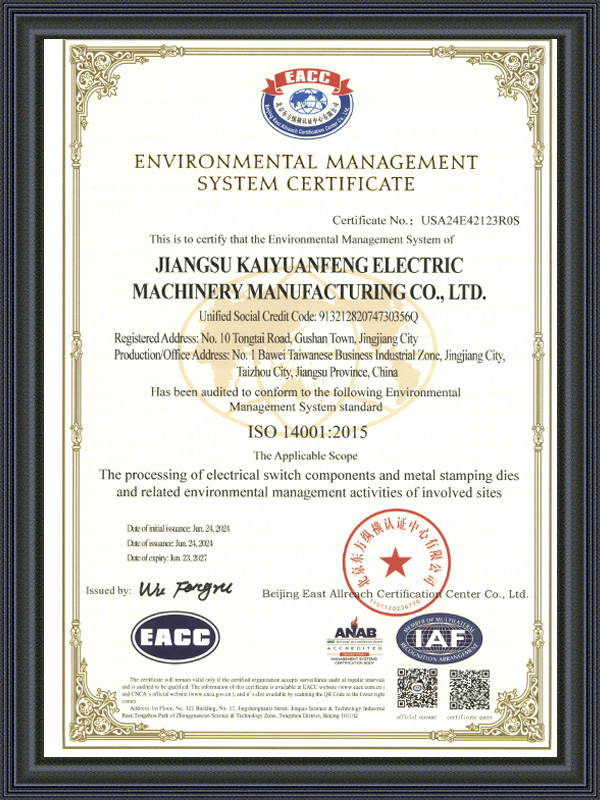
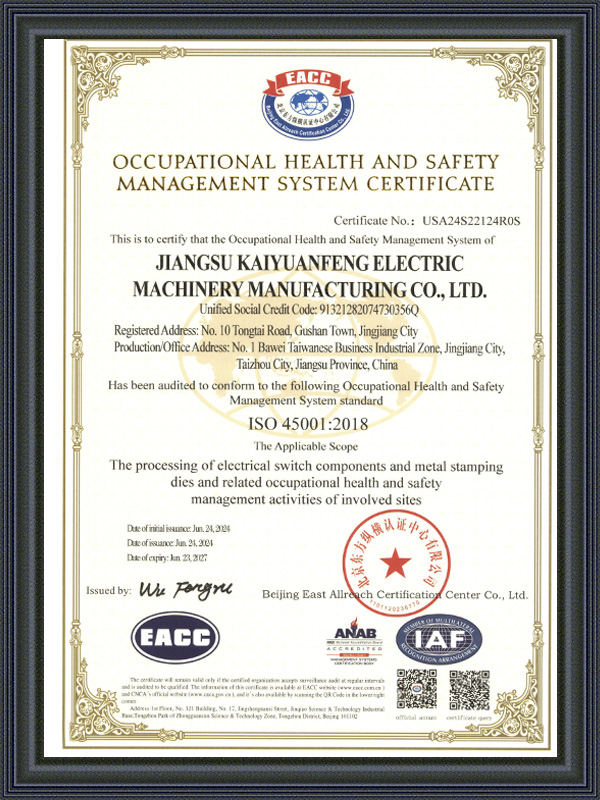
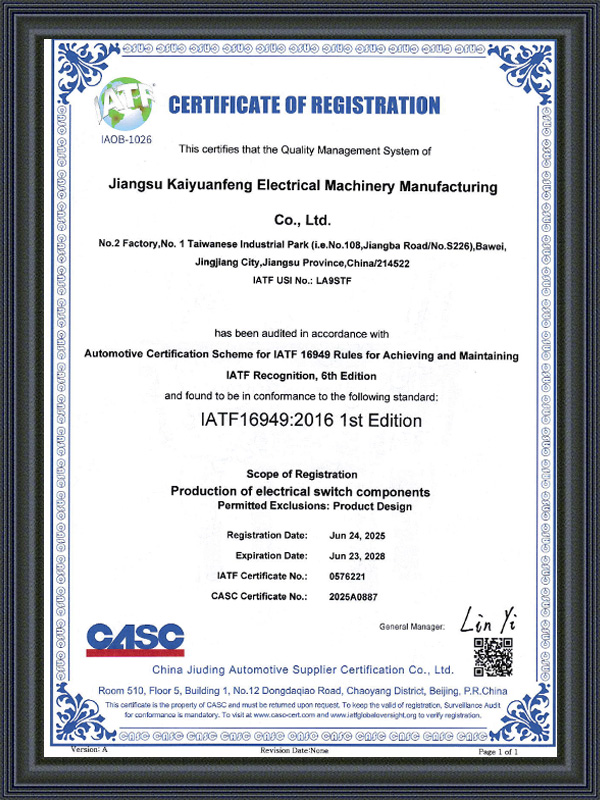
With 28 related patents supporting its innovation capabilities and an ISO-certified management system aligned with international standards, Jiangsu Kaiyuanfeng incorporates customer requirements into processes from product development through manufacturing and quality control.
With more than a decade of industry experience, the company focuses on reliable products and responsive service for long-term B2B partnerships. Its product-development philosophy emphasizes technological innovation, while its quality approach focuses on stable manufacturing processes and customer-specific requirements.
7. How Can OEM Customers Customize MCCB Stationary Contact Assemblies?
OEM and ODM customers may require customized stationary contact assemblies to match a specific MCCB frame, rated current, contact system, operating mechanism, or internal layout. Customization can cover the base geometry, hole positions, contact-tip dimensions, material combinations, welding locations, surface treatment, and packaging.
- Provide a technical drawing, sample, or existing part number.
- Confirm rated current, voltage, breaking capacity, and intended application.
- Define base material, contact material, thickness, and surface requirements.
- Agree on critical dimensions, tolerances, welding requirements, and inspection standards.
- Conduct prototype approval and sample testing before mass production.
- Establish batch inspection and traceability requirements for regular supply.
This process is particularly useful for importers and MCCB manufacturers sourcing from China because it converts a general product inquiry into a controlled engineering and quality specification.
8. Common Questions About MCCB Stationary Contact Assemblies
Q1. What is an MCCB stationary contact assembly?
An MCCB stationary contact assembly is the fixed contact-side component of a molded case circuit breaker. It provides the stationary electrical interface for the moving contact and forms part of the main current path. Depending on the design, it can consist of a copper or copper-alloy carrier combined with a dedicated contact tip or contact area.
Q2. What material is commonly used for MCCB stationary contacts?
Copper and copper alloys are common choices for the current-carrying base because they provide good electrical and thermal conductivity. Silver-based or other engineered contact materials may be used at the contact interface where switching performance and resistance to electrical wear are important. The correct material depends on the breaker design and electrical duty rather than one universal specification.
Q3. How do you test an MCCB stationary contact assembly?
Testing can include dimensional inspection, visual inspection, electrical continuity, contact resistance, weld-strength testing, and material verification. For qualified production programs, additional tests may be defined by the MCCB manufacturer's internal specifications and the applicable circuit-breaker test program. The complete breaker must ultimately meet the applicable requirements, such as those in IEC 60947-2:2024.
Q4. Why is spot welding important in MCCB contact assemblies?
Spot or resistance welding can provide a repeatable connection between the contact tip and current-carrying base when the process is properly controlled. Inconsistent welding may increase electrical resistance or reduce mechanical strength. For high-volume production, controlling welding current, pressure, time, positioning, and inspection is essential for batch-to-batch consistency.
Q5. Can MCCB stationary contact assemblies be customized?
Yes. B2B manufacturers can develop customized stationary contact assemblies according to engineering drawings, samples, or approved specifications. Common customization areas include dimensions, copper alloy, contact material, contact-tip geometry, hole locations, welding points, surface treatment, and packaging. Prototype validation should be completed before mass production.
Q6. What should I provide when requesting a quotation for MCCB stationary contacts?
For an accurate quotation, buyers should provide the part drawing or sample, MCCB model or frame size, rated current, material requirements, contact-tip specifications, annual quantity, expected MOQ, packaging requirements, and quality standards. If a drawing is unavailable, photographs with key dimensions and a physical sample can help the supplier evaluate feasibility.
Q7. Where can I buy wholesale MCCB stationary contact assemblies?
Wholesale buyers should source from manufacturers capable of providing stable material control, repeatable welding, dimensional consistency, inspection records, and OEM customization. Jiangsu Kaiyuanfeng Electrical Machinery Manufacturing Co., Ltd. supplies MCCB current-carrying components and supports B2B customers with R&D, manufacturing, sales, and service capabilities.
Q8. What standard applies to low-voltage MCCBs in 2026?
As of 2026, IEC 60947-2:2024 is the current IEC edition for low-voltage circuit breakers covered by the standard. It applies to circuit breakers with main contacts intended for circuits up to 1,000 V AC or 1,500 V DC and replaced the previous 2016 edition. Individual MCCB projects may also require additional regional, national, customer, or product-specific requirements.

 English
  中文简体
中文简体  русский
  عربى
عربى