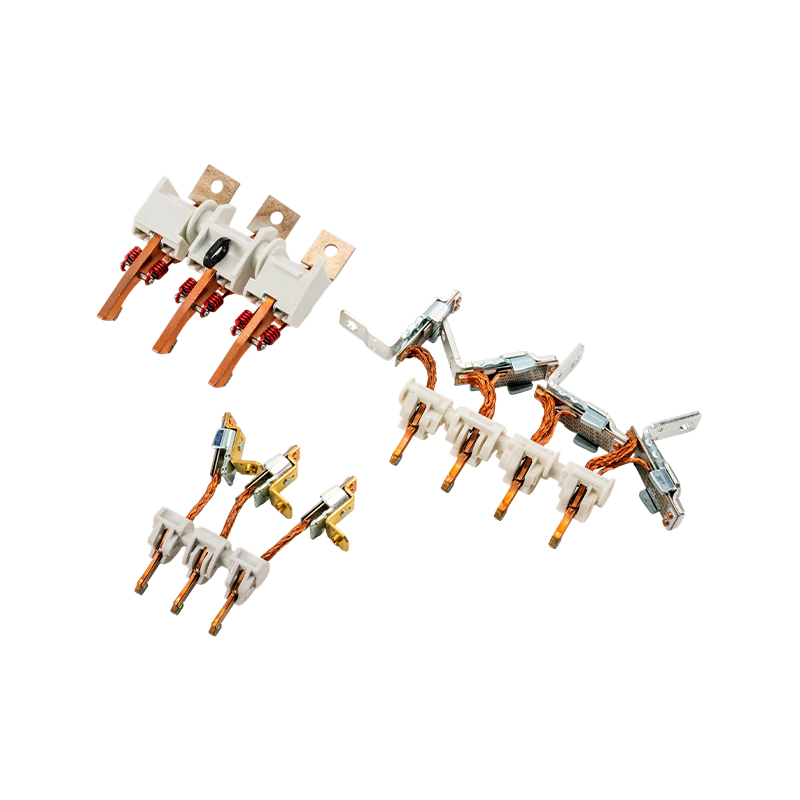
A Complete MCCB Moving Contact Assembly is an integrated moving-contact component used inside a molded case circuit breaker (MCCB). Unlike a standalone moving contact arm or contact tip, a complete assembly is supplied as a matched component set designed to work with the breaker’s stationary contact, operating mechanism, arc-management structure, and current path.
For MCCB manufacturers, OEMs, electrical distributors, and replacement-parts wholesalers, purchasing a complete assembly can simplify production and reduce the risks associated with separately sourcing and assembling multiple conductive and mechanical parts. The assembly may incorporate a moving contact arm, contact tip, connection or pivot area, riveted or welded components, and other design-specific parts.
As of 2026, IEC 60947-2:2024 is the latest IEC edition for low-voltage circuit breakers covered by the standard. It applies to circuit breakers with main contacts intended for circuits up to 1,000 V AC or 1,500 V DC. The exact construction of a complete moving contact assembly remains dependent on the MCCB manufacturer's electrical, mechanical, thermal, and dimensional design.
2. How Does a Complete MCCB Moving Contact Assembly Work?
(1) Electrical Contact and Current Carrying
When the MCCB is closed, the moving contact assembly presses against the stationary contact and forms part of the main current path. The conductive components must maintain stable electrical continuity while minimizing contact resistance and associated heat generation.
(2) Mechanical Movement
The assembly moves according to the operating mechanism during switching and tripping. Accurate positioning is essential because excessive misalignment can produce uneven contact pressure, accelerated wear, or unstable electrical performance. For high-volume MCCB production, dimensional repeatability is therefore as important as material selection.
(3) Circuit Interruption
When an MCCB interrupts an overload or short-circuit condition, the moving contact separates from the stationary contact. An electrical arc can develop during separation, so the contact assembly must work together with the breaker’s arc-management system. Contact geometry, opening speed, contact material, and mechanical strength all influence the overall interruption performance.
3. What Components Are Included in a Complete MCCB Moving Contact Assembly?
The exact configuration differs between MCCB manufacturers and frame sizes. However, a complete moving contact assembly commonly integrates several functional elements instead of supplying only a single copper contact arm.
Typical components and functions of a complete MCCB moving contact assembly.
| Component |
Primary Function |
Key Requirement |
| Moving contact arm |
Transfers current and moves between contact positions |
Conductivity, strength, dimensional accuracy |
| Contact tip |
Provides the primary contact interface |
Switching durability and stable contact resistance |
| Welded or joined area |
Connects conductive components |
Reliable mechanical and electrical bonding |
| Pivot or mounting area |
Connects assembly to operating mechanism |
Accurate geometry and mechanical stability |
4. Which Materials Are Used for Complete MCCB Moving Contact Assemblies?
Copper and copper alloys are widely considered for current-carrying parts because they combine electrical conductivity with useful mechanical properties. The specific grade should be selected according to the required current capacity, mechanical loading, thermal performance, forming process, and product design.
Contact tips may use silver-based materials or other engineered contact alloys when the switching application requires specialized electrical and wear performance. Buyers should avoid selecting materials based solely on the nominal conductivity of the base metal because the complete contact system must also satisfy mechanical and thermal requirements.
For example, at a hypothetical current of 400 A, an electrical resistance of 100 μΩ would generate approximately 16 W of I²R loss. This illustrates why resistance control is important in high-current applications. Actual allowable resistance must be determined from the complete MCCB design and applicable temperature-rise requirements.
5. Why Are Welding Quality and Dimensional Accuracy Important?
In a complete moving contact assembly, the connection between the contact tip and conductive arm is critical. Resistance welding or another qualified joining process can provide a repeatable connection when parameters are properly controlled. Poor welding may cause weak mechanical bonding, inconsistent electrical resistance, cracks, or premature component failure.
For industrial production, manufacturers should control welding current, welding time, electrode pressure, positioning, and component cleanliness. Inspection can include visual checks, dimensional inspection, weld-strength testing, electrical continuity, contact resistance, and production-batch traceability.
- Stable contact-tip positioning before welding.
- Consistent welding parameters for high-volume production.
- Reliable weld strength and electrical continuity.
- Controlled dimensions for correct contact alignment.
- Traceable raw materials and production batches.
For OEM and wholesale purchasing, buyers should evaluate the complete assembly rather than focusing only on the unit price. A technically compatible assembly can reduce production integration work, assembly labor, and the risk of mismatched components.
Key procurement factors for OEM and wholesale complete MCCB moving contact assemblies.
| Procurement Factor |
Why It Matters |
| MCCB frame and rated current |
Defines electrical and mechanical requirements |
| Complete assembly dimensions |
Ensures compatibility with the breaker mechanism |
| Contact material |
Affects contact resistance, switching, and wear |
| Welding and joining quality |
Determines connection reliability |
| Quality documentation |
Supports incoming inspection and traceability |
| MOQ and annual capacity |
Supports stable long-term supply planning |
For international procurement, buyers should also confirm packaging, sample approval, tooling requirements, production lead time, inspection standards, and whether the supplier supports OEM/ODM development. These details are especially important for regular orders involving thousands or tens of thousands of assemblies.
7. Jiangsu Kaiyuanfeng Complete MCCB Moving Contact Assembly Manufacturer
Jiangsu Kaiyuanfeng Electrical Machinery Manufacturing Co., Ltd. is a Complete MCCB Moving Contact Assembly Manufacturer and Wholesale Complete MCCB Moving Contact Assembly supplier. Established in Taizhou in August 2013 with an initial registered capital of RMB 5 million, the company specializes in key circuit breaker components and integrates R&D, design, production, sales, and service.
The company focuses on circuit breaker component manufacturing and incorporates customer requirements into processes from product development through production. Its product-development capabilities are supported by 28 related patents, addressing technical challenges in key circuit breaker component applications.
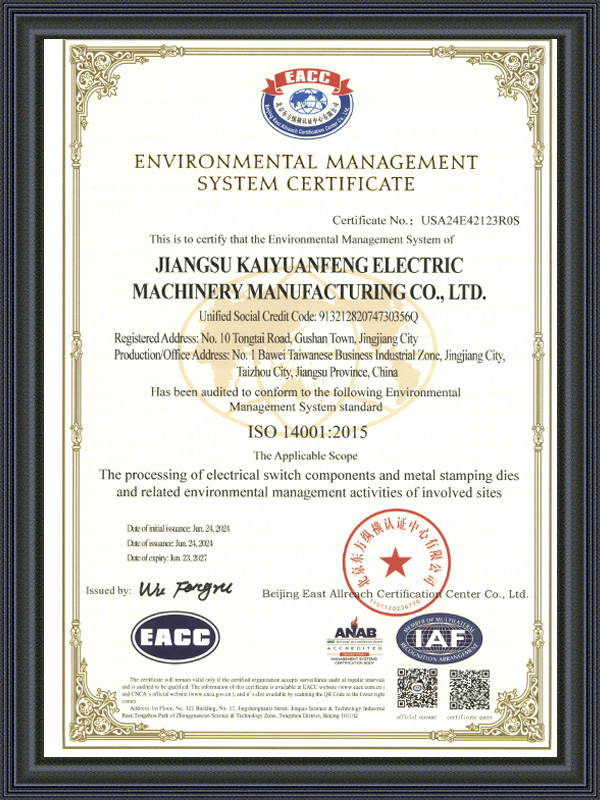
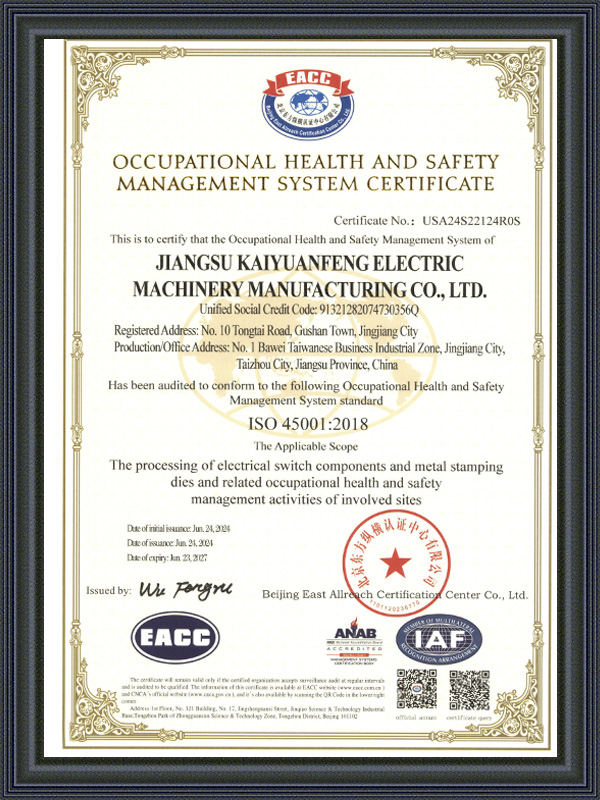
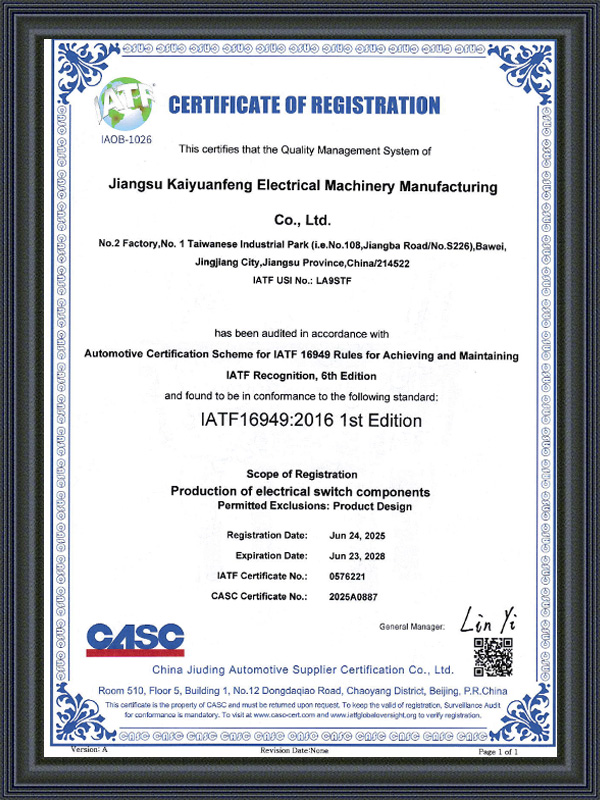
Jiangsu Kaiyuanfeng has obtained ISO certification and operates a management system aligned with international standards to support quality assurance and operational efficiency. This provides B2B customers with a structured foundation for supplier qualification, production control, and long-term cooperation.
With over a decade of industry experience, the company maintains a customer-centered approach and provides R&D, manufacturing, sales, and service support. Its long-term goal is to become a core supplier of key circuit breaker components and contribute to reliable electrical system safety.
8. How Can OEM Customers Customize a Complete MCCB Moving Contact Assembly?
OEM customers may need customized moving contact assemblies to match a proprietary MCCB frame or replace an existing assembly. Customization can involve the moving arm geometry, contact-tip material, contact dimensions, thickness, hole positions, pivot structure, welding locations, surface treatment, and packaging.
- Provide a technical drawing, CAD file, existing part number, or physical sample.
- Confirm MCCB frame size, rated current, voltage, and intended application.
- Specify conductive material and contact-tip requirements.
- Define critical dimensions, tolerances, welding locations, and inspection standards.
- Approve prototype samples before mass production.
- Confirm packaging, labeling, MOQ, annual quantity, and delivery requirements.
This engineering-led approach is particularly suitable for MCCB manufacturers and electrical wholesalers that need stable replacement parts or customized components for private-label and OEM product lines.
9. Common Questions About Complete MCCB Moving Contact Assemblies
Q1. What is a complete MCCB moving contact assembly?
A complete MCCB moving contact assembly is an integrated movable contact component designed to work with the stationary contact and operating mechanism inside a molded case circuit breaker. Depending on the product design, it can include the moving contact arm, contact tip, welded or joined parts, and mechanical connection features.
Q2. What is the difference between a moving contact and a complete moving contact assembly?
A moving contact can refer to an individual conductive contact or contact arm, while a complete moving contact assembly generally refers to a matched, integrated component ready for installation. The complete assembly can reduce the need for the buyer to separately source, align, weld, and assemble individual components.
Q3. What materials are commonly used in complete MCCB moving contact assemblies?
Copper and copper alloys are commonly considered for current-carrying components. Contact tips may use silver-based or other specialized contact materials depending on the switching application. Material selection should consider conductivity, mechanical strength, thermal performance, contact wear, and the specific MCCB design.
Q4. How is a complete MCCB moving contact assembly tested?
Component-level inspection may include dimensional verification, material checks, visual inspection, electrical continuity, contact resistance, weld-strength testing, and mechanical movement checks. The complete MCCB must then undergo the applicable electrical, thermal, mechanical, and interruption tests specified by the relevant product standard and manufacturer's qualification program.
Q5. Why is low contact resistance important in an MCCB moving contact assembly?
Electrical resistance creates heat according to the I²R relationship. For example, a hypothetical 100 μΩ resistance carrying 400 A produces approximately 16 W of resistive loss. Reducing and controlling unnecessary resistance can therefore help manage temperature rise, although the actual acceptable resistance depends on the complete MCCB construction and applicable test requirements.
Q6. Can complete MCCB moving contact assemblies be customized for OEM production?
Yes. OEM manufacturers can customize dimensions, copper alloy, contact-tip material, geometry, welding position, mounting features, surface treatment, and packaging. A technical drawing or sample is strongly recommended because even small dimensional differences can affect contact alignment and compatibility with the operating mechanism.
Q7. What information is needed to order wholesale complete MCCB moving contact assemblies?
A buyer should ideally provide the MCCB model or frame size, rated current, technical drawing or sample, material specifications, contact-tip requirements, annual demand, MOQ, packaging requirements, quality standards, and delivery expectations. These details allow the manufacturer to quote more accurately and determine tooling and production requirements.
Q8. What standard applies to MCCB products in 2026?
The latest IEC edition is IEC 60947-2:2024, which covers low-voltage circuit breakers and applies to circuit breakers with main contacts intended for circuits up to 1,000 V AC or 1,500 V DC. Buyers should also confirm applicable regional regulations, certification requirements, and customer-specific testing requirements for the finished MCCB.
Q9. Where can I buy complete MCCB moving contact assemblies wholesale?
B2B buyers can work directly with specialized circuit breaker component manufacturers such as Jiangsu Kaiyuanfeng Electrical Machinery Manufacturing Co., Ltd. for customized and wholesale requirements. When selecting a supplier, buyers should evaluate manufacturing experience, engineering support, quality management, welding capability, sample approval, dimensional consistency, and long-term production capacity.
Q10. How can I choose a reliable MCCB moving contact assembly supplier?
A reliable supplier should be able to provide technical drawings or samples, material traceability, stable manufacturing processes, quality inspection, customized production, and clear communication regarding MOQ and lead time. For long-term OEM cooperation, production consistency, engineering capability, quality management, and after-sales support are generally more important than selecting a supplier based solely on the lowest unit price.

 English
  中文简体
中文简体  русский
  عربى
عربى