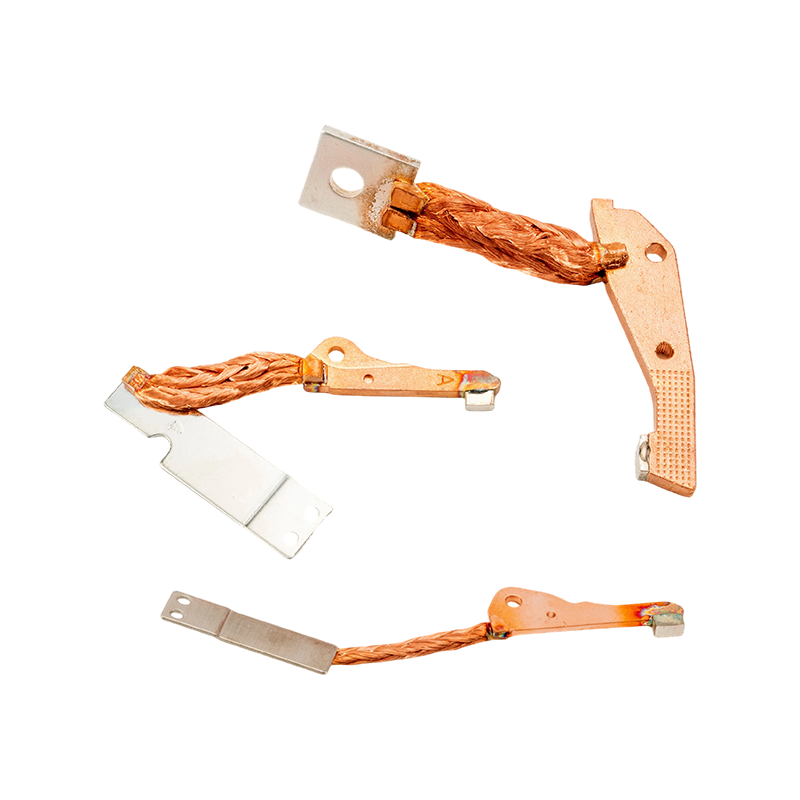
An MCCB Moving Contact Assembly is a critical current-carrying and switching component inside a molded case circuit breaker (MCCB). Unlike the stationary contact, the moving contact assembly physically travels between the closed and open positions to establish or interrupt the main electrical circuit. Its movement, contact pressure, alignment, conductivity, and mechanical strength directly influence breaker performance.
For MCCB manufacturers, OEMs, and electrical component distributors, a moving contact assembly must be engineered as part of the complete contact and operating mechanism. It is not simply a copper component. The assembly may include a conductive contact arm, contact tip, riveted or welded contact, pivot or connection point, and other mechanical features depending on the MCCB design.
As of 2026, IEC 60947-2:2024 is the latest IEC edition for low-voltage circuit breakers covered by this standard. It applies to circuit breakers with main contacts intended for circuits up to 1,000 V AC or 1,500 V DC. The standard provides requirements and tests for circuit breakers, while the detailed geometry and material specifications of a moving contact assembly remain dependent on the manufacturer's design.
2. How Does an MCCB Moving Contact Assembly Work?
(1) Closing the Electrical Circuit
When an MCCB is switched ON, its operating mechanism drives the moving contact toward the stationary contact. The two contact surfaces meet with controlled contact pressure, creating a low-resistance path for current. Proper contact alignment is essential because uneven contact can increase localized resistance and temperature rise.
(2) Carrying Rated Current
After closing, the moving contact assembly forms part of the main current path. Its electrical resistance should remain sufficiently low to control I²R losses. For example, at a hypothetical current of 400 A, 100 μΩ of resistance would result in approximately 16 W of resistive heat. This simple example shows why contact resistance and thermal design are important for high-current MCCBs.
(3) Opening During Fault Interruption
When an MCCB trips, the operating mechanism rapidly separates the moving and stationary contacts. An electrical arc may develop between the contacts during interruption. The moving contact must therefore maintain dimensional stability and mechanical integrity while the contact system handles electrical, thermal, and electromagnetic stresses.
3. What Materials Are Used for MCCB Moving Contacts?
Copper and copper alloys are commonly considered for current-carrying contact arms because of their favorable electrical and thermal conductivity. The actual alloy should be selected according to the required conductivity, mechanical strength, forming characteristics, temperature-rise behavior, and manufacturing process.
The contact tip may use a specialized contact material, including silver-based materials or other engineered alloys, depending on switching duty and electrical requirements. For an OEM project, material selection should be based on the complete MCCB design rather than selecting a material only according to its nominal conductivity.
Typical material considerations for different parts of an MCCB moving contact assembly.
| Assembly Area |
Typical Material Direction |
Key Requirement |
| Moving contact arm |
Copper or copper alloy |
Conductivity and mechanical strength |
| Contact tip |
Silver-based or engineered contact alloy |
Switching and wear resistance |
| Pivot or connection area |
Copper alloy or specified conductive metal |
Mechanical stability and reliable electrical connection |
4. Why Are Contact Welding and Assembly Accuracy Important?
The contact tip is frequently joined to the moving conductive arm using a qualified welding or joining process. Inconsistent joining can result in weak mechanical strength, unstable electrical resistance, misalignment, or premature contact deterioration.
For high-volume MCCB production, welding consistency is especially important. A supplier should control parameters such as welding current, welding time, electrode pressure, contact-tip position, and component tolerances. Quality inspection can include appearance checks, dimensional inspection, weld-strength verification, electrical continuity, contact resistance, and batch traceability.
- Stable contact-tip positioning before welding.
- Repeatable welding parameters for mass production.
- Reliable weld strength and electrical continuity.
- Controlled dimensional tolerances for correct contact alignment.
- Production-batch traceability for B2B quality management.
5. What Should B2B Buyers Check When Sourcing Moving Contact Assemblies?
When sourcing MCCB moving contact assemblies, buyers should provide detailed technical information rather than requesting a generic “copper moving contact.” The assembly must match the breaker frame, contact system, operating mechanism, rated current, and interruption requirements.
Recommended technical checkpoints for wholesale and OEM MCCB moving contact assembly procurement.
| Specification |
Why It Matters |
| MCCB frame and rated current |
Determines the required current-carrying and mechanical design |
| Contact material |
Influences conductivity, switching performance, and wear |
| Critical dimensions |
Ensures correct installation and contact alignment |
| Welding or joining specification |
Controls mechanical and electrical connection reliability |
| Testing requirements |
Supports incoming inspection and product qualification |
Importers and electrical component distributors should also confirm MOQ, annual purchasing volume, sample approval, packaging, production lead time, inspection documents, and customization capabilities. These factors are particularly important when purchasing thousands or tens of thousands of components for continuous MCCB production.
Jiangsu Kaiyuanfeng Electrical Machinery Manufacturing Co., Ltd. is an MCCB Moving Contact Assembly Manufacturer and Wholesale MCCB Moving Contact Assembly supplier. Established in Taizhou in August 2013 with an initial registered capital of RMB 5 million, the company specializes in key circuit breaker components and integrates R&D, design, production, sales, and service.
The company supplies current-carrying components for molded case circuit breakers, featuring high spot welding rates and reliable weld strength. Its manufacturing capabilities are focused on producing components that meet the dimensional, electrical, and mechanical requirements of circuit breaker manufacturers.
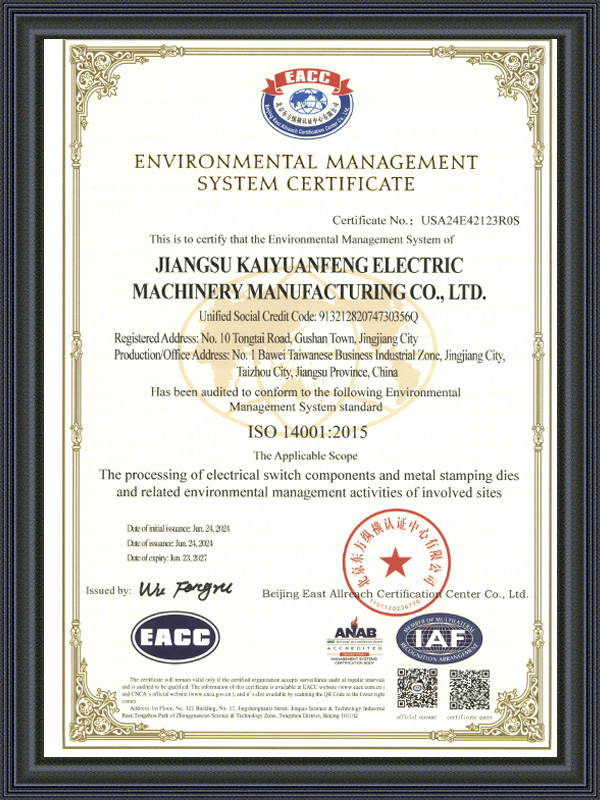
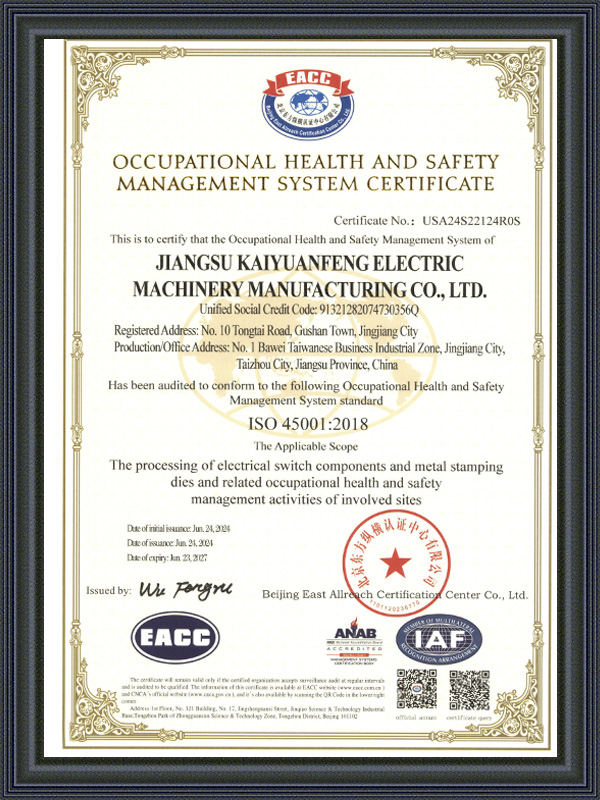
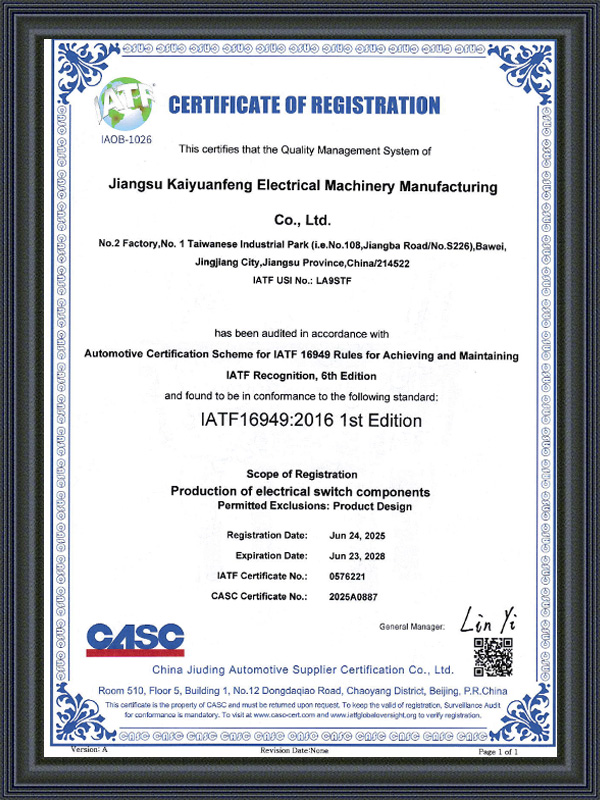
Jiangsu Kaiyuanfeng supports technological innovation through 28 related patents and operates an ISO-certified management system aligned with international standards. Customer requirements are incorporated into the product-development and manufacturing process to support consistent quality and production efficiency.
With over 10 years of industry experience, the company maintains a customer-centric approach and focuses on reliable products and responsive service. For MCCB manufacturers, electrical wholesalers, OEM customers, and industrial distributors, the company aims to provide long-term supply support for key circuit breaker components.
7. How Can OEM Customers Customize an MCCB Moving Contact Assembly?
OEM and ODM customers may require customized moving contact assemblies to fit a proprietary MCCB structure or replace an existing component. Customization can cover the contact arm geometry, copper material, contact-tip composition, hole location, thickness, bending angle, welding position, surface treatment, and packaging.
- Provide a CAD drawing, technical drawing, part number, or physical sample.
- Confirm MCCB frame size, rated current, voltage, and intended application.
- Specify the conductive base material and contact-tip requirements.
- Define critical dimensions, tolerances, welding locations, and inspection criteria.
- Approve prototype samples before proceeding to mass production.
- Establish packaging, batch traceability, and quality acceptance requirements.
A structured OEM process reduces the risk of dimensional mismatch and helps ensure that the moving contact assembly works correctly with the stationary contact and operating mechanism.
8. Common Questions About MCCB Moving Contact Assemblies
Q1. What is an MCCB moving contact assembly?
An MCCB moving contact assembly is the movable current-carrying component that travels between the ON and OFF positions of a molded case circuit breaker. It works with the stationary contact to establish the main circuit when closed and separate the circuit during switching or fault interruption.
Q2. What material is commonly used for MCCB moving contacts?
Copper and copper alloys are commonly used for the conductive moving arm because of their combination of electrical conductivity and mechanical properties. The contact tip may use silver-based or other specialized contact materials. The final material selection should be based on the MCCB's rated current, switching duty, temperature-rise requirements, and overall contact design.
Q3. What is the difference between an MCCB moving contact and stationary contact?
The stationary contact remains fixed inside the breaker, while the moving contact travels during opening and closing operations. Both form the main contact system, but the moving contact additionally needs to withstand repeated mechanical movement and must maintain accurate alignment with the stationary contact.
Q4. How do you test an MCCB moving contact assembly?
Testing may include dimensional inspection, material verification, visual inspection, electrical continuity, contact resistance, weld-strength testing, and mechanical movement checks. For complete MCCB qualification, the assembled breaker must also undergo the applicable performance and verification tests required by the relevant standard and product specification.
Q5. Can an MCCB moving contact assembly be customized?
Yes. Manufacturers can customize the moving contact according to drawings, samples, or detailed specifications. Typical customization includes copper alloy, contact-tip material, dimensions, bending geometry, hole positions, welding locations, surface treatment, and packaging. Prototype approval is recommended before mass production.
Q6. What information should I provide when requesting a wholesale quotation?
Buyers should provide the MCCB model or frame size, rated current, technical drawing or sample, contact material, dimensions, annual quantity, target MOQ, packaging requirements, and quality standards. Providing these details allows the manufacturer to evaluate tooling, material consumption, production processes, inspection requirements, and pricing more accurately.
Q7. How does moving contact resistance affect MCCB performance?
Higher resistance causes greater I²R heating under load. For example, if an interface has 100 μΩ resistance and carries 400 A, the theoretical resistive loss is 16 W. Actual MCCB designs involve multiple interfaces and thermal paths, so the final acceptable resistance must be determined through the complete breaker design and applicable temperature-rise tests.
Q8. What standard applies to MCCBs in 2026?
The latest IEC edition is IEC 60947-2:2024, which covers circuit breakers for low-voltage applications and applies to main contacts intended for circuits up to 1,000 V AC or 1,500 V DC. However, buyers should also confirm regional standards, certification requirements, and the MCCB manufacturer's own technical specifications for each project.
Q9. Where can I buy an MCCB moving contact assembly manufacturer in China?
B2B buyers can work directly with specialized circuit breaker component manufacturers such as Jiangsu Kaiyuanfeng Electrical Machinery Manufacturing Co., Ltd. when they require OEM/ODM development, wholesale quantities, customized dimensions, controlled welding processes, and long-term supply. Buyers should evaluate production capability, quality systems, technical support, sample approval, and batch consistency before selecting a supplier.

 English
  中文简体
中文简体  русский
  عربى
عربى